Facebook

Twitter (X)

Instagram

Somali Magazine - People's Magazine
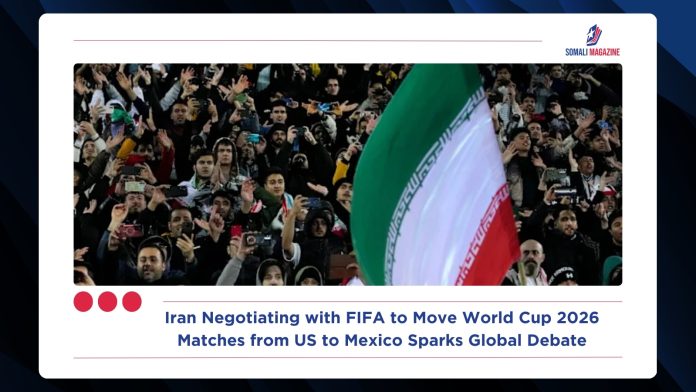
The issue of Iran negotiating with FIFA to move World Cup 2026 matches from US to Mexico has drawn international attention, highlighting how geopolitics can intersect with global sport. Reports indicate that Iranian officials are in discussions with FIFA over concerns related primarily to visa restrictions and diplomatic tensions that could affect the team’s ability to participate fully in matches scheduled in the United States.
The 2026 tournament is set to be jointly hosted by the United States, Mexico, and Canada, marking the first time three nations will share hosting duties. However, ongoing US visa issues in football have raised questions for countries with strained diplomatic relations with Washington, including Iran. Iranian authorities are said to be seeking assurances that players, staff, and supporters will face no barriers when traveling for the competition.
FIFA Iran talks have not been publicly detailed in full, but sources familiar with international football governance suggest that such discussions are not unusual when political sensitivities arise. FIFA has historically maintained that football should remain separate from politics, yet logistical challenges tied to international relations often require diplomatic engagement behind the scenes.
From Iran’s perspective, the request to potentially relocate matches to Mexico is framed as a practical solution rather than a political statement. Mexico World Cup matches could offer fewer entry complications, given different visa policies and diplomatic dynamics. Analysts note that such a move, while complex, could be considered if it ensures smooth participation without disruptions.
FIFA, on the other hand, faces a delicate balancing act. The organization must uphold its tournament structure while ensuring that all qualified teams can compete under fair conditions. Any decision to adjust match locations would involve coordination with host nations, broadcasters, and security agencies, making it a significant logistical undertaking.
Experts in global sports governance emphasize that similar concerns have emerged in past tournaments, though rarely at this scale. With World Cup 2026 host countries preparing for one of the largest sporting events in history, the stakes are particularly high. Ensuring inclusivity and accessibility for all teams remains a central priority for FIFA.
While no official decision has been announced, the discussions themselves underscore broader challenges facing international sport in an increasingly complex political landscape. Fans and stakeholders alike are watching closely to see how FIFA navigates the situation.
As the tournament approaches, the outcome of Iran negotiating with FIFA to move World Cup 2026 matches from US to Mexico could set an important precedent. It may shape how future competitions handle geopolitical tensions while striving to preserve the spirit of global unity that defines the World Cup.