
Facebook

Twitter (X)

Instagram

Somali Magazine - People's Magazine
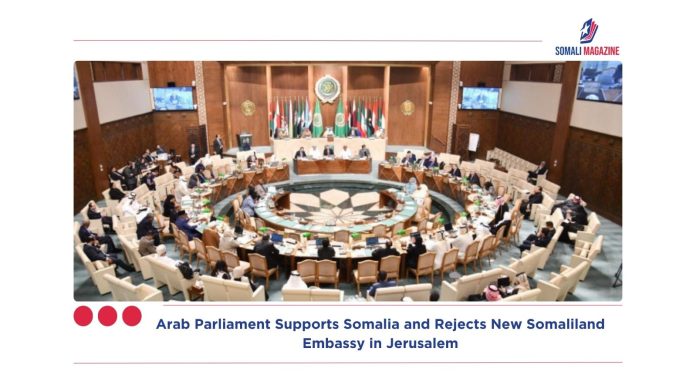
The Arab Parliament backs Somalia following a decisive legislative session in Cairo, formally rejecting the breakaway northern administration’s unilateral establishment of a diplomatic bureau in contested territory. In an official declaration issued on Tuesday from its headquarters, the influential legislative body strongly rebuked the recent actions taken by Hargeisa authorities, classifying the opening of the unsanctioned Jerusalem mission as an explicit violation of international law, United Nations security resolutions, and long-standing regional accords. The pan-Arab parliamentary intervention adds significant diplomatic momentum to the federal capital of Mogadishu, which has been aggressively mobilizing its international networks to counter a deepening Middle Eastern diplomatic crisis initiated by Somaliland’s sudden strategic realignment with Israel.
The escalating international row stems from a highly controversial state visit conducted by Somaliland President Abdirahman Mohamed Abdullahi, who recently traveled to Jerusalem to cut the ribbon on a fully functional, accredited embassy. The Arab Parliament’s joint text emphasized that establishing diplomatic outposts or recognizing the holy city as a legitimate location for foreign representation directly undermines the historical, legal, and political consensus surrounding occupied Palestinian territories. Lawmakers stated that any administrative or symbolic modifications executed by unrecognized entities carry absolutely no legal validity and are completely null and void under global statuettes. The body further asserted that by choosing to engage with an occupying power outside the centralized authority of the federal government, the breakaway territory’s leadership is effectively involving its population in hazardous geopolitical arrangements that serve external agendas rather than the collective interests of the Somali people.
To fortify the central government’s position, the pan-Arab legislative resolution explicitly reiterated its unshakeable, foundational commitment to defending the sovereign territorial boundaries and independent national unity of the Federal Republic of Somalia. Parliamentary representatives called upon the wider global community, the United Nations Security Council, and the African Union to immediately assume their moral and legal responsibilities by actively opposing these destabilizing cross-border treaties. Analysts point out that this institutional backing from Cairo arrives precisely alongside parallel condemnations from the Organization of Islamic Cooperation and the Arab League, systematically narrowing Hargeisa’s path toward broader international recognition. As the federal ministry continues to formalize counter-measures against the unsanctioned mission, this unified regional stance underscores a clear regional consensus that national borders cannot be altered through independent diplomatic maneuvering.