
Facebook

Twitter (X)

Instagram

Somali Magazine - People's Magazine
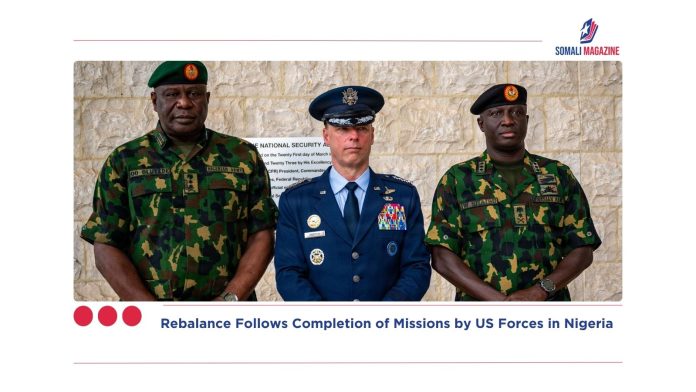
A deployment of US forces in Nigeria has successfully completed a tactical campaign targeting the regional leadership of Islamic State militants, prompting a planned drawdown of personnel. According to recent public statements delivered by the United States Africa Command chief, General Dagvin Anderson, the temporary mission achieved its critical military objectives in the Lake Chad Basin. The specialized operation, which culminated in the elimination of top-tier threat actors, has allowed Washington to scale back its immediate combat presence while transitioning toward long-term institutional support. General Anderson confirmed that the strategic withdrawal of a significant portion of the deployed troops occurred after fulfilling the specific tactical mandate requested by local authorities. Despite the reduction in boots on the ground, the military partnership remains intact, with American personnel shifting focus to intelligence sharing and security cooperation at the direct request of the federal government in Abuja. This transition highlights a highly coordinated effort to suppress extremist violence while respecting national sovereignty and regional leadership.
The announcement follows a high-impact joint anti-ISIS operation conducted in May, which targeted entrenched networks in the northeastern region of the country. Military officials confirmed that the multi-phase offensive resulted in the elimination of Abu-Bilal al-Minuki, identified by international defense analysts as the second-highest-ranking global leader within the Islamic State infrastructure. Al-Minuki had been heavily implicated in orchestrating media campaigns, financing transnational terror cells, and directing sophisticated logistics networks spanning multiple continents. By disabling this high-level command node, the joint intervention significantly disrupted the communication channels and operational readiness of extremist factions throughout West Africa. AFRICOM representatives emphasized that the success of the mission demonstrates the efficacy of combining specialized American capabilities with partner-led initiatives, effectively reorienting the footprint of US forces in Nigeria toward strategic advisement. Following the operation, local military units have maintained high levels of pressure on remaining insurgent pockets, leading to reported increases in defections and surrenders among combatants in Borno State.
This rebalancing of Western military assets reflects a broader evolution in security cooperation across the strategic African continent. While direct combat operations have concluded for this specific deployment, the persistent threat posed by extremist organizations requires continuous bilateral vigilance. Security experts note that the Lake Chad Basin remains a critical theater for international counter-terrorism efforts, where transnational networks frequently exploit porous borders. Moving forward, Washington intends to sustain its partnership with Abuja primarily through advanced reconnaissance, technical training, and data sharing to empower domestic forces to independently prosecute targets. By publicizing the outcomes of these tactical successes, both nations aim to dismantle the psychological influence of militant recruitment networks. Ultimately, the dynamic role of US forces in Nigeria underscores a broader shift toward sustainable, host-nation-led defense architectures designed to guarantee long-term stability and secure critical regional corridors against asymmetrical threats.