
Facebook

Twitter (X)

Instagram

Somali Magazine - People's Magazine
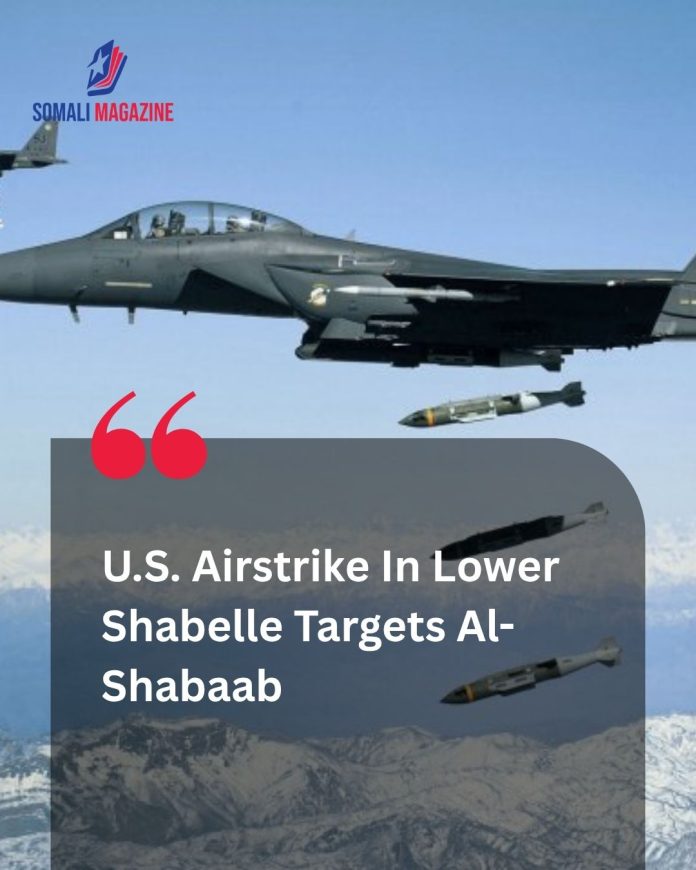
The joint military campaign against extremist networks in the Horn of Africa has intensified following a precision kinetic strike executed by American forces in the volatile southern lowlands. Operating in close coordination with the Federal Government of Somalia, U.S. Africa Command (AFRICOM) conducted a targeted U.S. airstrike in Lower Shabelle to degrade the operational capabilities of al-Shabaab militants. According to official military dispatches, the engagement took place in a designated rural corridor approximately 55 kilometers southwest of the capital city of Mogadishu—a region historically utilized by the al-Qaeda-affiliated insurgent group as a strategic staging ground for launching asymmetric assaults.
Defense representatives confirmed that the strike specifically targeted active combatants without causing harm to surrounding civilian infrastructure, aligning with rigorous operational planning designed to minimize collateral impact. While AFRICOM maintained strict security protocols by withholding specific details regarding the assets and tactical units involved in the mission, the localized disruption represents a vital component of ongoing efforts to prevent the group from planning, coordinating, and executing large-scale regional offenses.
A Shifting Dynamic in Air Campaigns
This latest engagement highlights a broader, highly aggressive shift in the United States’ defensive posture throughout the region. Security analysts monitoring East African defense policies note that the frequency of counterterrorism operations has escalated dramatically:
-
Targeting Prioritization: Following an intense focus on Islamic State remnants in northern territories, U.S. and partner forces have returned their primary operational focus to disrupting al-Shabaab’s expanding southern networks.
-
Loosened Restrictions: Operational authorizations have been increasingly decentralized to localized field commanders, permitting rapid-response actions that prevent target evasion.
-
Command Independence: The acceleration of independent drone and kinetic strikes aims to establish a consistent security perimeter as regional transition frameworks take shape.
Preserving Regional Stability
The persistent application of military pressure is considered essential to preventing al-Shabaab from recapturing key agricultural and economic zones across southern and central Somalia. While the Somali National Army and its allied local militias spearhead ground offenses, the availability of specialized international air support remains an irreplaceable force multiplier. By systematically targeting command-and-control hubs, weapons transport routes, and hidden training facilities, joint forces continue to keep the insurgent leadership off-balance.
As defense ministries prioritize the long-term stabilization of the Lower Shabelle region, establishing a secure administrative presence in newly cleared zones remains the primary operational objective. Military commanders emphasize that while airstrikes are crucial for immediate tactical deterrence, sustainable progress will ultimately depend on local governance and the continuous training of professional national security personnel.