
Facebook

Twitter (X)

Instagram

Somali Magazine - People's Magazine
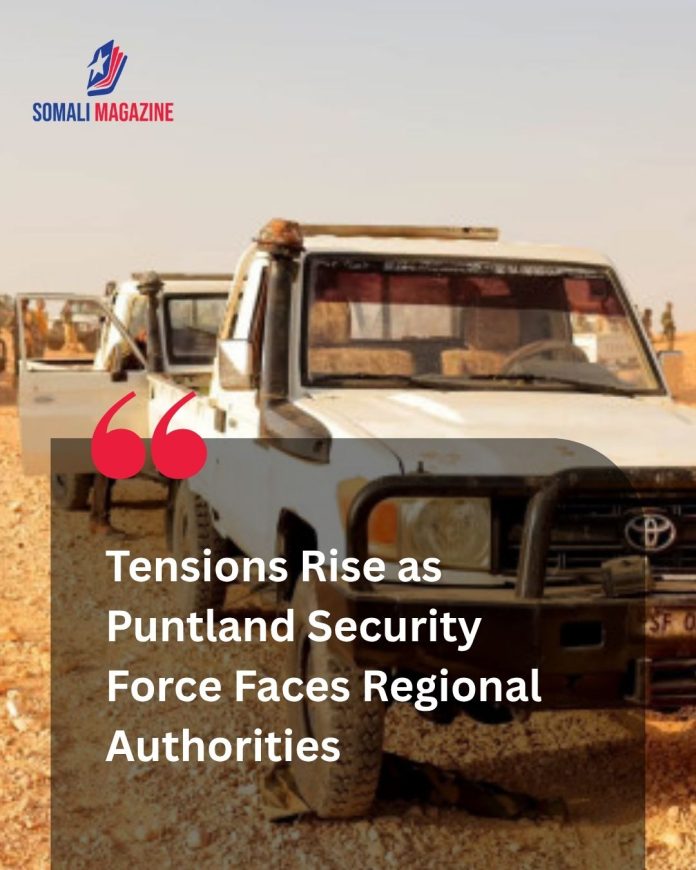
Security stability across northeastern Somalia faces severe strain as the elite Puntland Security Force is at odds with regional authorities following renewed armed confrontations and competing claims over military command. Tensions escalated dramatically near the strategic commercial port city of Bosaso when regional Darwish defense units clashed with a Puntland Security Force convoy in the mountainous Laag area. State leadership under President Said Abdullahi Deni characterized the confrontation as a targeted law enforcement operation aimed at securing transport corridors, reporting that regional troops seized multiple technical vehicles and detained several personnel following the exchange. In contrast, force representatives asserted that their units were ambushed while carrying out routine movements, maintaining that the specialized unit remains a legitimate security instrument dedicated to counterterrorism.
The origins of the standoff stem from a fundamental disagreement over military command structures, political jurisdiction, and federal alignment within Somalia’s decentralized governance framework. Originally established as a specialized counterterrorism outfit with extensive foreign training and operational support, the unit historically operated with significant autonomy while spearheading major campaigns against extremist insurgencies in the rugged Galgala mountains. However, relations between the force’s leadership and the regional administration fractured significantly after administrative attempts to restructure the unit’s command and strip its senior officers. Over recent years, the force has increasingly aligned its institutional loyalties with the Federal Government of Somalia, with central defense officials in Mogadishu officially recognizing the unit as a integrated branch of the national armed forces.
This deepening federal alignment directly conflicts with regional state policies aimed at restricting uncoordinated central military influence across the state. In response to growing federal security footprints in the Bari, Nugaal, and Mudug regions, authorities in Garowe enacted strict regulatory measures prohibiting federal military recruitment and restricting unauthorized troop movements between major urban centers. Regional officials argue that all armed formations operating within state borders must strictly report to local command hierarchies to ensure internal order. Conversely, federal defense representatives and unit commanders maintain that national constitutional provisions grant central authorities primary responsibility over national defense, placing federal forces beyond state-level operational bans.
The ongoing rift underscores the broader political power struggle between regional state administrations and the central government over sovereign authority. Local business leaders, traditional elders, and parliamentary mediation committees have actively engaged regional leadership to prevent further armed escalations around Garowe and Bosaso. However, as rival military deployments remain positioned along vital commercial highways, security analysts warn that unresolved jurisdictional disputes could jeopardize long-term anti-terror achievements in Bari region counterterrorism sectors. Without a sustained political framework to reconcile federal defense mandates with regional autonomy, the structural standoff in Bosaso continues to pose complex challenges for regional stability.