
Facebook

Twitter (X)

Instagram

Somali Magazine - People's Magazine
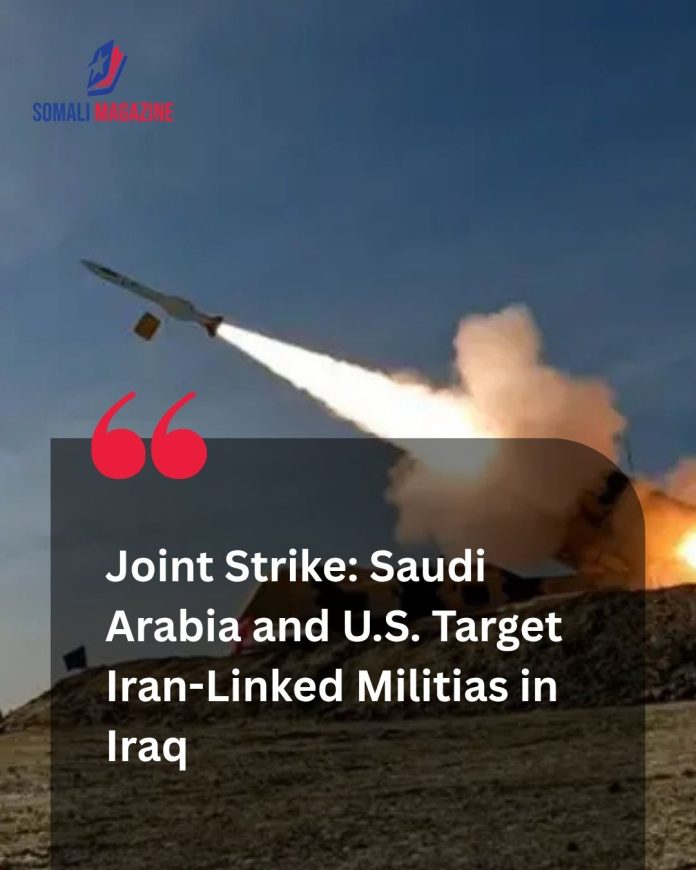
Saudi Arabia says it struck Iran-backed groups in Iraq with U.S. coordination, marking a significant military escalation following a wave of aerial assaults against the Kingdom’s critical oil facilities. The Saudi Ministry of Defense announced the operation early Wednesday, confirming that its armed forces, in partnership with the United States Central Command (CENTCOM), conducted precision strikes against logistics hubs and weapons storage sites identified as belonging to militias loyal to Iran. Officials in Riyadh stated that the action was a necessary exercise of the country’s inherent right to self-defense under Article 51 of the United Nations Charter, aimed at neutralizing threats originating from Iraqi territory.
The joint military operation serves as a robust response to intensified hostilities observed over the previous 72 hours. According to statements released by CENTCOM, American and Saudi fighter jets targeted militant infrastructure after more than 30 drone attacks were directed at U.S. forces and Saudi energy assets. While CENTCOM reported that none of the attempts against American personnel were successful, the command highlighted a troubling pattern, noting that Iran-aligned groups in Iraq had launched over 600 attempted attacks against U.S. citizens and facilities between February and April 2026. Washington and Riyadh have explicitly accused Iran’s Islamic Revolutionary Guard Corps (IRGC) of directing these militias to destabilize the region.
The impact on the ground has been significant, with reports of casualties emerging from the targeted areas. Iraq’s Popular Mobilization Forces (PMF), an umbrella coalition of Shiite armed groups, confirmed that its headquarters in several provinces—including Basra and Nineveh—sustained heavy damage. Initial reports from local officials indicate that at least 10 fighters were killed and over 30 others wounded, with casualty figures expected to rise as search operations continue. The PMF condemned the operation as a “treacherous” violation of Iraqi sovereignty and an attack on the country’s official security institutions, further complicating the already fragile security landscape in Baghdad.
Despite the kinetic nature of the response, Saudi officials emphasized that the Kingdom does not seek a broader regional war. Major General Turki Al-Maliki, spokesperson for the Saudi Ministry of Defense, reaffirmed that Riyadh remains committed to regional stability but will respond firmly to any future aggression against its national interests. As the situation unfolds, international observers remain on high alert for potential retaliatory measures, especially after the IRGC confirmed it had launched separate ballistic missiles toward U.S. positions in the region, all of which were reportedly intercepted. The developments have already triggered volatility in global energy markets, underscoring the precarious state of security across the Middle East.