
Facebook

Twitter (X)

Instagram

Somali Magazine - People's Magazine
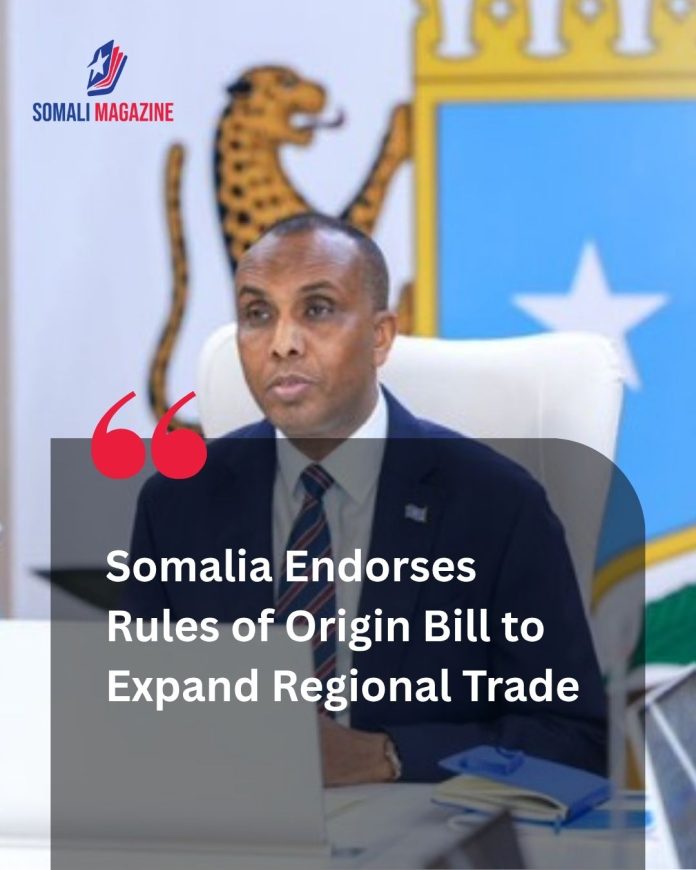
As the Somali Cabinet approves rules of origin law to boost exports and regional trade, federal authorities have established a critical legal mechanism to certify domestic products and unlock preferential market access across East Africa and the broader continent. Endorsed during the weekly Council of Ministers meeting chaired by Prime Minister Hamza Abdi Barre in Mogadishu, the draft legislation submitted by the Ministry of Commerce and Industry defines explicit legal criteria for determining the authenticity of goods produced within the country. The statutory measure aligns national trade regulations with international standards, marking a major milestone in the federal government’s effort to modernize economic governance following the nation’s formal accession to regional economic blocs.
The newly approved legal framework provides a standardized procedure for issuing official certificates of origin for Somali agricultural, livestock, fisheries, mining, and manufactured goods. Under the legislation, domestic producers will be empowered to obtain verifiable documentation proving where their commodities were harvested, processed, or manufactured. Ministry officials highlighted that establishing these regulatory standards is a mandatory prerequisite for local enterprises seeking to benefit from tax exemptions and duty-free tariff preferences available under the East African Community and the African Continental Free Trade Area frameworks. By verifying the origin of locally produced commodities, the law protects domestic markets from unauthorized transshipments while positioning home-grown businesses to compete fairly across regional commercial supply chains.
Government leaders underscored that formalizing export certification forms part of a comprehensive strategy aimed at stimulating domestic manufacturing, encouraging value-addition, and narrowing the country’s persistent trade deficit. Trade and Industry Minister Jamaal Mohamed Hassan noted that the administration is concurrently reviewing complementary tax policies to prioritize locally manufactured products, thereby attracting foreign direct investment and generating sustainable employment opportunities for young professionals. The legislative momentum builds upon recent economic milestones, including comprehensive external debt relief and ongoing infrastructure modernization across major maritime ports, which together enhance Somalia’s capacity to export high-value marine and agricultural commodities.
While the draft bill must now proceed to the Federal Parliament for legislative debate and final ratification, private sector representatives and economic analysts have welcomed the executive decision as a vital catalyst for commercial expansion. Establishing clear legal guidelines provides foreign investors and international trading partners with necessary institutional predictability. Ultimately, as the Somali Cabinet approves rules of origin law to boost exports and regional trade, federal institutions demonstrate a firm commitment to transforming the country into an active, competitive participant within the expanding African free trade landscape.