
Facebook

Twitter (X)

Instagram

Somali Magazine - People's Magazine
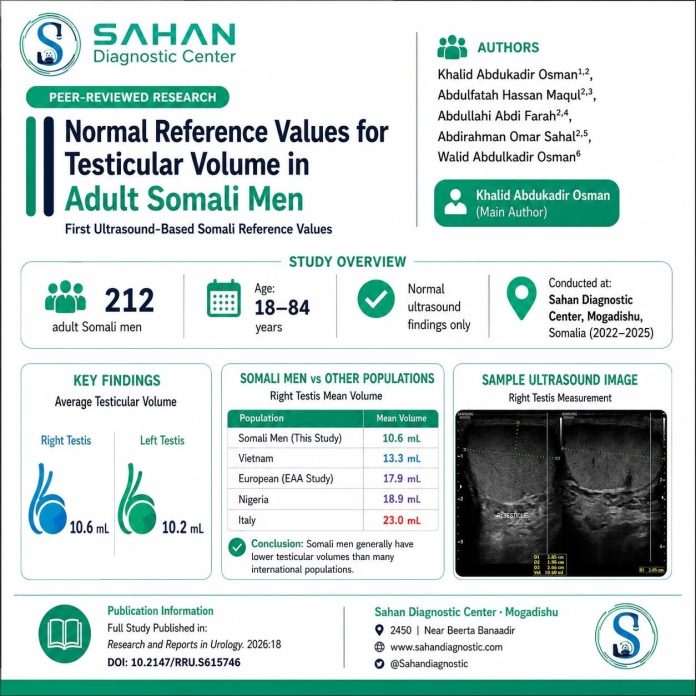
Newly published medical research establishing ultrasound reference values for testicular volume in adult Somali men marks a major milestone for diagnostic accuracy and clinical care across the region. In a retrospective study published in the peer-reviewed medical journal Research and Reports in Urology, a team of medical researchers led by Dr. Khalid Abdukadir Osman investigated sonographic data to establish localized anatomical baselines. Conducted at the Sahan Diagnostic Center in Mogadishu, the investigation analyzed records from 212 sonographically normal adult men aged 18 to 84 who underwent scrotal ultrasonography between June 2022 and December 2025. The research team included specialists from Mogadishu University alongside medical institutions in China, Ethiopia, and Uganda, aiming to address a longstanding evidence gap in East Africa.
According to the published findings, the mean testicular volume for adult Somali men was measured at 10.61 milliliters for the right testis and 10.19 milliliters for the left testis, with both displaying a median volume of 10.0 milliliters. Based on statistical percentile calculations, the study established 95 percent reference intervals of 5.7 to 18.0 milliliters for the right side and 5.2 to 17.0 milliliters for the left side. The data revealed a statistically significant right-left asymmetry, with the right testis being larger in 46.7 percent of participants. Furthermore, researchers noted no significant correlation between age and testicular volume, suggesting that physiological maturity rather than chronological aging remains the primary determinant of volume during adulthood.
The study highlights how applying external medical guidelines can lead to frequent misdiagnoses in local clinical settings. When comparing the Somali cohort to international datasets, researchers observed substantial differences. European, West African, and Asian populations frequently demonstrate mean testicular volumes ranging between 13 and 19 milliliters. According to the research team, relying on European lower limits of normal—typically set around 11 to 12 milliliters—would erroneously misclassify a large proportion of healthy Somali men as having abnormally reduced testicular size or atrophy. By establishing population-specific ultrasound-based normative data, the authors provide essential benchmarks tailored specifically for andrological assessment standards in Somalia.
Additionally, the study calculated a Minimal Detectable Difference of 4.1 milliliters for right-left volume asymmetry. Clinicians routinely evaluate asymmetry when assessing conditions such as varicoceles or developmental anomalies. The researchers explained that because normal physiological variation in Somali men can reach up to 4.1 milliliters before exceeding measurement error, applying standard international thresholds like two milliliters could lead to false-positive diagnoses. By integrating these ultrasound reference values for testicular volume in adult Somali men into routine clinical practice, healthcare providers can enhance diagnostic specificity, improve fertility evaluations, and ensure accurate clinical decision-making across medical centers in Mogadishu and throughout the nation.