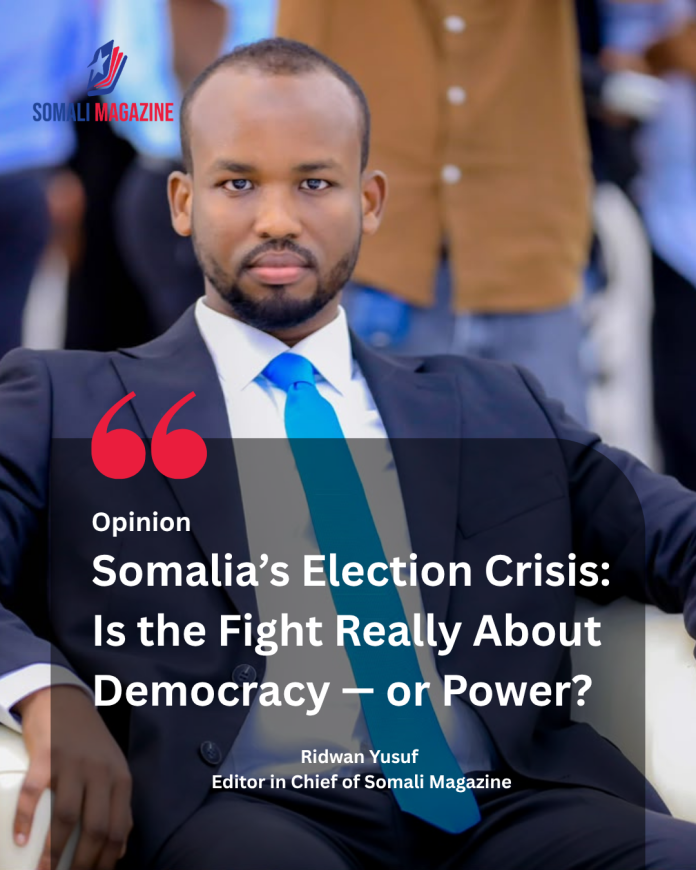
OPINION | SOMALI MAGAZINE
Let’s be honest.
Somalia’s political crisis may have very little to do with democracy—and everything to do with who controls power.
Politicians speak about democracy.
They speak about the constitution.
They speak about elections.
They speak about the interests of the Somali people.
But there is one question that rarely gets asked loudly enough:
If the rules of the game were not going to benefit them, would they still defend them?
That is the uncomfortable question Somalia must confront.
Everyone Wants Democracy—Until Democracy Becomes Inconvenient
In Somalia, political actors often demand elections when they believe elections will work in their favor.
When the political environment changes, however, the language changes too.
Suddenly, the debate becomes about security.
Or the constitution.
Or federalism.
Or electoral procedures.
Or whether the country is “ready.”
These may all be legitimate concerns.
But the Somali public has every right to ask:
Are these genuine national concerns—or political arguments being used to protect political interests?
Who Controls the Rules Controls the Game
The biggest political battle may not actually be over who wins the next election.
It may be over who gets to design the election itself.
Who decides the rules?
Who determines the timetable?
Who controls the institutions?
Who decides who participates?
And who benefits from the final arrangement?
Because if one political side controls the rules of the game, the public has every reason to question whether the competition is truly fair.
A football match cannot be considered fair if one team chooses the referee, writes the rules and decides when the match begins.
Why should politics be any different?
The Government Has Questions to Answer
If the government believes its political reforms are genuinely democratic, then it should be prepared to explain them clearly to the Somali people.
Not just to politicians.
Not just to parliament.
Not just to political allies.
To the public.
Why these reforms?
Why this electoral system?
Why this timetable?
And why should Somalis trust the process?
Transparency should not be feared by anyone who genuinely believes they are acting in the national interest.
But the Opposition Has Questions Too
The opposition cannot simply demand elections and declare itself the defender of democracy.
It must answer its own uncomfortable questions.
Would they accept the same electoral rules if those rules strengthened their opponents?
Would they accept the outcome if they lost?
Would they respect institutions they currently criticize if those institutions produced a result they did not like?
Democracy is not only the right to win.
It is also the responsibility to accept losing.
Somalia Cannot Build Democracy Around Political Survival
This is where Somalia’s political culture faces its biggest test.
If every government believes losing power means losing everything, politics becomes a fight for survival.
If every opposition group believes the only legitimate election is one it can win, elections become meaningless.
And if every constitutional debate is interpreted as a strategy to help one political camp, public confidence disappears.
Somalia does not simply need another election.
Somalia needs an election that Somalis believe belongs to them.
The Bigger Question
Perhaps the most dangerous question in Somalia today is not:
“Who will win the next election?”
It is:
“Who is writing the rules that will determine who gets the chance to win?”
That is the conversation the country should be having.
Because democracy cannot be reduced to a ballot box.
Democracy is the rules.
Democracy is transparency.
Democracy is competition.
Democracy is accountability.
And above all, democracy means accepting that political power does not belong permanently to one person, one party, one administration or one political group.
So, What Is This Really About?
Maybe Somalia’s politicians are genuinely fighting for democracy.
Maybe they genuinely believe their position is best for the country.
But Somali citizens should not be expected to simply believe every political argument they hear.
They should question it.
They should ask who benefits.
They should ask who loses.
They should ask who controls the process.
And they should ask whether the same politicians would defend the same principles if they were sitting on the opposite side of the political table.
Because at the end of the day, Somalia’s political crisis may not be a battle between democracy and dictatorship.
It may be something much more complicated: a battle between political interests, dressed in the language of democracy.
And that leaves Somalia with one unavoidable question:
Is this really about democracy—or is it ultimately about power?
What do you think?
Ridwan Yusuf Mohamud
CEO/ Editor in chief of Somali Magazine