
Facebook

Twitter (X)

Instagram

Somali Magazine - People's Magazine
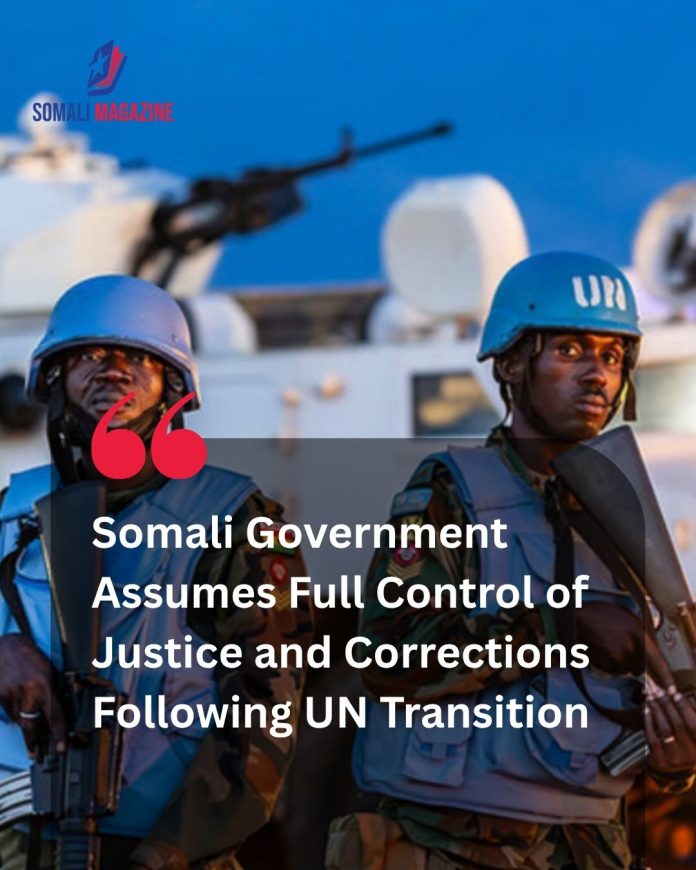
Institutional reform in the Horn of Africa reached a landmark milestone after the United Nations mission concludes justice and prisons support in Somalia as part of a planned transfer of state-building responsibilities. Under the framework established by United Nations Security Council Resolution 2753, the specialized rule of law initiatives previously managed under the former assistance mission and its successor, the United Nations Transitional Assistance Mission in Somalia, are progressively handing over operational oversight directly to Somali judicial and correctional authorities. The formal completion of the dedicated mission-led justice and corrections stream reflects a broader strategic shift toward national ownership, enabling federal institutions to take full charge of judicial administration, facility management, and legal reform.
For over a decade, international technical teams supported the rebuilding of Somalia’s legal infrastructure, which had suffered catastrophic destruction during decades of civil conflict. Operating through the Joint Justice and Corrections Section alongside agencies like the United Nations Development Programme and the United Nations Office on Drugs and Crime, the United Nations provided capacity-building programs, judicial training, and structural advice. Key achievements under the joint framework included establishing federal-state legal coordination agreements, introducing international custody standards such as the Nelson Mandela Rules, and funding infrastructure assessments to address severe prison overcrowding and facility sanitation across federal member states.
The conclusion of mission-level operational support initiates a phased transition phase where long-term programmatic assistance will be absorbed by specialized United Nations agency teams and local ministries. Under the agreed roadmap, primary responsibility for correctional governance, prisoner rehabilitation, and legal aid delivery rests with the Federal Government of Somalia Ministry of Justice and the Custodial Corps. Government officials emphasized that while direct mission oversight is concluding, bilateral legal partnerships and agency-level development projects will continue providing targeted financial and technical assistance to reinforce institutional integrity.
Human rights advocates and legal scholars view the transition as both a significant achievement and a crucial test for the nation’s governance framework. While federal authorities have made notable strides in formalizing judicial procedures and establishing alternative dispute resolution mechanisms, significant challenges persist regarding resource allocation, facility modernization, and legal access for marginalized communities. As the United Nations mission concludes justice and prisons support in Somalia, international observers highlight that sustaining rule of law progress will depend heavily on consistent state funding, transparent judicial oversight, and unwavering commitment to fundamental human rights standards.