
Facebook

Twitter (X)

Instagram

Somali Magazine - People's Magazine
The store tour translated a high-level conversation about trade and investment into a close look at Somalia’s retail market, consumer demand and commercial capacity.

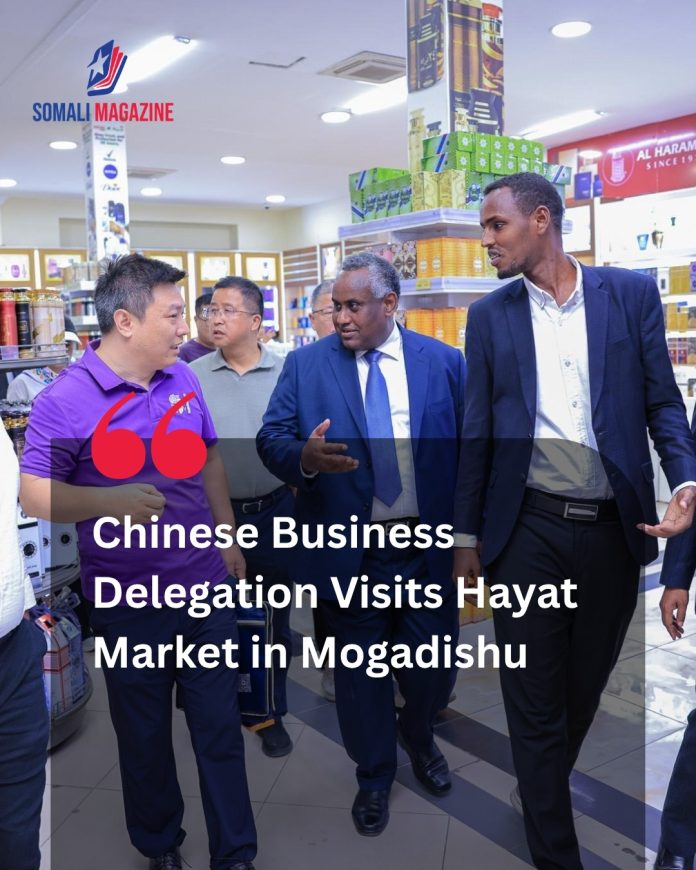
MOGADISHU — A delegation of Chinese entrepreneurs and business leaders visited Hayat Market following the first Somalia–China Business Networking Forum, turning the forum’s call for direct engagement into a practical tour of one of Mogadishu’s best-known retail businesses.
The visit brought delegates into the aisles, fresh-food counters, electronics areas and textile sections of the store. Photographs show Somali hosts explaining operations while visitors examined product displays, interacted with staff and took part in cultural exchanges designed to make the commercial encounter personal as well as practical.
From forum discussion to a working marketplace
The networking forum opened in Mogadishu on 25 August 2026 with more than 30 Chinese companies and business leaders in attendance. It was convened by Somalia’s Ministry of Commerce and Industry at the hangar of Aden Adde International Airport under the theme “Building Partnerships, Creating Opportunities.”
Deputy Prime Minister Salah Ahmed Jama officially opened the event. Speakers included Commerce and Industry Minister Jamaal Mohamed Hassan and ministers responsible for fisheries, communications, energy and water, alongside government officials, Somali business leaders and project developers.
The programme included presentations on Somalia’s National Transformation Plan 2025–2029, the New Mogadishu development project and investment opportunities in several sectors. Business-to-business and business-to-government meetings were intended to move the relationship beyond formal speeches and toward identifiable partnerships.
“The best way to change perceptions is through experience, and the best way to build confidence is through real partnerships.”
— Dr Hodan Osman Abdi, Somalia’s ambassador to China, speaking at the forum (reported by Hiiraan Online)
Why the Hayat visit mattered
A retail store gives a visiting investor a concentrated view of an economy. Shelves reveal the origins and range of consumer goods. Fresh-food counters show local supply possibilities and cold-chain requirements. Electronics departments demonstrate purchasing patterns, while payment and delivery systems indicate how technology is shaping commerce.

Hayat Market says it was founded in April 2020 and is headquartered in Mogadishu. Its official directory lists branches in Taleex, Zope, Boondheere, Digfer and Alikamin, while Adeeg.com serves as its official e-commerce platform. The company’s mix of groceries, fresh food, household products, textiles, electronics and home goods offered delegates a broad view of demand in the capital.
What the visitors witnessed
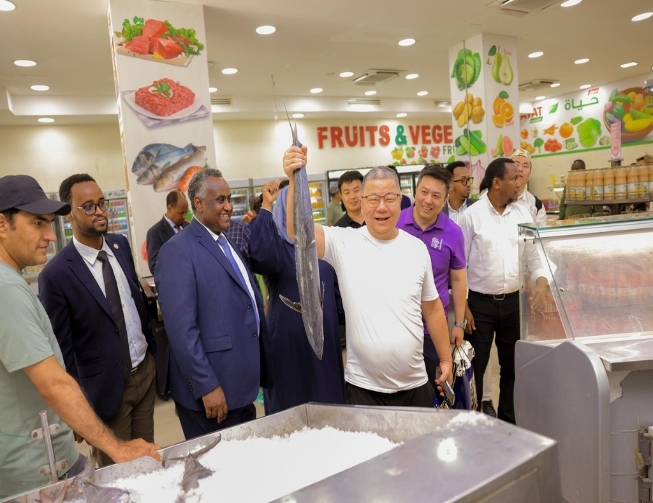
The photographic record shows a store tour built around variety and conversation. Delegates moved through brightly lit departments and examined both food and non-food goods. At the fresh-fish counter, visitors handled large fish while Somali hosts explained the section — a vivid moment given the forum’s emphasis on Somalia’s fisheries and export potential.
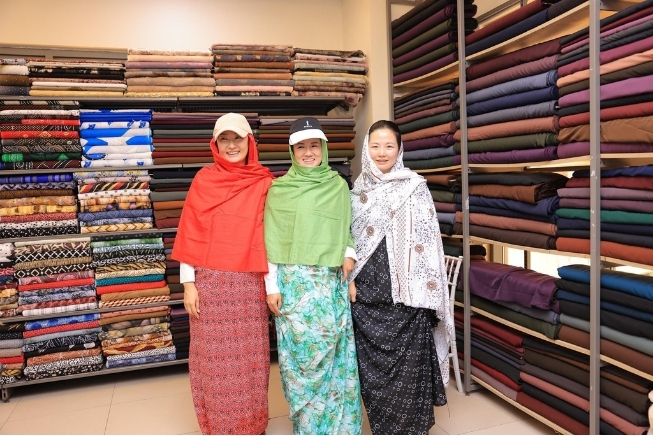
In the textile area, Chinese women visitors tried Somali shawls and posed with local hosts amid shelves of colourful fabrics. Elsewhere, delegates were presented with traditional garments and caps. These exchanges were not investment agreements, but they helped create the familiarity on which longer commercial relationships often depend.
Trade imbalance, and the opportunity behind it
Figures cited during the forum showed the scale of the challenge. China exported about $968 million in goods to Somalia in 2024, while Somalia’s exports to China were about $3.1 million. Officials presented that imbalance not only as a deficit, but also as an opportunity to build processing, packaging, logistics and export capacity inside Somalia.
The retail visit illustrated one side of that relationship: Chinese-manufactured and internationally sourced goods already occupy an important place in Somali consumer markets. The policy challenge is to create more value in both directions — attracting technology and investment while enabling Somali products to reach Chinese buyers.
Fisheries offer one immediate example. Somalia and China have signed an agreement allowing Somali fishery products to enter the Chinese market duty-free, and officials have said exports are expected to begin. Turning access into sustained trade will require quality control, cold storage, packaging, certification and dependable transport.
A visit framed by hospitality
The delegation’s stop at Hayat Market also carried a strong cultural dimension. Several visitors were dressed in Somali shawls and traditional caps for group photographs beside a banner reading “Somalia–China Trade Partnership.” Gifts were exchanged, and Somali and Chinese participants posed together across different sections of the store.
Such scenes matter because investment decisions are not made from figures alone. They depend on confidence in local counterparts, a realistic understanding of market conditions and the ability to move from introductions to follow-up. The forum provided the national platform; the Hayat visit added a ground-level view of how business operates in Mogadishu.
The next measure is follow-through
The significance of the delegation’s visit will ultimately be measured by what follows: supplier discussions, distribution partnerships, technology transfer, investment in processing and logistics, or new routes for Somali exports. A store tour cannot deliver those outcomes on its own, but it can replace distance with direct observation.
For Hayat Market, hosting the delegation placed the company within a broader story about Somalia’s changing commercial landscape. For the visitors, the tour offered evidence of an organised consumer market, a wide product mix and local partners ready to explain how trade works on the ground.
The message of the week was simple: partnerships become more credible when people see the market for themselves. At Hayat Market, that principle moved from the forum stage into the aisles.
Six moments from the delegation’s Hayat Market visit
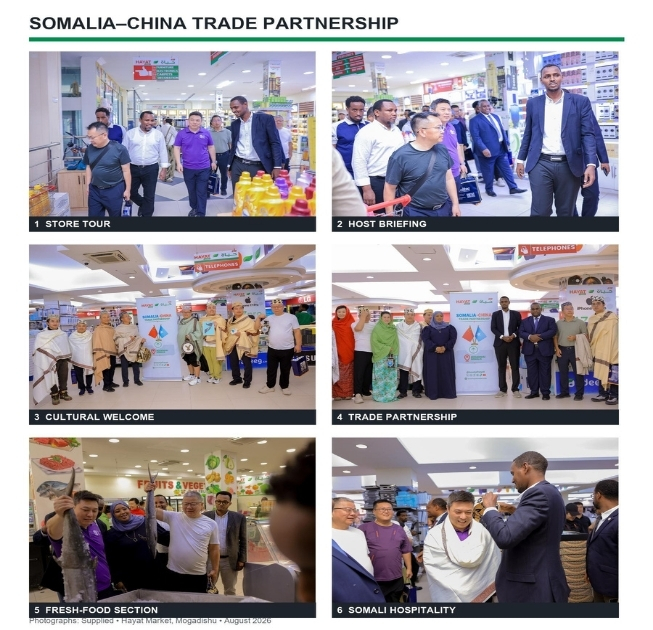
The visit combined a guided commercial tour with fresh-food inspection, product discussion and Somali cultural hospitality. All photographs supplied.