
Facebook

Twitter (X)

Instagram

Somali Magazine - People's Magazine
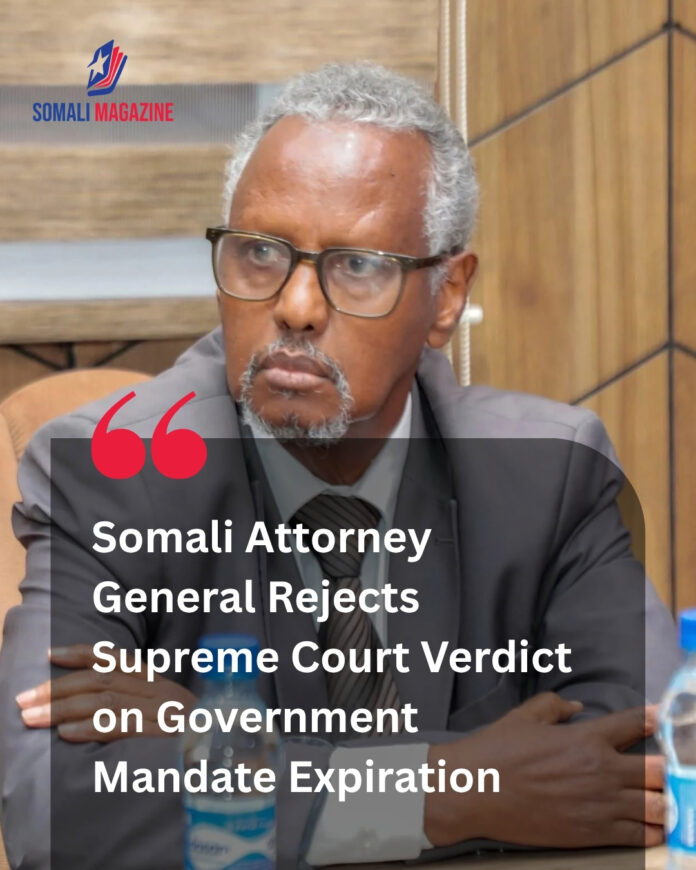
Somalia’s Attorney General rejects Supreme Court ruling that says government’s term has expired, launching a sharp legal challenge against the highest bench’s decision to declare federal mandate extensions unconstitutional. The formal rejection follows an unprecedented verdict delivered by a five-judge panel of the Supreme Court, which ruled that the constitutional mandates of both houses of parliament and the executive branch lapsed earlier this year. The judicial panel asserted that the terms of lawmakers expired in April while the presidential mandate concluded in May, ordering relevant political stakeholders to agree on a consensus-based electoral framework within thirty days and hold nationwide elections within ninety days.
In a official defense response, the Attorney General argued that the judicial panel’s ruling relies on flawed constitutional interpretations and fails to respect legal amendments enacted by Parliament regarding governance continuity. Government legal representatives maintained that statutory term adjustments passed by the legislature remain valid to ensure administrative stability and facilitate universal suffrage preparations. The executive branch’s rejection of the verdict highlights growing institutional friction over whether sitting administrations can apply newly passed constitutional term extensions to their current tenures or if those modifications apply strictly to future elected leadership cycles.
The legal confrontation stems from a petition brought before the court regarding the removal of Chief Justice Baashe Yusuf Ahmed and the subsequent presidential decree seeking to restructure judicial leadership. While the Supreme Court declared post-mandate executive actions unconstitutional and reduced the current cabinet to a temporary caretaker capacity with authority restricted to basic day-to-day operations, state attorneys contend that the court lacked the procedural standing to invalidate parliamentary statutes governing institutional mandates. Opposition figures and constitutional experts have warned that conflicting legal declarations between the executive legal office and the Supreme Court risk paralyzing national governance.
As Somalia’s Attorney General rejects Supreme Court ruling that says government’s term has expired, political leaders and legal observers in Mogadishu remain focused on how state institutions will navigate the constitutional dispute. International partners continue to encourage calm, dialogue, and strict adherence to constitutional principles to prevent administrative paralysis. The ongoing standoff underscores the delicate balance of institutional checks and balances as federal authorities work to establish clear consensus on national electoral procedures and governance frameworks.