
Facebook

Twitter (X)

Instagram

Somali Magazine - People's Magazine
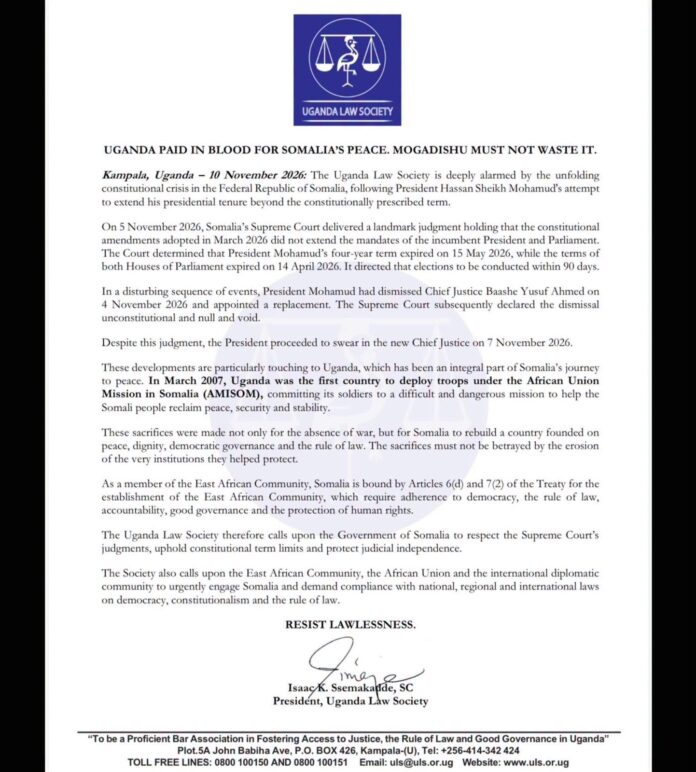
Following rapid political developments in Mogadishu, the Uganda Law Society urges Somali President to uphold Supreme Court rulings and respect constitutional term limits following a controversial judicial oversight dispute. In a formal press statement issued on 10 November 2026 by President Isaac K. Ssemakadde, the Uganda Law Society expressed deep alarm over executive attempts to extend presidential and parliamentary tenures beyond their constitutionally prescribed mandates. The bar association highlighted that Somalia’s highest judicial authority ruled on 5 November 2026 that March 2026 constitutional amendments did not extend the mandates of incumbent leaders, directing national elections to be conducted within ninety days.
The statement underscored a sequence of events where Chief Justice Baashe Yusuf Ahmed was dismissed on 4 November 2026 and subsequently replaced, despite the Supreme Court declaring the removal unconstitutional, null, and void. Notwithstanding the high court’s determination, executive authorities proceeded to swear in a new chief justice on 7 November 2026. The Uganda Law Society noted that Uganda has been an integral partner in national peace efforts since March 2007, when it became the first nation to deploy peacekeeping troops under the African Union Mission in Somalia. Regional legal experts emphasized that these historical sacrifices were made to help rebuild a nation founded on democratic governance, human dignity, and the rule of law.
Legal scholars and regional observers emphasize that as a member of the East African Community, the federal state remains bound by Articles 6(d) and 7(2) of the EAC Treaty, which require strict adherence to democracy, accountability, and the protection of human rights. The legal association warned that executive disregard for judicial determinations threatens the integrity of public institutions and undermines broader democratic progress built across the Horn of Africa over past decades. Executive representatives maintain that administrative changes inside the judicial sector are aimed at improving judicial efficiency, denying claims of intentional constitutional non-compliance.
As the Uganda Law Society urges Somali President to uphold Supreme Court rulings, continental bodies including the East African Community, the African Union, and international diplomatic partners are being called upon to engage federal authorities urgently. Regional observers continue to monitor the constitutional dialogue in Mogadishu, emphasizing that resolving institutional impasses through constitutional mechanisms remains critical for regional stability. Moving forward, civil society and international legal observers stress that respecting judicial independence will be essential for maintaining public trust and preserving national stability.