Facebook

Twitter (X)

Instagram

Somali Magazine - People's Magazine
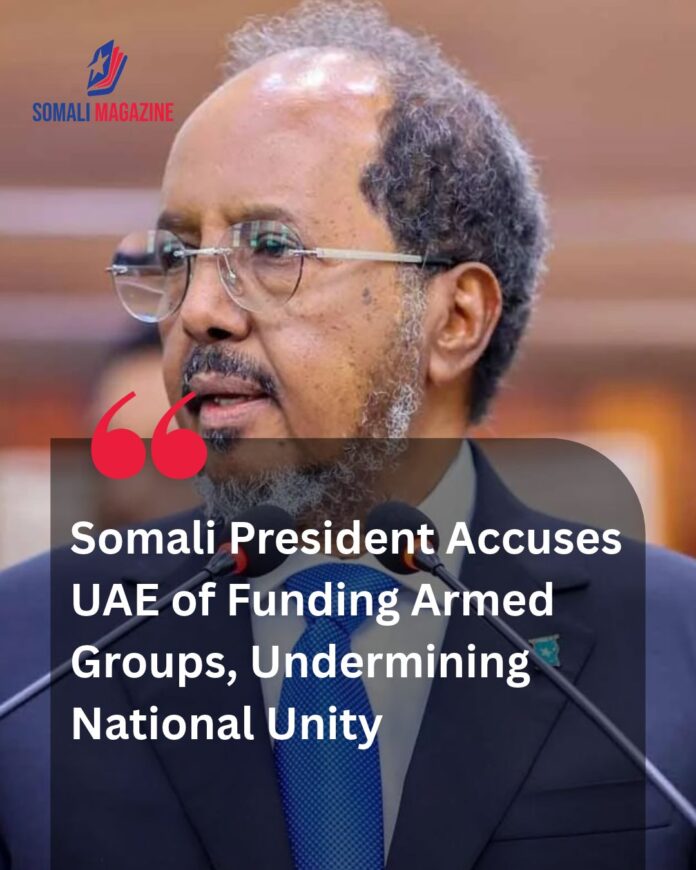
In a public address that highlights deepening diplomatic friction across the Red Sea and the Horn of Africa, the Somali president accuses UAE of funding armed groups, undermining national unity, and bypassing federal authority through unauthorized security and commercial arrangements. Speaking in Mogadishu on Tuesday, November 17, President of Somalia Hassan Sheikh Mohamud outlined a series of sweeping allegations against Abu Dhabi, asserting that external interference has fueled internal political divisions. According to official statements released by the presidency and state media, the Somali president alleged that the United Arab Emirates established military bases without central government consent, signed unilateral port agreements in Berbera, Bosaso, and Kismayo, and financially backed regional factions against Mogadishu. The United Arab Emirates had not immediately issued a public response to the latest remarks, though Abu Dhabi has previously maintained that its engagement in the region focuses on development and security assistance.
The address marks an escalation in tensions that surged earlier this year when Somalia’s federal cabinet announced on January 12, 2026, the annulment of all bilateral agreements with the UAE, including defense cooperation and port management deals. Mogadishu subsequently restricted Emirati military and cargo aircraft from using Somali airspace. In his Tuesday speech, the Somali president reiterated allegations that Berbera port was used in January without federal approval to facilitate the transit of a fugitive Yemeni separatist leader. He further claimed that Abu Dhabi played a role in facilitating Israel’s diplomatic recognition of Somaliland—a move Mogadishu firmly rejects as an infringement on its territorial integrity.
The diplomatic standoff intersects directly with long-standing constitutional and fiscal disputes between the federal government and several federal member states. Administrations in Somaliland, Puntland, and Jubaland previously rejected Mogadishu’s January decision to terminate the Emirati agreements, insisting that their existing commercial and security partnerships remain valid. Political analysts note that this divergence underscores unresolved questions over how port revenues, foreign investments, and external security ties are governed under Somalia’s federal framework. While the Somali president appealed to leaders in Somaliland, Puntland, and Jubaland to resolve internal grievances through domestic dialogue rather than foreign mediation, regional stakeholders remain deeply divided over electoral timelines and executive authority.
As the Somali president accuses UAE of funding armed groups, undermining national unity, he simultaneously emphasized that Somalia remains open to restoring diplomatic ties based on mutual respect, equality, and strict non-interference. Despite the severe strain on bilateral relations since January, formal diplomatic channels have not been completely severed. Moving forward, observers warn that resolving the impasse will require both delicate regional diplomacy across the Gulf and inclusive political negotiations inside Somalia to prevent external rivalries from deepening domestic fragmentation.