
Facebook

Twitter (X)

Instagram

Somali Magazine - People's Magazine
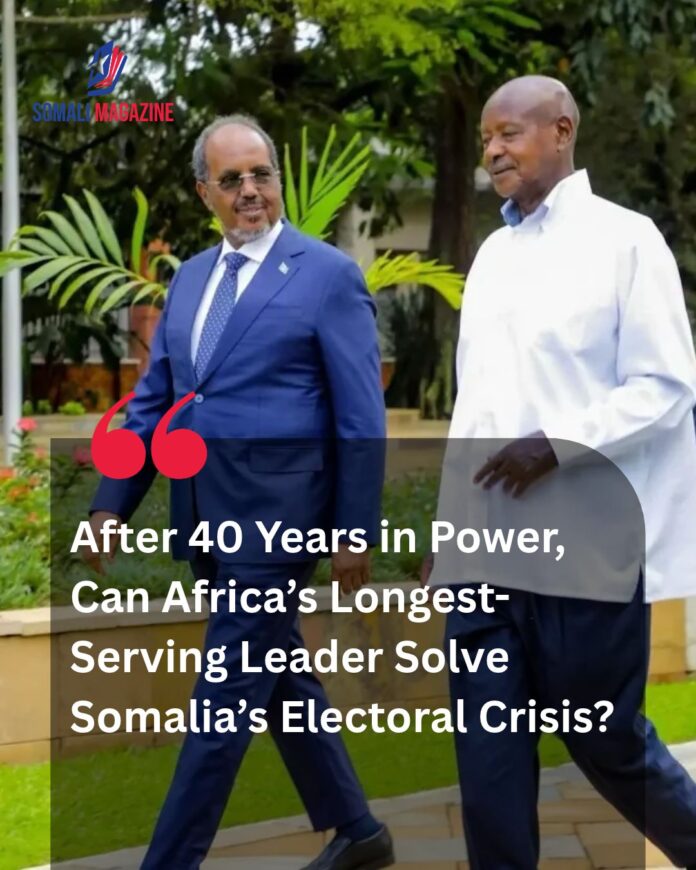
Deepening constitutional and electoral divisions in Mogadishu have placed regional diplomacy under scrutiny as Somalia’s political impasse sparks debate over whether Ugandan President Yoweri Museveni can help stabilize the country’s federal order. Following bilateral talks at State House in Entebbe on Monday, November 23, 2026, Somali President Hassan Sheikh Mohamud invited Museveni to visit Mogadishu, an invitation the Ugandan leader accepted. While Museveni urged Somali leaders to embrace national unity, dialogue, and peaceful political competition, the joint communiqué issued after the meeting focused on security cooperation against al-Shabaab and made no mention of elections or a formal Ugandan mediation role.
Despite the cautious official framing, the prospect of Museveni traveling to Mogadishu drew immediate reactions across Somalia’s political spectrum. Opposition leaders—including former Somali President Mohamed Abdullahi Farmaajo—welcomed the planned visit, calling for inclusive dialogue anchored in the constitution and a recent Supreme Court ruling against extending the presidential term. Several observers also pointed to historical precedent, recalling how Museveni brokered the June 2011 Kampala Accord to break a leadership deadlock in Mogadishu. However, Villa Somalia officials pushed back against suggestions that Uganda would act as a formal mediator, maintaining that Somali political stakeholders should engage directly.
The diplomatic maneuvering unfolds amid a widening institutional standoff over Somalia’s post-2012 federal system, often referred to by political commentators as the country’s Third Republic. Tensions between the federal government, opposition coalitions, and regional administrations in Puntland and Jubaland have intensified over constitutional amendments, disputed term limits, and electoral rules. Just one day after the Entebbe talks, Somalia’s Council of Ministers approved amendments to the National Electoral Law introducing closed party lists and a 10 percent national threshold ahead of parliamentary and presidential elections scheduled by the electoral commission for April and May 2027—a move opposition figures and regional critics warned could narrow the space for negotiated compromise.
Political analysts note that Uganda’s leverage in 2026 differs substantially from 2011, when Ugandan troops formed the primary security shield around Somalia’s transitional leadership. Earlier in November 2026, the Uganda Peoples’ Defence Forces began withdrawing troops deployed under a bilateral agreement and outlined plans to pull out its African Union Support and Stabilization Mission in Somalia (AUSSOM) contingent by the end of 2027.
As Somalia’s political impasse tests both domestic institutions and regional partnerships, significant uncertainty remains over how talks in Mogadishu might proceed. Exact dates for Museveni’s visit, the scope of Uganda’s diplomatic engagement, and whether federal and opposition leaders will agree on a shared electoral framework remain unconfirmed.