
By: Abdi Dahir Mohamed
A source who spoke to Somali Magazine alleges that the Mayor is financially benefiting from land-related activities in the capital. As thousands face eviction and public properties become subjects of controversy, questions about money, power and accountability are growing.
Mogadishu is facing a land crisis that raises questions far beyond property ownership. Behind the demolitions, evictions, disputed documents and the reclamation of public properties lies a more troubling issue: who is financially benefiting from the city’s land business?
For ordinary residents, land represents security, family heritage, investment and sometimes the only asset they possess. For others, Mogadishu’s rapidly increasing land values represent enormous commercial opportunities.
But when public property is reclaimed, residents are removed and valuable land changes hands, the public has a right to know where the money goes.
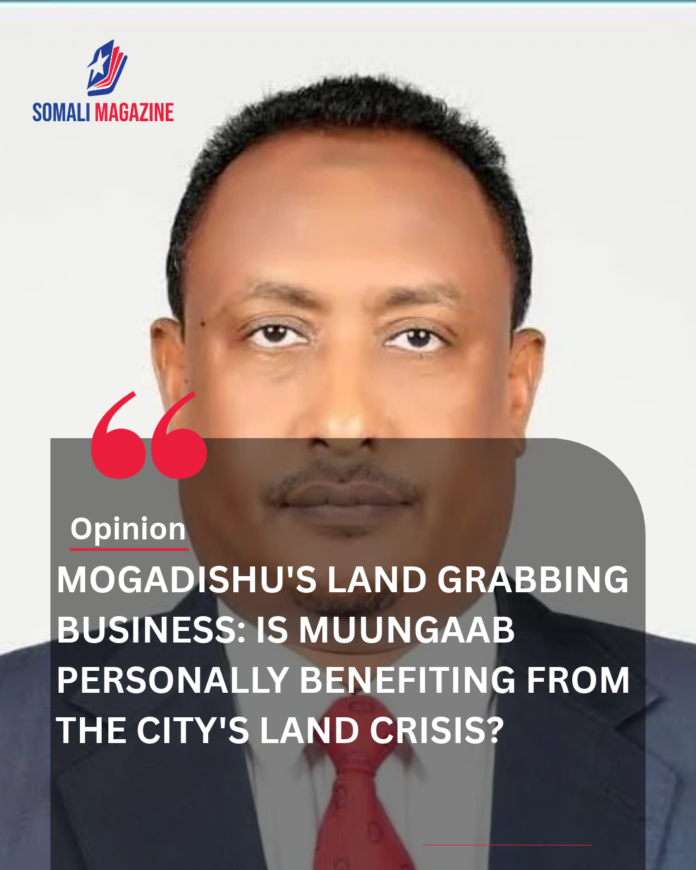
At the centre of this debate is Hassan Mohamed Hussein Muungaab, the Governor of Benadir Region and Mayor of Mogadishu.
A source who spoke to Somali Magazine has alleged that Muungaab is personally making substantial money from land-related activities in Mogadishu.
Somali Magazine has not independently verified this allegation through financial records, transaction documents or other corroborating evidence. The allegation must therefore be investigated rather than treated as an established fact.
Nevertheless, it raises a serious public-interest question:
Is the Mayor simply overseeing a complicated land administration crisis, or are there financial interests connected to the system operating under his leadership?
1. THE BUSINESS BEHIND MOGADISHU’S LAND CRISIS
Land in Mogadishu has become an increasingly valuable economic asset.
As the capital expands, properties in commercially attractive locations can command substantial prices. Public institutions, residential settlements, markets and undeveloped land have become subjects of competing ownership claims.
The problem is that Somalia still struggles with reliable land registration and the verification of historical ownership documents.
This creates opportunities for fraudulent claims, questionable transactions and the exploitation of vulnerable residents.
The European Union Agency for Asylum’s June 2026 report documented 143,548 evictions in Mogadishu during 2025, including 63,132 people removed from government properties.
The report also documented concerns about evictions conducted without adequate notice, genuine consultation, compensation or alternative housing.
These figures demonstrate the scale of the crisis. They do not, by themselves, establish that Muungaab personally profited from any eviction.
But they make one question unavoidable: what happens to the land after people are removed from it?
Who controls it? Who receives it? Is it returned to public use, allocated to institutions or transferred to private interests?
And where money changes hands, where does that money go?
2. WHO BENEFITS WHEN PUBLIC LAND IS RECLAIMED?
There is a legitimate reason for governments to reclaim properties that legally belong to the state.
Government land should not be occupied unlawfully, sold through fraudulent documents or converted into private property without legal authority.
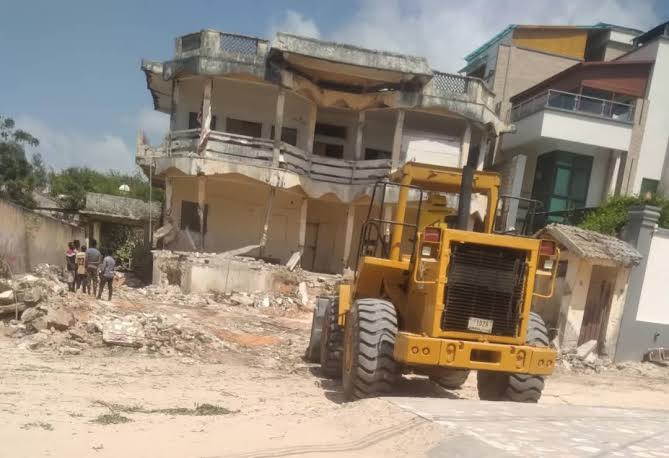
However, the process must be transparent.
If a government property is reclaimed in the name of public interest, residents should be able to establish what happens to it afterwards.
Is it being used for a hospital, school, government office, road or another public purpose?
Or does it eventually become commercially controlled by private individuals?
The distinction is fundamental.
The EUAA has documented concerns raised by opposition groups and political leaders about the alleged unlawful sale of cleared public properties.
These allegations require independent examination through ownership records, transfer agreements, procurement documents and financial accounts.
If properties reclaimed for the public eventually benefit private individuals through questionable arrangements, the public deserves to know who authorized those arrangements and who received the proceeds.
3. THE ALLEGATION REACHING SOMALI MAGAZINE
The most serious allegation in this investigation comes from a source who contacted Somali Magazine.
The source alleges that Muungaab is personally benefiting financially from land-related activities in Mogadishu.
This is an allegation about personal financial interests, not simply criticism of his administration’s performance.
If supported by evidence, it would raise serious questions about possible conflicts of interest, abuse of public office and the management of municipal property.
However, several questions remain unanswered.
Which specific properties are involved?
Who are the alleged intermediaries?
How are payments supposedly made?
Are there financial records, ownership transfers, business relationships or witnesses who can corroborate the account?
Has any money been transferred directly or indirectly to the Governor?
Somali Magazine considers these questions central to establishing whether the allegation has substance.
A serious investigation must follow the evidence wherever it leads, including to public officials, private developers, intermediaries and other beneficiaries.
4. MUUNGAAB’S PUBLIC POSITION ON LAND GRABBING
On 21 July 2025, Muungaab visited Bakara Market following complaints from traders about alleged attempts by unidentified individuals to seize market land.
According to the Somali National News Agency, he stated that the land belonged to Mogadishu Municipality and warned against attempts to use forged documents to claim public property.
His public position was that traders should not be forcibly removed from the market.
This raises an important question about consistency.
If the Mayor recognises that illegal land acquisition and fraudulent documentation threaten Mogadishu’s residents, what comprehensive measures has his administration implemented to prevent similar practices throughout the city?
Does the administration maintain a transparent inventory of public land?
Are all property transfers independently verified?
Are officials and private individuals investigated when credible allegations of illegal land acquisition emerge?
And can the Mayor demonstrate that nobody connected to his administration is benefiting improperly from municipal property?
5. THE HUMAN COST: THOUSANDS OF PEOPLE AFFECTED
While political and commercial interests compete over valuable properties, ordinary families face the consequences.
Internally displaced people, poor households and residents of informal settlements are particularly vulnerable.
Some families have occupied their homes for years, only to discover that their settlements are subject to competing ownership claims or government recovery operations.
The EUAA’s reporting on Mogadishu documents the scale of these evictions and concerns over the treatment of affected communities.
Behind every statistic is a family that must find somewhere else to live.
The question is whether the administration has developed an effective system to distinguish legitimate public-property recovery from unlawful displacement.
If public land is reclaimed, there must be a clear legal basis, transparent procedures and appropriate safeguards for affected people.
No individual should be allowed to turn public authority into a private commercial advantage.
6. WHO CONTROLS THE MONEY?
This is perhaps the most important part of the investigation.
Mogadishu needs a transparent financial record of its public-property transactions.
The Benadir Regional Administration should disclose:
– The number of public properties reclaimed during the current administration.
– The legal status and intended use of each property.
– Any properties subsequently allocated, leased, sold or transferred.
– The individuals or institutions authorized to approve such transactions.
– The valuation of properties transferred or disposed of.
– The amount of revenue collected and the government accounts into which it was deposited.
An independent audit should examine whether public-property transactions have followed the law and whether all proceeds have entered the appropriate public accounts.
If the Mayor or any other public official has a personal financial interest in these transactions, that interest should be disclosed and investigated through lawful procedures.
Transparency is the most effective way to address suspicions surrounding public property.
7. SEVEN QUESTIONS MUUNGAAB MUST ANSWER
Somali Magazine is seeking direct answers from Governor Hassan Mohamed Hussein Muungaab.
1. Has the Mayor, directly or through intermediaries, received any financial benefit from the acquisition, reclamation, allocation or transfer of land in Mogadishu since his appointment in May 2025?
2. Does he or any business interest associated with him have a financial relationship with individuals or companies involved in municipal land transactions?
3. Has any public property reclaimed during his administration subsequently been transferred to private individuals or commercial entities?
4. Who authorises land allocations and transfers, and what independent verification procedures are followed?
5. Will the administration publish a complete register of public properties reclaimed, allocated, leased or transferred since May 2025?
6. Will the Mayor support an independent investigation into allegations of financial misconduct involving public land?
7. Will he publicly disclose any relevant financial interests and provide documentary evidence demonstrating that municipal land transactions have been conducted lawfully?
These are serious questions, and the Governor deserves an opportunity to answer each of them.
8. AN INDEPENDENT INVESTIGATION IS NOW NECESSARY
The controversy surrounding Mogadishu’s land administration should not be resolved through political statements or competing accusations.
It requires an independent investigation.
Such an investigation should examine property ownership documents, land transfers, eviction authorisations, municipal revenue records, financial transactions and the involvement of public officials and private beneficiaries.
It should also establish whether properties reclaimed in the public interest have remained public assets.
If wrongdoing is established, those responsible should face the appropriate legal consequences, regardless of their political position or influence.
The investigation must not presume guilt or target an individual without evidence. Its purpose should be to establish the facts and protect the public interest.
CONCLUSION: WHO IS MAKING MONEY WHILE MOGADISHU LOSES ITS LAND?
Mogadishu’s land belongs to its people and its future generations.
The city’s public properties should serve public purposes. Its institutions should protect citizens, not expose them to arbitrary decisions or questionable commercial arrangements.
Muungaab has a responsibility to demonstrate that his administration is protecting public land and managing property transactions transparently.
The allegation reaching Somali Magazine concerning his personal financial benefit is serious. It remains unverified, but it deserves a direct response and a thorough investigation.
If the allegation is false, the Governor has an opportunity to address it through public disclosure, documentary evidence and support for independent scrutiny.
If evidence emerges that public officials have personally benefited from unlawful land transactions, the matter must be investigated and those responsible held accountable.
Mogadishu cannot become a city where ordinary families lose their homes while powerful individuals become wealthier through the land crisis.
The people deserve to know who is benefiting, how the transactions are being conducted and whether the law is being applied equally.
And the question facing Muungaab is one that cannot be answered with another political speech:
IS THE MAYOR PROTECTING MOGADISHU’S LAND, OR IS THERE A PERSONAL FINANCIAL INTEREST THAT THE PUBLIC HAS A RIGHT TO KNOW ABOUT?
Somali Magazine invites Governor Hassan Mohamed Hussein Muungaab, the Benadir Regional Administration, relevant federal institutions and anyone with documentary evidence to respond. The magazine will consider substantive responses and publish verified corrections where necessary.