
Facebook

Twitter (X)

Instagram

Somali Magazine - People's Magazine
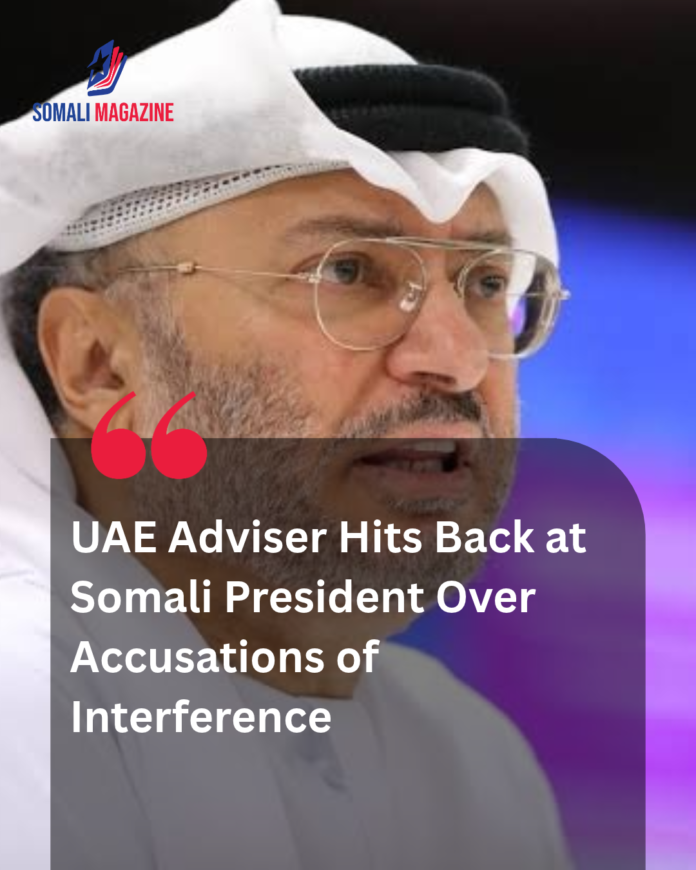
In a sharp diplomatic exchange that underscores widening friction between Abu Dhabi and Mogadishu, a senior UAE adviser hits back at the Somali president over accusations of interference following a televised address by the President of Somalia, Hassan Sheikh Mohamud. Writing on the social media platform X on Wednesday, November 18, Dr. Anwar Gargash, Diplomatic Adviser to the UAE President, rejected the allegations leveled by the Somali leader a day earlier. Gargash stated that the criticism reflected fluctuations in Mohamud’s positions and policies, raising questions about whether personal political calculations were being prioritized over Somalia’s broader national interests. He further emphasized that the United Arab Emirates had stood by Somalia and its people during difficult circumstances, adding that it was regrettable that internal Somali political disputes were being drawn into regional disagreements.
The rebuttal came less than 24 hours after the Somali president delivered a forceful speech in Mogadishu accusing the United Arab Emirates of undermining Somalia’s sovereignty and territorial unity. In his Tuesday remarks, Mohamud alleged that Abu Dhabi had established military bases outside Somalia’s national security framework, funded armed groups and political opponents, and signed unilateral port deals at Berbera, Bosaso, and Kismayo without federal consent. Following the presidential address, Somalia’s Ministry of Foreign Affairs issued a formal statement on Wednesday urging the UAE to conduct all bilateral engagements exclusively through the Federal Government and warning that Mogadishu would take lawful measures to safeguard its sovereignty.
Diplomatic observers note that the latest war of words reflects deep-seated tensions that escalated significantly in January 2026, when Somalia’s federal cabinet annulled all bilateral security and port agreements with the UAE and restricted Emirati military and cargo aircraft from using Somali airspace. While Abu Dhabi has historically maintained extensive commercial, humanitarian, and security ties across the Horn of Africa, including major port infrastructure investments in Berbera, Mogadishu’s federal authorities have increasingly challenged direct foreign engagements with regional member states. Regional administrations in Somaliland, Puntland, and Jubaland have previously pushed back against federal efforts to void existing external agreements, highlighting unresolved constitutional disputes over resource governance and foreign policy authority inside Somalia.
As a senior UAE adviser hits back at the Somali president over accusations of interference, both governments continue to frame their positions around long-term ties with the Somali population. Gargash stressed that the UAE’s relationship with the Somali people remains deeper and more enduring than transient political differences, while Somali officials similarly stated that their concerns target specific government policies rather than relations between the two peoples. Moving forward, political analysts caution that bridging the diplomatic divide will require quiet regional mediation and renewed domestic dialogue in Somalia to prevent external rivalries from deepening internal political fragmentation.