
Facebook

Twitter (X)

Instagram

Somali Magazine - People's Magazine
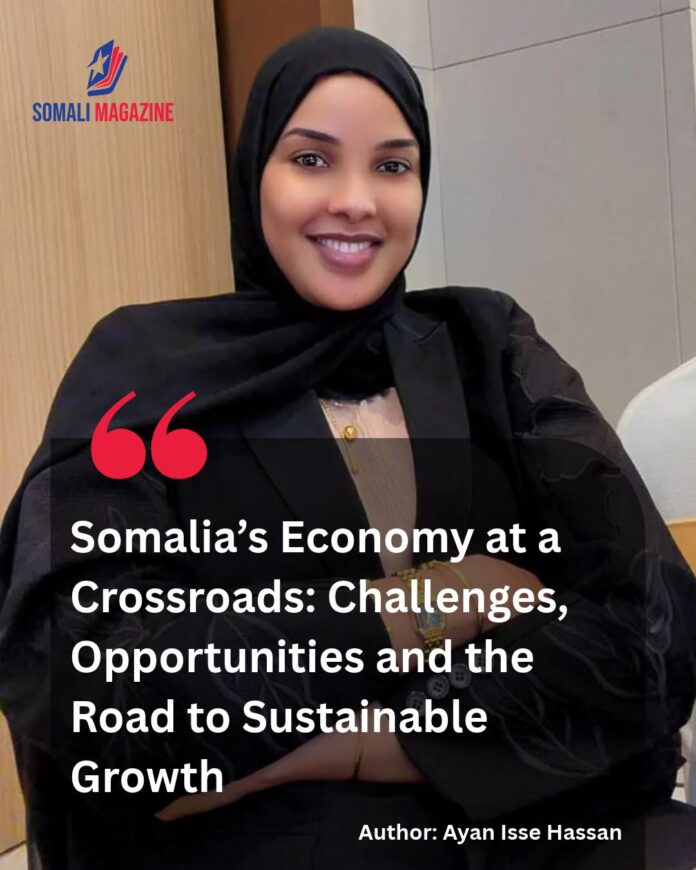
By Somali Magazine | Author: Ayan Isse Hassan
Somalia stands at a defining moment in its economic history. After decades of conflict, institutional disruption and economic uncertainty, the country is gradually rebuilding its economic foundations, strengthening public institutions and positioning itself for greater participation in regional and international markets.
With a strategic location along the Indian Ocean and the Gulf of Aden, an entrepreneurial population, a dynamic private sector and significant natural resources, Somalia possesses considerable economic potential. Yet, despite these advantages, the country continues to face structural challenges that prevent its economy from delivering meaningful improvements in living standards, employment and national development.
The central question is no longer whether Somalia has economic potential. It is whether the country can translate that potential into a productive, diversified and inclusive economy capable of creating opportunities for its people.
An Economy Showing Resilience Amid Uncertainty
Somalia’s economy has demonstrated resilience despite difficult domestic and international circumstances. The private sector continues to play a central role in economic activity, particularly in telecommunications, financial services, trade, construction, transportation and retail.
However, economic growth has slowed. According to the International Monetary Fund’s October 2026 assessment, Somalia’s real gross domestic product is projected to grow by 2.3 percent in 2026, compared with approximately 3.1 percent in 2025. The IMF projects a gradual recovery to 2.7 percent in 2027.
The World Bank has also highlighted the impact of declining international assistance, climate-related shocks and rising living costs on economic performance.
These developments demonstrate that economic growth alone is not sufficient. Somalia needs growth that generates employment, expands productive capacity, strengthens household incomes and reduces the country’s dependence on external support.
The Private Sector: The Backbone of Somalia’s Economy
One of Somalia’s greatest economic strengths is its entrepreneurial private sector.
In the absence of strong public institutions and extensive government service provision over many years, private businesses have developed systems that continue to support everyday economic activity.
Somali entrepreneurs have established businesses across telecommunications, banking, money transfers, retail, aviation, logistics, construction, hospitality and international trade. Their investments have helped maintain commercial activity and connect Somali communities with regional and global markets.
The telecommunications and financial technology sectors are particularly important. Mobile money services have transformed how businesses and households conduct transactions, while digital financial platforms have expanded access to payments and financial services.
Nevertheless, the private sector faces significant obstacles, including expensive electricity, limited access to affordable financing, regulatory uncertainty, infrastructure gaps and insufficient institutional coordination.
Creating a more competitive business environment requires predictable regulations, transparent licensing systems, stronger commercial laws and effective mechanisms for resolving business disputes.
The government must recognize that a successful private sector is not simply a source of employment and taxation. It is an essential partner in rebuilding the national economy.
Agriculture, Livestock and Fisheries: Unlocking Untapped Potential
Agriculture and livestock remain fundamental to Somalia’s economic future. For generations, livestock exports have supported livelihoods, international trade and household incomes, particularly in rural communities.
Somalia’s extensive coastline also presents considerable opportunities for developing a sustainable fisheries industry.
However, these productive sectors remain constrained by inadequate infrastructure, limited access to modern technology, insufficient investment in processing facilities, weak storage systems and vulnerability to droughts and floods.
Much of the country’s agricultural and livestock potential remains underdeveloped because production is not sufficiently connected to modern markets, industrial processing and value-added manufacturing.
Rather than relying primarily on exporting raw agricultural products and livestock, Somalia should invest in processing industries, cold-storage facilities, veterinary services, irrigation systems and modern agricultural technology.
Developing these industries would increase export earnings, create employment and strengthen food security.
The future of Somalia’s agricultural economy should be built around production, processing, manufacturing and regional trade.
The Revenue Challenge: Building an Economy That Can Finance Its Own Development
One of Somalia’s most pressing economic challenges is its limited capacity to generate domestic revenue.
According to the World Bank’s October 2026 Public Finance Review, domestic revenue increased from 6.2 percent of GDP in 2024 to an estimated 6.3 percent in 2025. However, this remains significantly below the 15–17 percent average recorded among comparable countries.
This gap illustrates the difficulties facing a government attempting to finance national development while depending heavily on external assistance.
Somalia needs a broader and more efficient revenue system. Customs administration must be strengthened, tax collection modernized and revenue-generating activities brought into the formal economy.
Equally important is ensuring that public revenue is managed transparently and directed towards essential national priorities, including education, healthcare, security, infrastructure and economic development.
Taxation should not become an additional burden on struggling households and small businesses. Instead, the government should build a fair system that encourages business formalization, improves compliance and distributes the responsibility of financing public services more effectively.
A country cannot achieve lasting economic independence without developing the capacity to finance its own institutions and development priorities.
Infrastructure and Energy: The Foundation of Economic Competitiveness
Reliable infrastructure is essential for economic transformation.
Somalia’s businesses face considerable operational costs associated with electricity, transportation, logistics and limited infrastructure. Among these challenges, electricity remains particularly significant.
The World Bank’s 2026 Somalia Economic Update highlights that although approximately 71 percent of households report access to electricity, only 21 percent receive more than eight hours of electricity supply per day.
The country’s heavy reliance on diesel-powered electricity generation also exposes businesses and households to fluctuations in international fuel prices.
Expanding renewable energy, particularly solar power, could help reduce electricity costs, improve reliability and strengthen the competitiveness of Somali businesses.
Investment in roads, ports, airports, water infrastructure and modern logistics systems is equally important.
Somalia’s geographical position provides an opportunity to become an important commercial gateway connecting East Africa, the Middle East and international markets. However, this potential can only be realized through sustained investment in infrastructure, efficient port management and regional transport connectivity.
Foreign Investment and Somalia’s Position in East Africa
Somalia’s participation in the East African Community presents an important opportunity to strengthen regional economic integration.
Membership creates opportunities to expand trade, attract investment, improve market access and establish stronger commercial relationships with neighboring economies.
For Somali businesses, regional integration offers the possibility of expanding beyond domestic markets and participating in larger supply chains.
Foreign investors may also find opportunities in sectors such as renewable energy, fisheries, agriculture, telecommunications, construction, logistics, real estate and financial services.
However, investment decisions depend on confidence. Investors require political stability, clear regulations, enforceable contracts, transparent institutions and predictable commercial policies.
Somalia must therefore move beyond promoting investment opportunities and focus on establishing the institutional conditions necessary to attract and retain long-term capital.
The country also needs to strengthen partnerships between domestic businesses and international investors so that foreign investment contributes to local employment, technology transfer and the development of national industries.
Youth Unemployment and the Future of the Somali Workforce
Somalia’s young population represents one of its greatest economic assets, but it also presents a major development challenge.
Thousands of young people enter the labour market every year, yet the availability of formal employment opportunities remains limited.
The gap between education and labour market requirements is a significant concern. Many graduates struggle to find employment because their academic qualifications do not always match the practical skills demanded by businesses.
Addressing this challenge requires a stronger connection between educational institutions, vocational training centres and the private sector.
Investment in technical education, entrepreneurship, digital skills, engineering, agriculture and professional development can help prepare young Somalis for emerging economic opportunities.
The government should also encourage businesses to invest in local talent through apprenticeships, professional training and employment programmes.
Economic development must ultimately be measured not only by GDP growth or investment figures, but also by the opportunities it creates for ordinary citizens.
The Diaspora: A Strategic Economic Partner
The Somali diaspora remains one of the country’s most important economic partners.
Remittances support millions of households, finance education and healthcare, sustain small businesses and contribute to domestic consumption.
Beyond sending money to families, members of the diaspora have increasingly become involved in business investment, property development, education, healthcare and other commercial activities.
Their international experience, professional networks and access to global markets represent an important resource for national development.
However, Somalia needs more structured mechanisms to transform diaspora contributions into productive long-term investment.
Creating transparent investment frameworks, improving financial regulations and developing reliable investment opportunities could encourage more diaspora capital to flow into productive sectors.
The objective should be to transform diaspora engagement from predominantly household support into a stronger source of enterprise development, employment and industrial growth.
Economic Reform, Governance and Institutional Confidence
No economic transformation can succeed without effective institutions and accountable governance.
Somalia has made important progress in rebuilding its public financial management systems, strengthening financial regulation and achieving debt relief through the Heavily Indebted Poor Countries Initiative.
Nevertheless, significant challenges remain.
The country needs stronger coordination between federal and federal member state institutions, clearer revenue-sharing arrangements, improved public expenditure management and greater transparency in the use of public resources.
The IMF has also emphasized the importance of strengthening financial supervision, improving access to finance, modernizing revenue collection and carefully advancing monetary and currency reforms.
These measures are essential to creating a stable environment in which businesses can operate confidently and investors can make long-term commitments.
Economic policies must also be consistent. Frequent uncertainty in regulations, taxation and institutional responsibilities can discourage investment and weaken business confidence.
Somalia needs an economic governance framework that prioritizes accountability, institutional cooperation and measurable development outcomes.
The Road Ahead: Turning Economic Potential into National Prosperity
Somalia’s economic future will depend on the decisions made today.
The country cannot rely indefinitely on remittances, international assistance and the resilience of private entrepreneurs while leaving its productive sectors underdeveloped.
A sustainable economic strategy must prioritize domestic revenue mobilization, agricultural modernization, industrial development, reliable energy, infrastructure investment, regional trade and employment creation.
The government must establish an enabling environment for businesses, while the private sector must continue investing in innovation, productivity and local capacity.
International partners should support Somalia’s long-term institutional and economic development, but national economic transformation must increasingly be driven by domestic priorities and productive investment.
Most importantly, economic growth must reach beyond major commercial centres and benefit communities across the country. Rural livelihoods, small businesses, women entrepreneurs and young professionals must become central participants in the national development process.
Somalia has the geographical advantage, entrepreneurial spirit, human capital and natural resources to build a stronger economy. What remains essential is the ability to convert these advantages into coordinated national policies, effective institutions and sustainable investment.
The future of Somalia’s economy will not be determined by its potential alone, but by how effectively that potential is transformed into productivity, employment, opportunity and prosperity for its people.