
Facebook

Twitter (X)

Instagram

Somali Magazine - People's Magazine
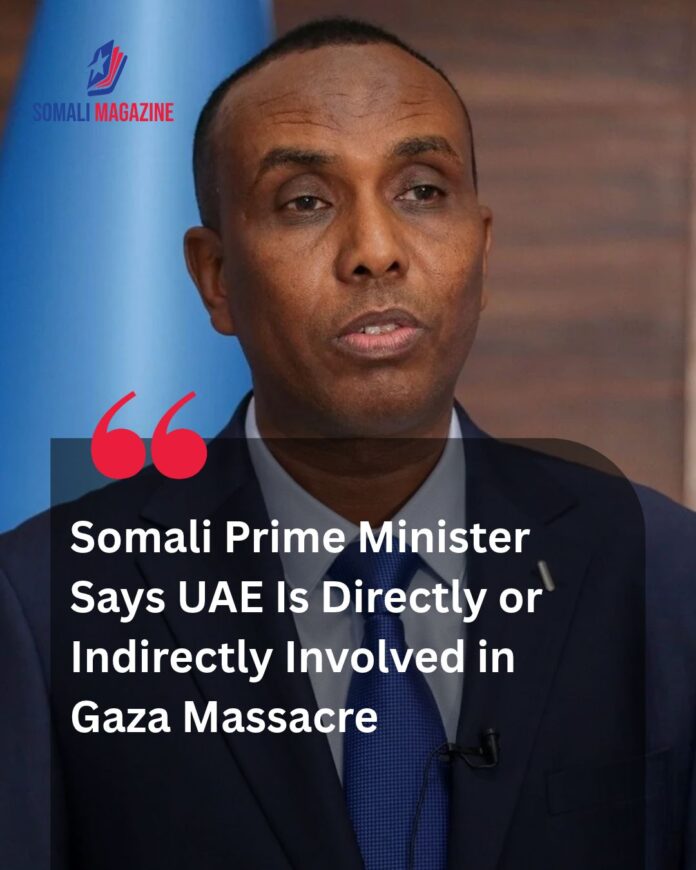
Amid a rapidly deteriorating diplomatic standoff between Mogadishu and Abu Dhabi, the Somali Prime Minister accuses UAE over Gaza conflict, widening an already acute geopolitical rift between the two nations. Speaking in public remarks circulated this week, Prime Minister of Somalia Hamza Abdi Barre stated that the United Arab Emirates is directly or indirectly involved in the massacre that took place in Gaza. The assertion marks one of the sharpest public criticisms leveled by Somalia’s federal leadership against a Gulf state in recent years, linking Middle Eastern conflict dynamics directly to Mogadishu’s broader grievances regarding Emirati foreign policy in the Horn of Africa. While the prime minister did not present specific documentary evidence during the remarks, the statement underscores how deeply bilateral trust has fractured.
The comments come immediately after Somalia’s Council of Ministers, chaired by Barre on Thursday, November 19, 2026, ordered the UAE ambassador in Mogadishu to depart the country within 72 hours and recalled Somalia’s envoy from Abu Dhabi. Earlier in the week, President of Somalia Hassan Sheikh Mohamud accused the UAE of violating Somalia’s sovereignty by operating unauthorized military installations, supporting armed groups outside federal command, and pursuing unilateral port arrangements without federal approval. In response, Dr. Anwar Gargash, Diplomatic Adviser to the UAE President, rejected the allegations of interference, arguing that Mogadishu’s rhetoric reflected shifting domestic political calculations rather than national interest. The Emirati government had not yet issued a formal diplomatic response specifically addressing Barre’s remarks regarding Gaza.
Historically, the United Arab Emirates has maintained close ties with Israel following the 2020 Abraham Accords while simultaneously positioning itself as a major provider of humanitarian aid, field hospitals, and medical evacuations for Palestinians in Gaza. Conversely, Somalia has consistently maintained strong diplomatic solidarity with the Palestinian cause across multilateral forums, including the United Nations, the Arab League, and the Organization of Islamic Cooperation. In Mogadishu, federal officials have increasingly framed their dispute with Abu Dhabi not merely as a bilateral disagreement over ports or security cooperation, but as part of wider regional alignments affecting sovereignty and stability across the Red Sea and Horn of Africa corridors.
As the Somali Prime Minister accuses UAE over Gaza conflict, diplomatic analysts note that introducing high-stakes Middle Eastern grievances into an active bilateral rupture complicates prospects for near-term mediation. Regional observers point out that Somalia’s federal government is simultaneously managing domestic political deadlock over constitutional amendments and upcoming electoral timelines, alongside ongoing counter-terrorism operations against the al-Shabab terrorist group. Whether regional mediators in the Gulf or East Africa will step in to de-escalate the rhetoric remains unconfirmed, though analysts warn that prolonged hostility between Mogadishu and Abu Dhabi risks deepening political polarization across the region.