
Facebook

Twitter (X)

Instagram

Somali Magazine - People's Magazine
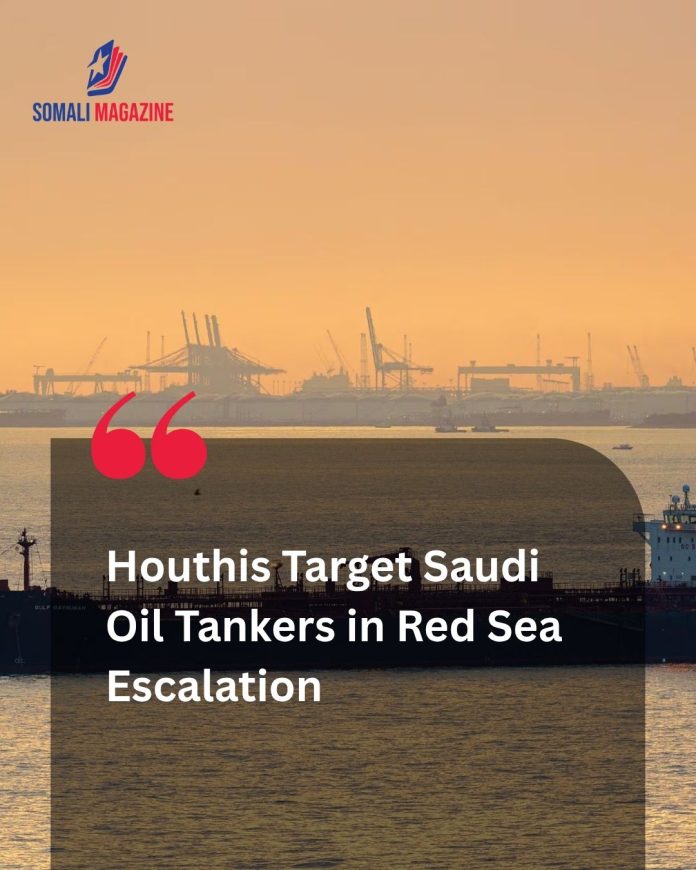
Global energy markets and shipping networks face severe disruption after Yemen-based Houthis target Saudi tankers in Red Sea waters, raising fears of a critical secondary trade chokepoint alongside ongoing hostilities in the Gulf. Houthi military representatives claimed responsibility for launching drones and ballistic missiles against two Saudi-flagged crude vessels, identified as the Encelia and the Layla, asserting that the actions enforced a newly declared maritime blockade against Saudi Arabian ports. Official sources confirmed that the Encelia sustained a projectile strike near the port of Jizan, triggering a localized fire at the vessel’s bow, though crew members managed to contain the blaze without reported casualties. Independent maritime security analysts noted that while the impact on the second tanker remained unconfirmed, distress signals and radio warnings prompted several commercial vessels to execute sharp diversions away from the southern corridor.
The escalation comes at a delicate moment for East African and Middle Eastern maritime stability, as the Bab el-Mandeb Strait serves as the primary gateway linking the Red Sea, the Gulf of Aden, and the Indian Ocean. With alternative trade corridors through the Strait of Hormuz facing extreme operational restrictions, major energy exporters had increasingly rerouted millions of barrels of crude overland via pipelines to Red Sea terminals such as Yanbu. The renewed threat along the Bab el-Mandeb route threatens to choke off this alternative supply line, forcing commercial operators to consider lengthy, costly detours around the African continent. Maritime tracking data indicated that multiple supertankers carrying crude to Asian markets made abrupt U-turns or altered course immediately following broadcasted warnings from the armed movement.
Security experts warn that a dual-chokepoint crisis places immense pressure on international naval forces operating in the region, including US-led coalition vessels tasked with safeguarding international trade lanes. High-level international defense authorities reported conducting additional precision strikes against military infrastructure in response to the escalating threats to civilian navigation. However, regional analysts emphasize that asymmetrical attacks using low-cost drones and anti-ship missiles present continuous tactical hurdles for heavy naval patrols. The potential expansion of active combat zones across both ends of the Arabian Peninsula threatens to drive up global freight rates, increase insurance premiums for maritime logistics, and complicate long-term stabilization efforts across neighboring African coastal economies dependent on Red Sea stability.
As diplomatic channels struggle to de-escalate the broader regional confrontation, international shipping bodies have advised commercial mariners to exercise heightened caution and maintain close coordination with maritime security centers. Somali and regional Horn of Africa authorities continue to monitor developments closely, recognizing that sustained naval volatility near the Bab el-Mandeb could impact regional port traffic, food supply chains, and coastal security frameworks. Government officials and international trade organizations maintain that ensuring unimpeded passage through vital straits remains essential for global economic resilience, urging all parties to adhere to international maritime law and prevent further devastation to regional trade corridors.