
Facebook

Twitter (X)

Instagram

Somali Magazine - People's Magazine
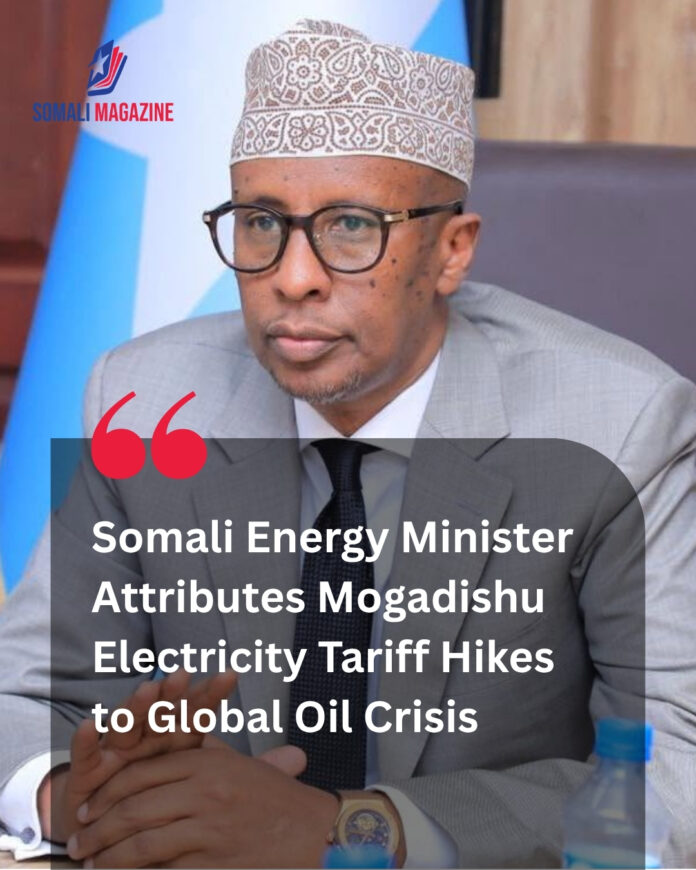
The Somali Energy Minister blames fuel costs, Middle East crisis for Mogadishu electricity price hike following a five-cent per kilowatt-hour tariff increase enacted by major private power utility suppliers across the capital region. Official statements issued by the Ministry of Energy and Water Resources explain that escalating conflict in the Middle East and severe shipping bottlenecks along international maritime routes, including the Strait of Hormuz, have caused global petroleum market volatility that directly impacts local energy generation. Energy administrators highlighted that because Somalia relies almost exclusively on imported refined diesel fuel to power its commercial electrical grids, local generation costs are acutely vulnerable to sudden global price spikes.
The joint tariff adjustments were announced by Mogadishu’s primary private utility providers—BECO Power, Mogadishu Power Supply, and Blue Sky Energy—after executive meetings evaluated sustained increases in imported fuel expenses over recent months. Under the revised pricing schedules, Mogadishu Power Supply raised its tariff from 33 cents to 38 cents per kilowatt-hour, while BECO Power and Blue Sky Energy increased their rates from 41 cents to 46 cents per kilowatt-hour. Utility executives expressed regret regarding the additional financial burden placed on consumers, noting that current operational costs left companies with no alternative while indicating that tariffs will be reviewed if global oil prices stabilize.
Economic analysts observe that the five-cent increase represents a significant cost expansion for local households, small enterprises, and industrial consumers across urban districts. For a standard household consuming 200 kilowatt-hours per month, the price adjustment adds approximately $10 to monthly utility expenditures, compounding broader inflationary pressures on basic consumer goods. Chamber of commerce representatives and local business owners have raised concerns that high energy tariffs will constrain commercial expansion, lower operational margins, and increase overhead costs for manufacturing and service sectors.
Government officials and energy sector experts continue to advocate for structural reforms to diversify national energy infrastructure away from total fossil fuel dependency. The ministry reaffirmed its long-term strategic plans to expand renewable energy investments, particularly solar and wind generation systems, to build a resilient, affordable national power framework. As the Somali Energy Minister blames fuel costs, Middle East crisis for Mogadishu electricity price hike, state administrators urge private energy providers to maintain open dialogue with regulators to protect low-income consumers while long-term energy transition projects are developed.