
Facebook

Twitter (X)

Instagram

Somali Magazine - People's Magazine
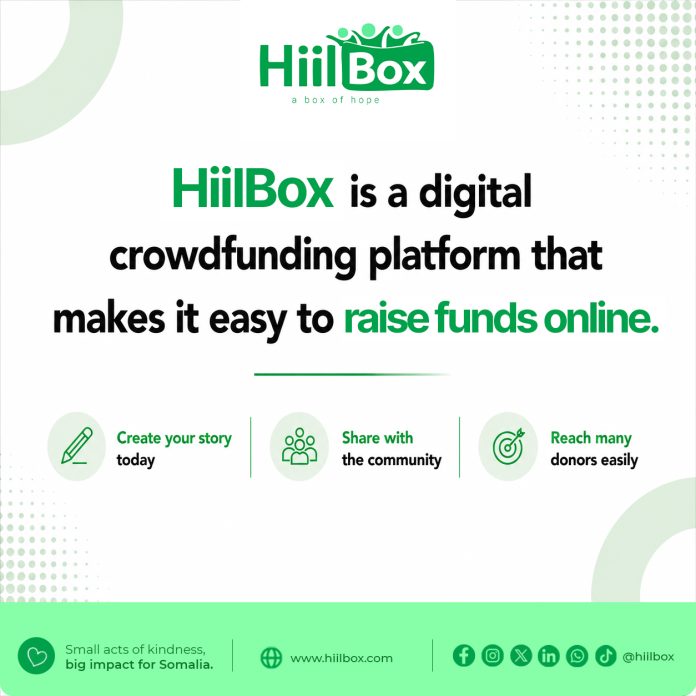
Discover how HiilBox, a Somali crowdfunding platform, is transforming digital fundraising in Somalia. Learn how mobile money, diaspora donations, and innovative technology are reshaping giving in the Horn of Africa.
Executive Summary
Across the global economic landscape, crowdfunding has fundamentally restructured the mechanisms through which individuals and communities mobilize financial resources. From facilitating urgent medical interventions and educational access to enabling humanitarian relief, entrepreneurial ventures, and community development initiatives, online fundraising platforms have become integral components of the contemporary digital economy. Regions spanning North America, Europe, Asia, and increasingly Africa have witnessed the exponential growth of crowdfunding ecosystems that connect fundraisers with expansive networks of supporters through secure digital payment infrastructures. These platforms have demonstrably enhanced operational transparency, expanded donor reach across geographical boundaries, and streamlined the fundraising process for both individual petitioners and institutional actors.
Somalia presents a compelling paradox within this global context. The nation is widely recognized as possessing one of Africa’s most sophisticated digitally connected financial markets, with mobile money services having become thoroughly embedded within everyday commercial and social transactions. Millions of Somali citizens routinely utilize digital wallets for bill payments, remittances, goods acquisition, and business operations. Despite this remarkably advanced digital payment ecosystem combined with a deeply entrenched cultural tradition of generosity and mutual assistance dedicated online crowdfunding platforms have remained comparatively underdeveloped within the Somali context.
Instead, fundraising activities continue to operate predominantly through community networks, social media dissemination, messaging applications, and manually managed payment accounts. While these traditional methodologies have enabled thousands of families and Organizations to receive critical financial support, they present increasingly significant operational challenges as fundraising campaigns grow in scale, demand greater transparency, and attract increasingly international donor bases.
This article undertakes a comprehensive examination of the factors constraining crowdfunding development in Somalia, analyses the inherent strengths of the country’s existing fundraising culture, and explores how digital fundraising platforms may complement rather than displace traditional community support mechanisms. Additionally, this analysis considers the expanding role of technology in rendering fundraising more transparent, accessible, and inclusive for both local communities and the Somali diaspora population. As Somalia’s digital economy continues to mature, locally developed platforms such as HiilBox are beginning to address the operational challenges inherent in traditional fundraising methods, representing an important evolution in how communities organize financial support.
Introduction
The propensity to provide material assistance to others has historically constituted a defining characteristic of Somali social organization. Whether responding to medical emergencies, supporting families affected by environmental adversity, funding religious institutional reconstruction, financing educational opportunities, or assisting communities during humanitarian crises, Somalis have consistently relied upon collective action frameworks to address urgent needs. Families, neighbors, business networks, religious institutions, and the extensive Somali diaspora have consistently demonstrated a robust tradition of generosity and mutual support that transcends geographical boundaries.
Historically, these fundraising endeavors have been organized through personal networks characterized by high degrees of social trust. Community leaders, relatives, religious scholars, and volunteers have traditionally coordinated fundraising activities by collecting contributions through established relational channels. Over the preceding decade, digital communication platforms including WhatsApp, Facebook, Telegram, and various social media channels have significantly augmented the reach of these efforts, enabling campaigns to proliferate across cities and continents within compressed timeframes.
Simultaneously, digital financial services have fundamentally transformed the mechanisms through which monetary value circulates within Somalia. Mobile wallets and electronic payment systems have become the preferred modality for daily financial transactions, substantially reducing dependence on physical currency and enabling instantaneous transfers between individuals and commercial entities.
Notwithstanding these remarkable advances in financial technology, one important component of the digital economy has developed at a comparatively slower pace: structured online crowdfunding. Internationally, crowdfunding platforms provide centralized digital spaces where campaign organizers can articulate their narratives, establish fundraising objectives, receive donations through multiple payment channels, publish campaign updates, and demonstrate fundraising progress in real time. In Somalia, however, fundraising continues to be managed predominantly through decentralized methods that rely upon individual payment accounts and continuous social media dissemination.
This circumstance raises a fundamental question: Why has a nation possessing one of Africa’s most advanced mobile money ecosystems not experienced commensurate growth in digital crowdfunding platforms?
The answer does not reside in a single challenge. Rather, it reflects a complex interplay of technological evolution, fundraising traditions, payment accessibility, donor expectations, and the gradual development of digital services specifically designed for the Somali market. As locally developed platforms such as HiilBox emerge to address these challenges, understanding these multifaceted factors provides valuable insight into the future trajectory of digital fundraising not only for Somalia but for other emerging digital economies confronting analogous opportunities and constraints.
Somalia’s Digital Financial Revolution
To comprehensively analyses the potential for crowdfunding development in Somalia, it is essential to first appreciate the distinctive characteristics of the country’s financial landscape. External observers are frequently surprised to learn that Somalia has emerged as one of Africa’s most digitally connected payment ecosystems. While numerous nations continue to rely substantially on cash transactions, digital financial services have become deeply integrated into quotidian life across much of Somalia’s territory.
Contemporary mobile money utilization encompasses an extensive array of activities, including:
- Acquisition of groceries and everyday consumer goods
- Intra-family remittances
- Educational fee payments
- Utility bill settlement
- Fuel purchases
- Salary disbursements
- Charitable contributions
- Commercial transaction completion
For many Somali citizens, carrying physical currency has become substantially less common than utilising mobile wallet applications. This widespread adoption has been driven by local financial institutions and telecommunications enterprises that have invested in accessible mobile payment solutions specifically tailored to Somali consumer preferences. The convenience, speed, and affordability of these services have significantly accelerated financial inclusion and have rendered digital payments a routine component of everyday existence.
Unlike numerous countries where digital payments remain in emergent stages, Somalia has demonstrated that technological adoption can progress rapidly when solutions respond directly to local needs and contextual realities. This digital transformation has simultaneously strengthened inter-community connections. Families can now support relatives across disparate regions almost instantaneously, businesses can complete transactions electronically, and humanitarian Organizations are increasingly able to distribute assistance through digital payment channels.
From a technological perspective, many of the core prerequisites for digital crowdfunding are already present. The infrastructure exists. Citizens trust digital payments. Communities already transfer money electronically on a daily basis. Modern crowdfunding platforms, including Somalia’s HiilBox, leverage this existing infrastructure by consolidating donations into unified campaigns while supporting the payment methods already familiar to Somali users.
However, the challenge does not reside in the ability to move money digitally. Rather, it is how fundraising itself is organised, managed, presented, and experienced within the digital environment. This distinction is essential. Crowdfunding is not simply about accepting digital payments. It is about creating an organised fundraising ecosystem that integrates technology, transparency, campaign management, donor engagement, and accessible payment options into a unified user experience.
Traditional Fundraising in Somalia:
Long before digital platforms existed, Somali communities had already developed effective mechanisms for mutual assistance and resource mobilization. Community fundraising has never depended upon sophisticated technology. Instead, it has relied upon trust, personal relationships, shared responsibility, and a strong cultural belief in supporting those confronting hardship.
When an individual requires assistance, the fundraising process often commences with a simple appeal. A campaign organizer. may design a poster explaining the situation and include one or more contact details for receiving donations. These posters are commonly shared through WhatsApp groups, Facebook pages, Telegram channels, and other social media platforms where friends, relatives, colleagues, and members of the Somali diaspora can contribute.
These fundraising campaigns support a diverse range of causes, including:
- Medical treatment and emergency healthcare interventions
- Educational expenses
- Support for orphaned children
- Mosque construction and renovation
- Water project development
- Community development initiatives
- Disaster and drought relief
- Assistance for families affected by emergencies
- Humanitarian and charitable projects
This approach has enabled thousands of individuals and communities to receive timely financial support. Its greatest strength lies in the willingness of people to respond quickly when someone is in need. However, as fundraising campaigns become larger and attract supporters from multiple countries, managing donations through traditional methods becomes increasingly complex.
Campaign organizers may need to monitor several mobile wallets, multiple bank accounts, and various money transfer channels simultaneously. Donors may send funds using different payment methods, requiring organizers to manually reconcile incoming donations and provide updates through repeated social media posts. For campaigns with hundreds or even thousands of supporters, this administrative effort can become significant.
The challenge is not that traditional fundraising methods are ineffective. On the contrary, they have demonstrated remarkable resilience and have served Somali communities for generations. Rather, the challenge is that today’s fundraising environment has evolved. Donors increasingly expect real-time updates, transparent reporting, secure payment experiences, and easier ways to contribute regardless of where they live. These changing expectations are creating opportunities for a new generation of digital fundraising platforms that complement Somalia’s long-standing tradition of community support while reducing many of the operational complexities faced by campaign organizers.
Why Crowdfunding Has Yet to Flourish in Somalia
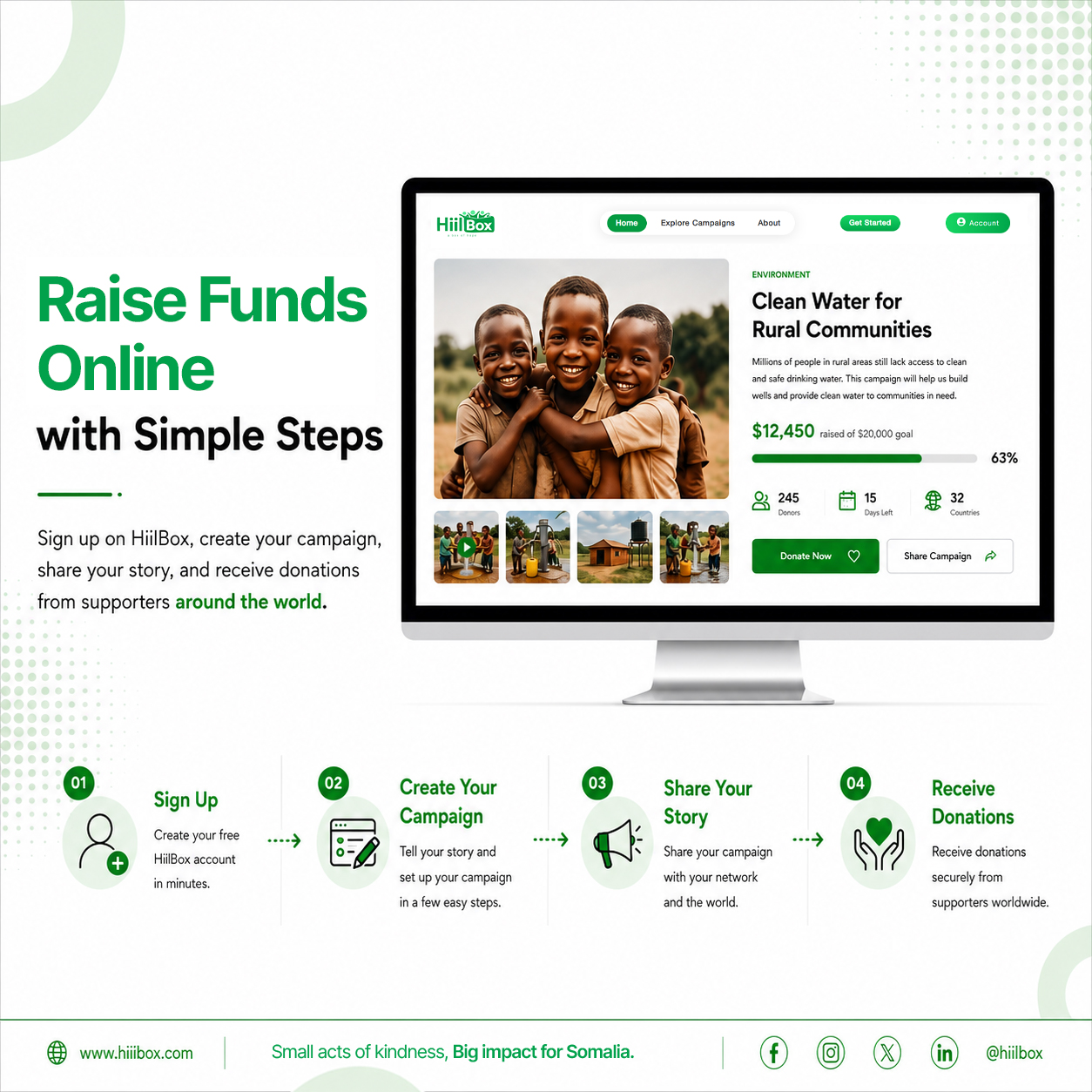
Although Somalia has embraced digital financial services, dedicated crowdfunding platforms have taken longer to emerge than many observers might anticipate. This does not suggest that fundraising is absent. On the contrary, fundraising is deeply embedded in Somali society and continues to play an essential role in supporting families, communities, charitable organizations, educational institutions, and humanitarian initiatives. The question, therefore, is not whether fundraising exists. Rather, it is why structured digital crowdfunding platforms have remained relatively uncommon despite widespread use of mobile money and digital communication technologies.
Several factors help explain this gap.
- Traditional Fundraising Has Worked for Decades
One reason crowdfunding platforms have developed slowly is that Somali communities already have well-established fundraising practices. When someone needs financial assistance, community members instinctively know how to respond. Friends share campaign posters. Relatives circulate messages. Mosques announce fundraising appeals. Community leaders coordinate donations. The Somali diaspora contributes whenever possible. Because these methods have produced positive results over many years, there has been limited urgency to adopt dedicated fundraising technology.
However, as campaigns become larger, involve more donors, and cross international borders, the administrative demands also increase. Technology does not replace community fundraising it enhances its efficiency. Modern platforms such as HiilBox are designed to complement traditional practices by introducing digital tools that reduce administrative burdens while maintaining the community-centered approach that has historically characterized Somali fundraising.
- Managing Donations Across Multiple Payment Channels
One of the most significant operational challenges facing campaign organizers today is managing donations received through multiple payment methods. Typical fundraisers print out a banner and put it in a ZAAD number, an EVC Plus number, an eDahab wallet, multiple bank accounts, and additional contact numbers. While this approach allows donors to choose their preferred payment method, it also creates additional work for the organizers.
Every payment must be checked manually. Transfers must be confirmed individually. Donation records often need to be maintained using notebooks or spreadsheets. Campaign updates require organizers to calculate totals manually before publishing new information on social media. As campaigns grow, this process becomes increasingly time-consuming and susceptible to human error.
Modern crowdfunding platforms, including HiilBox address this challenge by consolidating donations into a single fundraising campaign, regardless of the payment method used. Instead of managing multiple disconnected payment channels, organizers can monitor fundraising activity through one centralized dashboard, substantially reducing administrative burden.
- Transparency Has Become Increasingly Important
Public trust has always been the foundation of successful fundraising. Whether donations are collected by individuals, community groups, or charitable organizations, donors naturally want reassurance that their contributions are reaching the intended cause. As digital fundraising has expanded globally, donor expectations have evolved.
Many supporters now expect to see how much money has already been raised, the fundraising target, campaign progress, regular campaign updates, confirmation that donations have been received, and evidence that funds are being used appropriately. Traditional fundraising methods often make this information difficult to communicate consistently. Campaign organizers. may post periodic updates on WhatsApp or Facebook, but these updates can quickly become buried beneath newer messages. Supporters joining later may struggle to understand the campaign’s current status.
Dedicated crowdfunding platforms address this challenge by displaying fundraising progress in real time, allowing supporters to follow campaigns from beginning to end. Greater transparency benefits everyone involved. Donors gain confidence. Campaign organizers build credibility. Communities receive clearer information. Platforms such as HiilBox provide features that enable real-time progress tracking, donor acknowledgements, and transparent financial reporting.
- Campaigns Often Depend Entirely on Social Media
Social media has transformed fundraising. Platforms such as Facebook, WhatsApp, Telegram, TikTok, Instagram, and X have enabled campaigns to spread rapidly across communities and international networks. However, social media was not originally designed to manage fundraising campaigns. Posts quickly disappear beneath newer content. Finding older fundraising appeals can become difficult. Campaign updates may be scattered across dozens of separate posts. Important information can easily be missed by potential supporters.
As a result, organizers frequently repost the same campaign multiple times simply to maintain visibility. Dedicated crowdfunding platforms provide each campaign with its own permanent online page. Instead of disappearing after a few days, campaigns remain searchable, shareable, and accessible throughout the fundraising period. This allows supporters to revisit campaigns, monitor progress, and share one consistent link rather than repeatedly forwarding updated posters.
- Limited Access for International Supporters
Perhaps one of the greatest opportunities for digital fundraising lies beyond Somalia’s borders. Millions of Somalis live abroad, maintaining strong emotional, cultural, and financial ties with their families and communities. Every year, the Somali diaspora contributes billions of dollars through remittances, charitable giving, education support, healthcare assistance, and humanitarian relief.
Yet participating in local fundraising campaigns is not always straightforward. Many international supporters do not have access to local mobile money services. Instead, they rely on Visa, Mastercard, international bank cards, digital payment services, and online banking. When campaigns only provide local payment numbers, overseas supporters may need to visit a money transfer office, send funds through intermediaries, arrange bank transfers, or contact relatives inside Somalia to complete payments.
Although these methods work, they introduce additional steps that may discourage spontaneous giving. Modern crowdfunding platforms seek to bridge this gap by supporting both local payment systems and international payment methods within a single fundraising experience. HiilBox, for example, combines Somalia’s trusted mobile money ecosystem with international card payment capabilities, allowing campaigns to receive support from donors regardless of their location.
Why Dedicated Crowdfunding Platforms Matter
The evolution of crowdfunding is not simply about replacing traditional fundraising practices. Rather, it reflects a broader shift toward digital tools that help communities organize, manage, and communicate fundraising efforts more effectively. Around the world, modern crowdfunding platforms have introduced features that simplify the fundraising journey for both organizers and donors.
These platforms typically provide:
- A dedicated fundraising page
- Multiple payment options
- Secure online donations
- Real-time fundraising progress
- Campaign updates
- Donor engagement tools
- Financial reporting
- Mobile accessibility
- Campaign sharing through a single link
Instead of relying on disconnected communication channels, fundraising activities become organized within one digital environment. This benefits individual fundraisers, nonprofit organizations, humanitarian agencies, educational institutions, healthcare providers, and community projects alike. Importantly, crowdfunding platforms do not replace the generosity of communities. Instead, they provide the infrastructure that allows generosity to be managed more efficiently, transparently, and inclusively.
A New Chapter for Digital Fundraising in Somalia
As Somalia’s digital economy continues to evolve, a new generation of locally developed crowdfunding platforms is beginning to address many of the operational challenges associated with traditional fundraising. Among these initiatives is HiilBox A Somali crowdfunding platform developed to support individuals, nonprofit organizations, charities, educational institutions, healthcare providers, and community groups in managing fundraising campaigns through a centralized digital platform.
Rather than changing Somalia’s longstanding tradition of helping one another, platforms such as HiilBox seek to complement that tradition by introducing digital tools that simplify campaign management while improving accessibility and transparency. Several characteristics distinguish modern digital fundraising platforms from traditional fundraising approaches.
- Designed for the Somali Market
Unlike international crowdfunding services that may not support Somalia’s financial ecosystem, locally developed platforms are designed around the payment methods, languages, and fundraising practices already familiar to Somali communities. This localization helps reduce barriers for both campaign organizers and donors. HiilBox, for instance, integrates seamlessly with local mobile money services including ZAAD, EVC Plus, and eDahab, while also supporting international payment methods.
- Bringing Local and International Donors Together
One of the most significant developments in digital fundraising is the ability to connect supporters regardless of their location. Modern crowdfunding platforms support local mobile payment services alongside international card payments, allowing campaigns to receive support from donors inside Somalia as well as members of the Somali diaspora around the world. By reducing payment barriers, fundraising campaigns become more accessible to broader communities. HiilBox exemplifies this approach by combining local mobile money integration with international payment capabilities.
- Improving Transparency Through Technology
Modern fundraising increasingly depends on transparency. Digital crowdfunding platforms provide features that allow campaign organizers and donors to monitor fundraising progress through public fundraising totals, campaign goals, donation history, campaign updates, and donor acknowledgements where appropriate. These features are intended to improve visibility throughout the fundraising process and strengthen confidence among supporters. Platforms such as HiilBox provide these transparency tools, enabling campaign organizers to build trust with their donor communities.
- Simplifying Campaign Management
Instead of manually monitoring multiple payment channels and maintaining separate records, campaign organizers can manage fundraising activities through a centralized dashboard. This enables organizers to focus more on engaging supporters and communicating campaign progress, while reducing the administrative effort associated with manual fundraising management. HiilBox provides such a dashboard, allowing organizers to monitor all fundraising activity from a single interface.
Who Benefits from Digital Crowdfunding in Somalia?
Digital crowdfunding platforms serve a diverse range of campaign organizers and donors, each with distinct needs and objectives. Understanding this diversity helps illustrate the broad applicability of crowdfunding services within the Somali context.
Campaign Organizers such as:
- Individuals Seeking Medical Treatment or Emergency Assistance: Patients requiring urgent medical care can create campaigns to fund treatment costs, with contributions arriving quickly through multiple payment channels.
- Families Supporting Educational Expenses: Students and families can raise funds for tuition fees, educational materials, and other academic expenses, enabling access to education that might otherwise be financially inaccessible.
- Nonprofit Organizations and Charities: Established charitable organizations can use digital platforms to manage fundraising campaigns more efficiently, providing donors with transparent reporting and real-time progress updates.
- Educational Institutions: Schools, colleges, and universities can raise funds for infrastructure development, scholarship programs, and educational resources through organized crowdfunding campaigns.
- Healthcare Providers and Clinics: Medical facilities can fund equipment purchases, facility improvements, and community health initiatives through digital fundraising platforms.
- Community Groups and Religious Institutions: Community organizations and mosques can coordinate fundraising for community projects, religious institutional maintenance, and social welfare programs.
- Small Businesses and Entrepreneurs: Startups and small businesses can raise capital for business development, equipment acquisition, and operational expansion through crowdfunding campaigns.
- Humanitarian and Disaster Relief Organizations: Emergency response Organizations can rapidly mobilize funds for disaster relief, drought response, and humanitarian assistance through digital platforms.
-
Donors
- Local Somali Citizens Using Mobile Money: Community members within Somalia can contribute conveniently through familiar mobile money services, supporting causes that resonate with their communities.
- Somali Diaspora Members Using International Cards: Somalis living abroad can contribute directly through international payment methods, maintaining connections with their communities and supporting development initiatives.
- International Supporters and Global Donors: Individuals and Organizations worldwide can support Somali causes, expanding the potential donor base far beyond national boundaries.
- Corporate and Institutional Donors: Businesses and institutions can participate in crowdfunding campaigns, demonstrating corporate social responsibility and supporting community development.
Traditional Fundraising versus Digital Crowdfunding Platforms
To understand the transformative potential of digital crowdfunding, it is useful to compare traditional fundraising approaches with the capabilities offered by modern crowdfunding platforms.
| Feature | Traditional Fundraising | Digital Crowdfunding (HiilBox) |
| Campaign page | Social media posts that may become buried | Dedicated, permanent campaign page with persistent URL |
| Payment methods | Multiple manual channels requiring separate monitoring | Unified platform supporting multiple payment options |
| Progress tracking | Manual calculation of donation totals | Real-time automatic fundraising progress updates |
| Donor transparency | Limited visibility into campaign status | Full visibility into fundraising totals and donor contributions |
| International access | Difficult for diaspora supporters | Seamless international card payment capabilities |
| Campaign management | Manual spreadsheets and individual payment monitoring | Centralized dashboard with comprehensive campaign management tools |
| Campaign updates | Dispersed across multiple social media posts | Centralized update system visible to all supporters |
| Campaign sharing | Multiple links and contact numbers | Single campaign link for consistent sharing |
| Donor fundraiser verification and KYC | Limited fundraiser verification and KYC capabilities | Identity verification and secure payment processing |
| Reporting | Manual reporting requiring significant effort | Automated financial reporting and donation tracking |
| Campaign analytics | Limited insights into campaign performance | Comprehensive analytics on donor behavior and campaign reach |
This comparison illustrates how digital crowdfunding platforms address many of the operational challenges inherent in traditional fundraising methods while maintaining the community-centered approach that has historically characterized Somali fundraising practices.
Opportunities for Crowdfunding in Somalia
Although dedicated crowdfunding platforms are still in the early stages of development, Somalia possesses many of the conditions needed for digital fundraising to become an important part of the country’s digital economy. Unlike many emerging markets that must first build digital payment infrastructure, Somalia already has a population that is comfortable with electronic financial transactions. This provides a strong foundation upon which organized crowdfunding services can grow.
Several factors suggest that digital fundraising has significant long-term potential. Platforms such as HiilBox are well-positioned to capitalize on these opportunities.
- A Strong Culture of Community Support
Somalis have always supported one another during times of need. Whether responding to medical emergencies, funding education, rebuilding communities after natural disasters, or supporting humanitarian initiatives, collective action remains one of the country’s greatest strengths. Crowdfunding does not seek to replace this culture. Instead, it provides digital tools that make community support easier to organize, manage, and scale. Technology can strengthen traditions rather than replace them.
- Widespread Mobile Money Adoption
One of Somalia’s greatest competitive advantages is its mature mobile money ecosystem. Millions of transactions already take place every day through digital wallets. As people become increasingly comfortable with electronic payments, extending these same payment methods to organized fundraising becomes a natural progression. Platforms that integrate seamlessly with existing mobile money services, such as HiilBox are well-positioned to facilitate this transition.
- The Somali Diaspora
The Somali diaspora represents one of the country’s most important sources of financial support. Every year, millions of dollars flow into Somalia through remittances, charitable giving, family support, education, healthcare, and humanitarian assistance. Digital crowdfunding platforms have the potential to strengthen these connections by allowing supporters living abroad to contribute quickly through internationally recognized payment methods without relying on intermediaries or manual transfer processes. This creates opportunities for campaigns to reach a truly global audience while maintaining local impact.
- Growth of Digital Services
Somalia continues to experience rapid growth in internet access, smartphone usage, mobile applications, digital banking, financial technology, e-commerce, and online education. As digital services expand, users increasingly expect online experiences that are convenient, transparent, and accessible. Fundraising is likely to follow the same pattern.
- Increasing Demand for Transparency
Today’s donors expect more than simply knowing where to send money. Increasingly, supporters want to understand how much has been raised, whether fundraising goals have been achieved, how donations are being used, and whether campaigns continue to require support. Digital crowdfunding platforms provide tools that help satisfy these expectations while improving communication between organizers and supporters. Platforms such as HiilBox are designed to meet these transparency expectations through real-time progress tracking and comprehensive reporting features.
However, HiilBox is a Somali crowdfunding platform that enables individuals, nonprofit Organizations, charities, schools, healthcare providers, businesses, and community groups to create online fundraising campaigns and receive support from donors locally and internationally. The platform combines Somalia’s trusted mobile money ecosystem with international card payment capabilities, providing campaign organizers with digital tools to manage fundraising more efficiently while promoting transparency and donor engagement.
HiilBox aims to contribute to the continued evolution of digital giving in Somalia and the wider East African region. The platform is designed to complement traditional community fundraising practices by introducing technology that simplifies campaign management while maintaining the community-centered approach that has historically characterized Somali fundraising.
Potential Use Cases for Digital Crowdfunding in Somalia
The practical applications of digital crowdfunding platforms extend across numerous domains of social and economic activity. The following examples illustrate how platforms such as HiilBox can serve diverse community needs.
- Medical Emergencies
A family in Mogadishu can create a campaign to fund urgent surgery for a family member, receiving contributions from relatives in Minneapolis and neighbors in Mogadishu through one unified platform. The campaign page provides transparency regarding progress, and donors can track how their contributions are being utilized. This use case demonstrates the power of digital platforms to connect local and international supporters around urgent medical needs.
- Educational Support
A student from Hargeisa can crowdfund university tuition fees, with diaspora supporters contributing via international cards while local community members donate through mobile money. The campaign organizers. can provide updates on academic progress, demonstrating the impact of donor contributions. This use case illustrates how digital platforms can mobilize educational support across geographical boundaries.
- Community Development
A local organization can fund a water project in a rural community, providing transparent progress updates and real-time fundraising totals to build donor confidence. The campaign can showcase the community’s needs and the anticipated impact of the project. This use case demonstrates how digital platforms can support long-term development initiatives with clear, measurable outcomes.
- Disaster Response
During drought or flooding emergencies, humanitarian Organizations can rapidly mobilize funds through digital campaigns, enabling quick response to urgent needs while maintaining transparency regarding fund utilization. This use case highlights the speed and efficiency advantages of digital platforms in emergency contexts.
- Mosque and Religious Institution Support
Religious communities can coordinate fundraising for mosque construction, renovation, and maintenance, with contributions from both local congregants and diaspora supporters. This use case demonstrates the applicability of digital platforms to religious and cultural institutions.
Lessons from Global Crowdfunding Markets
Crowdfunding has evolved significantly over the past two decades. Today, millions of campaigns are created every year to support causes ranging from medical treatment and education to disaster response, entrepreneurship, scientific research, and creative projects. While every country has developed its own fundraising ecosystem, successful crowdfunding markets share several common characteristics.
- Trust Comes First
Successful crowdfunding platforms invest heavily in building public confidence. This includes identity verification, secure payment processing, transparent campaign information, clear fundraising goals, and regular campaign updates. Trust remains the foundation upon which digital fundraising is built. Platforms such as HiilBox incorporate these trust-building features, including secure payment processing and transparent campaign information.
- Simplicity Encourages Participation
The easier it is to donate, the more likely people are to contribute. Reducing unnecessary steps, simplifying payment processes, and making campaigns easy to share all contribute to stronger fundraising performance. Convenience encourages generosity. Digital platforms that offer intuitive interfaces and simple donation processes are more likely to succeed in attracting contributions.
- Storytelling Matters
Behind every successful fundraising campaign is a compelling story. People do not simply donate to financial targets. They donate to people, communities, and causes. Photographs, videos, progress updates, and authentic storytelling help supporters understand the impact of their contributions. Digital platforms that enable rich storytelling through multimedia content are more effective at engaging donors.
- Transparency Builds Long-Term Relationships
Crowdfunding is not only about collecting donations. It is also about maintaining trust after donations have been received. Campaign organizers who regularly update supporters and demonstrate how funds are being used often build stronger long-term relationships with their communities. Digital platforms that facilitate ongoing communication between organizers and supporters contribute to long-term donor engagement.
- Community Engagement Drives Success
Successful crowdfunding platforms foster community engagement through social sharing features, donor recognition, and campaign updates. When supporters feel connected to the campaign and its outcomes, they are more likely to contribute and share with their networks. Platforms that integrate social sharing capabilities and donor recognition features are better positioned to achieve campaign success.
- Looking Ahead: The Future of Digital Fundraising in Somalia
Somalia stands at an important point in its digital transformation. The country’s financial technology sector has demonstrated remarkable innovation over the past decade. Mobile money has become one of the country’s greatest technological success stories. The next stage may involve extending these same innovations into structured digital fundraising, with platforms such as HiilBox leading this evolution.
This does not mean traditional fundraising methods will disappear. Community fundraising through families, mosques, local Organizations, and personal networks will continue to play an important role in Somali society. However, digital crowdfunding platforms can complement these efforts by introducing technology that simplifies campaign management while improving accessibility and transparency.
As more Organizations, charities, educational institutions, healthcare providers, humanitarian agencies, and individuals adopt digital fundraising tools, Somalia has an opportunity to build a crowdfunding ecosystem that reflects its own unique culture, values, and financial infrastructure. The future of crowdfunding in Somalia will ultimately depend on several factors:
- Public Trust: The willingness of communities to embrace digital fundraising platforms depends on confidence in their security, transparency, and effectiveness. Platforms that priorities trust-building features, such as , HiilBox, are better positioned to gain public acceptance.
- Continued Innovation: Ongoing development of platform features and capabilities will expand the range of fundraising activities that can be effectively managed digitally.
- Strong Digital Payment Integration: Seamless integration with existing mobile money services and international payment systems will determine the accessibility of crowdfunding platforms. HiilBox integration with local mobile money services and international payment methods positions it well in this regard.
- Public Awareness: Education and awareness campaigns will help communities understand the benefits and operation of digital fundraising platforms.
- Supportive Regulatory Development: Appropriate regulatory frameworks will provide clarity and security for both platform operators and users.
- Collaboration: Partnership between technology providers, financial institutions, nonprofit Organizations, and communities will drive sustainable growth in the crowdfunding sector.
If these elements continue to develop together, crowdfunding could become an increasingly valuable tool for social development across Somalia. Platforms such as HiilBox represent the vanguard of this transformation, providing the technological infrastructure that allows Somalia’s tradition of generosity to be organized more efficiently, transparently, and inclusively.
Conclusion
Somalia has never lacked generosity. For generations, communities have demonstrated extraordinary resilience by supporting one another during times of hardship through collective action, charitable giving, and mutual assistance. What has changed is the technology available to organize that generosity.
Today, Somalia possesses many of the ingredients needed for successful digital fundraising: widespread mobile money adoption, growing internet connectivity, a vibrant entrepreneurial ecosystem, and a global diaspora committed to supporting local communities. While traditional fundraising methods continue to serve communities effectively, the growing demand for transparency, accessibility, and efficient campaign management has created opportunities for dedicated digital crowdfunding platforms.
These platforms should not be viewed as replacements for Somalia’s long-standing culture of community support. Instead, they represent an evolution in how communities organize fundraising, communicate with supporters, and manage donations in an increasingly digital world. Platforms such as HiilBox demonstrate how local innovation can bridge the gap between traditional fundraising practices and modern donor expectations, providing the technological infrastructure that allows generosity to be expressed more efficiently and transparently.
As Somalia’s digital economy continues to mature, crowdfunding has the potential to become another important tool for strengthening social solidarity, expanding charitable giving, and connecting communities across borders. The journey has only begun.