
Facebook

Twitter (X)

Instagram

Somali Magazine - People's Magazine
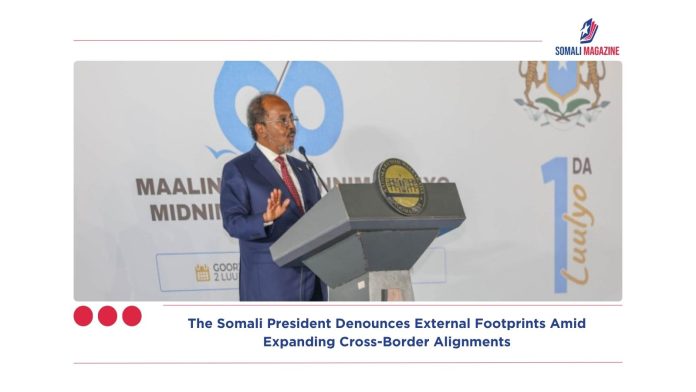
The Somali President has delivered a stern warning to international actors, asserting that external geopolitical powers have no legitimate footprint on the nation’s territory amid rapidly unfolding regional developments. Speaking in a televised address from Mogadishu in mid-2026, the head of state strongly condemned recent attempts by foreign entities to establish unauthorized security and diplomatic frameworks within the northern breakaway region. This sharp rebuke follows a series of unprecedented diplomatic developments in which international actors extended formal recognition to the autonomous administration in Hargeisa. The federal government has categorically rejected these unilateral accords, labeling them a direct violation of international law and a flagrant disregard for the country’s unified boundaries. Authorities in Mogadishu have engaged global bodies, including the United Nations and the African Union, to reaffirm international consensus on the nation’s strict territorial integrity.
This escalating diplomatic dispute marks a profound shift in the volatile geopolitical landscape of the Horn of Africa, introducing fresh cross-border complexities to an already unstable maritime corridor. Observers note that the growing alignment between the northern administration and external states involves potential maritime monitoring access along the critical Gulf of Aden. The Somali President cautioned that permitting foreign militaries to establish forward operational nodes or intelligence infrastructure risks dragging the domestic population into wider Middle Eastern proxy conflicts. According to official warnings, introducing highly controversial global rivalries to the coastal zone could trigger dangerous retaliatory strikes from opposing regional factions, which would inevitably jeopardize hard-won counter-terrorism achievements against local insurgent cells. The federal executive reaffirmed that while Mogadishu has continuously prioritized peaceful dialogue to resolve internal governance disputes with the northern territory, it will fiercely resist any foreign exploitation of these domestic divisions.
In response to these shifting security dynamics, the central government has rapidly fortified its strategic partnerships with historical allies to project a unified defensive posture. The administration recently finalized expansive maritime defense and resource management agreements with key international partners, providing a robust legal counterweight to unauthorized regional deals. Analysts emphasize that the maintenance of regional stability depends heavily on the preservation of established sovereign borders rather than the creation of localized proxy states. As high-stakes diplomatic consultations continue behind closed doors, the federal administration remains resolute in its refusal to accept any fragmentation of its ancestral domain. Ultimately, the long-term stabilization of this strategic Red Sea junction will depend on whether global stakeholders respect domestic legal frameworks or continue to pursue destabilizing unilateral arrangements in defiance of established international consensus.