
Facebook

Twitter (X)

Instagram

Somali Magazine - People's Magazine
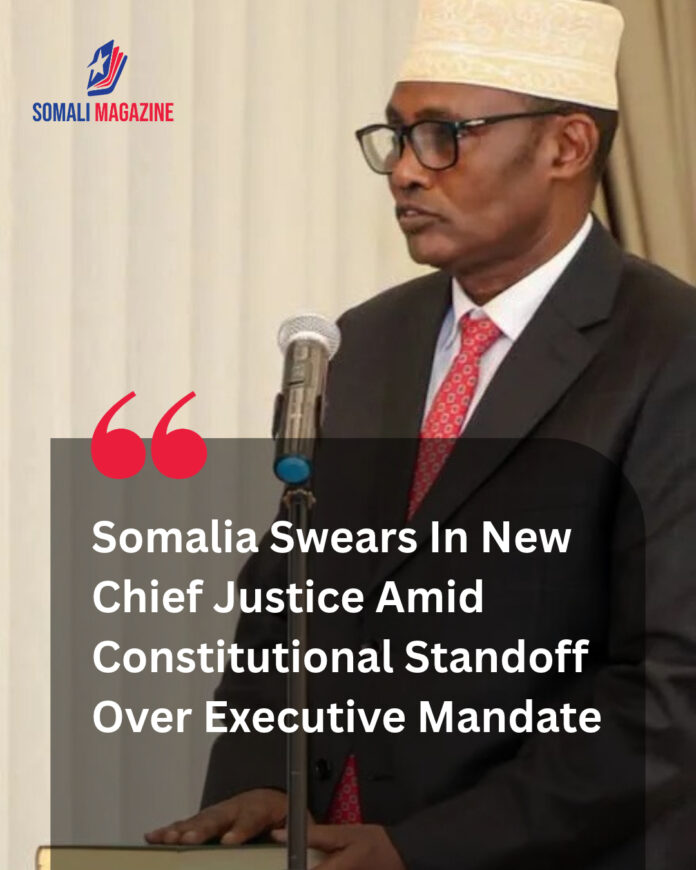
In a high-stakes ceremony held at Villa Somalia, Somalia swears in new Supreme Court chief amid dispute over government’s term, formalizing an administrative shift that has intensified legal friction in Mogadishu. Newly appointed Chief Justice Ibrahim Idle Suleiman took the oath of office before the Somali President, signaling executive determination to proceed with judicial restructuring despite fierce opposition from legal bodies and political coalitions. The swearing-in ceremony follows an executive decree replacing former Chief Justice Baashe Yusuf Ahmed, an action that has ignited a major constitutional confrontation between state institutions.
The judicial transition arrives at a critical juncture, directly intersecting with a broad legal controversy surrounding the mandate of the current administration. Prior to the ceremony, the Supreme Court under the outgoing leadership issued an unprecedented ruling declaring that the legal terms of both the executive branch and Parliament had expired. The judicial panel ruled that post-mandate administrative decisions were unconstitutional and ordered political stakeholders to negotiate a consensus-based electoral roadmap. However, government officials rejected the ruling, maintaining that statutory term adjustments enacted by Parliament remain valid to preserve operational continuity.
The appointment has drawn severe criticism from opposition coalitions and civil society representatives, who argue that replacing judicial leadership while a constitutional challenge is underway undermines judicial independence. Opponents point to the deployment of security forces near judicial compounds following the court’s verdict as evidence of executive overreach. Conversely, government spokespersons stated that the leadership change was necessary to address structural complaints within court management and to ensure smooth institutional governance across national legal bodies.
As Somalia swears in new Supreme Court chief amid dispute over government’s term, legal scholars and international partners are watching the situation closely to assess the impact on governance and the rule of law. Stakeholders continue to urge both executive leadership and political factions to pursue dialogue and resolve constitutional ambiguities through established legal channels. Moving forward, the primary focus remains on whether the newly installed judicial leadership can navigate the escalating constitutional dispute while restoring institutional alignment across the federal government.