Facebook

Twitter (X)

Instagram

Somali Magazine - People's Magazine
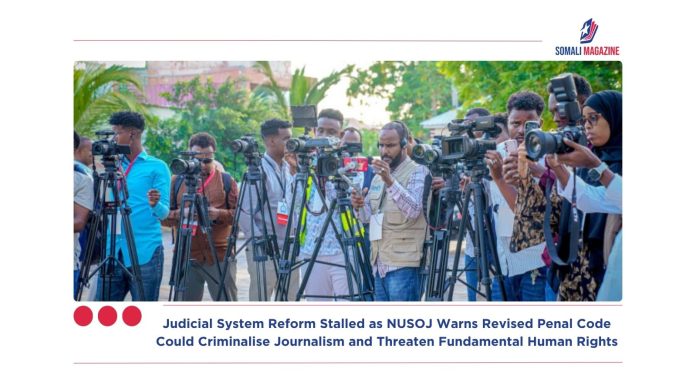
NUSOJ warns revised penal code could criminalise journalism and threaten fundamental human rights following a contentious federal push to implement updated statutory guidelines that media groups argue heavily restrict independent reporting. The high-profile critique, issued formally by the National Union of Somali Journalists, underscores deep anxieties over the survival of an objective press and the steady shrinking of civic space within the country. Media monitors assert that rather than modernizing the judicial system, the proposed legislative updates risk formalizing broad punitive measures traditionally used to suppress public-interest scrutiny. Prominent independent human rights organizations have aligned with the union’s stance, pointing out that broad statutory interpretations of “national security” could easily be leveraged to arrest reporters investigating institutional wrongdoing. Local legal observers emphasize that clear statutory boundaries are required to maintain a balanced democratic framework and protect the media from arbitrary state overreach.
The systemic threat to independent reporting surfaces amidst an atmosphere of heightened legal uncertainty, where specialized regional prosecution teams frequently rely on outdated statutes to penalize critical investigative journalism. For decades, courts across various administrations have continuously implemented archaic elements of the 1964 Penal Code to process criminal indictments against media professionals. Legal reform experts highlight that the proposed statutory revisions fail to repeal these problematic colonial-era mechanisms, instead introducing vague clauses that target digitized speech and independent civic movements. This legislative continuity has fueled widespread judicial transparency concerns, as arbitrary state enforcement has historically allowed predatory actors within law enforcement networks to operate with total impunity. Media advocates note that without explicit protective carve-outs for working journalists, the updated framework will only serve to legitimize targeted legal harassment and systemic media censorship.
The unfolding legislative dispute remains a critical test for the protection of freedom of expression, an essential constitutional guarantee that underpins the nation’s fragile transition toward long-term institutional stability. According to comprehensive annual monitoring data, local security forces remain the primary perpetrators of media freedom violations, frequently obstructing field reporting on delicate land disputes, political friction, and security operations. By expanding the state’s capacity to penalize critical reporting under the guise of statutory updates, the central administration risks severing vital channels of civic transparency and international accountability. As legislative committees convene behind closed doors to finalize the legal text, international watchdogs continue to urge federal policymakers to completely align the penal statutes with global human rights conventions. The ultimate resolution of this regulatory battle is widely regarded by regional observers as a definitive marker for the future of democratic governance across the Horn of Africa.