Facebook

Twitter (X)

Instagram

Somali Magazine - People's Magazine
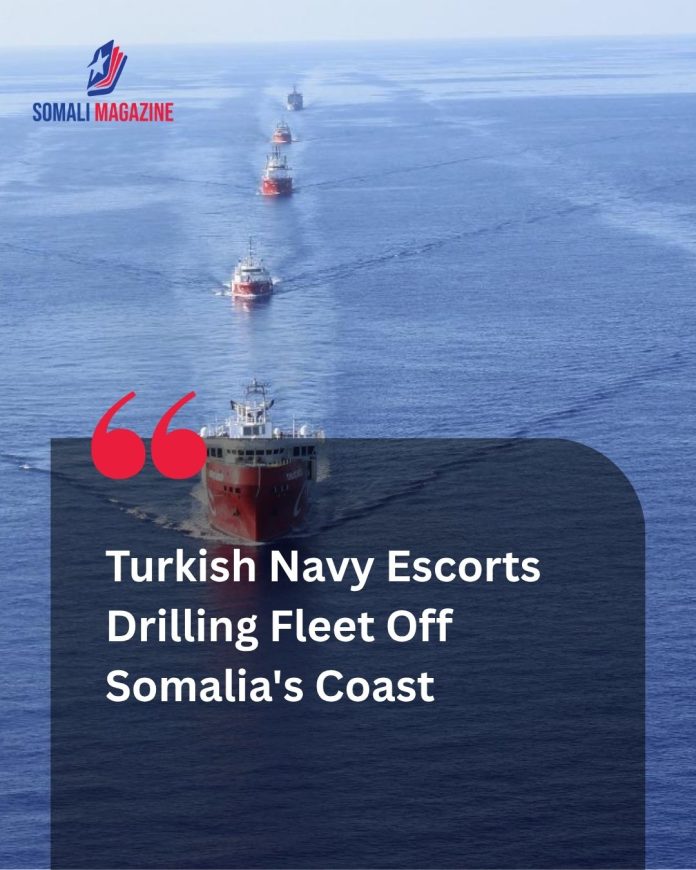
In a major milestone for Horn of Africa energy development, Turkish naval vessels escort drilling fleet off Somalia to secure deep-sea hydrocarbon exploration operations within the nation’s exclusive economic zone. Türkiye’s Ministry of National Defense confirmed that warships deployed under the Somalia Naval Task Group—including the frigates TCG Goksu, TCG Gelibolu, and the corvette TCG Bartin—are actively guarding the deep-water drilling ship Cagri Bey. The naval escort also encompasses specialized maritime support vessels Korkut, Altan, and Sancar as the fleet executes mission tasks offshore. The military deployment establishes a protective perimeter around the strategic exploration fleet, safeguarding ongoing energy operations against potential maritime security threats, piracy risks, and regional instability in ocean waters.
The security mission directly supports drilling activities at the Curad-1 oil well, located approximately 372 kilometers northeast of Mogadishu. Managed by state-owned energy enterprise Turkish Petroleum, Curad-1 represents the first official offshore oil well drilled in Somali territorial waters. Engineers project the well will reach an impressive depth of nearly 7,500 meters, positioning it among the deepest offshore drilling projects currently underway globally. The drilling phase follows extensive three-dimensional seismic surveys conducted across three offshore blocks by the Turkish research vessel Oruç Reis. Somali energy officials anticipate receiving initial geological evaluation results from the Curad-1 site by the end of 2026, marking a prospective turning point for the nation’s economic trajectory.
The naval protection deployment highlights the deepening bilateral defense and economic alignment between Ankara and Mogadishu. The ongoing maritime operation coincides with executive steps by Turkish President Recep Tayyip Erdogan requesting parliamentary authorization to extend Türkiye’s military mandate in Somalia for an additional two years. Under long-standing bilateral agreements covering military training, defense technology, and maritime security, Turkish armed forces have provided crucial advisory and technical assistance to rebuild Somali national defense institutions. Federal officials in Mogadishu emphasized that while national security forces continue expanding operational capacity, international naval partnerships remain essential to protect offshore economic infrastructure and vital maritime trade routes.
By combining naval defense capabilities with advanced offshore energy expertise, the joint initiative reflects a broader strategy to establish durable stability across the Horn of Africa. Turkish officials reaffirmed that state-owned drilling assets will continue operating under structured production-sharing frameworks designed to yield long-term economic benefits for both sovereign partners. As technical teams advance drilling operations toward target depths over coming months, the presence of naval escorts underscores the critical intersection of energy security, state sovereignty, and international defense cooperation in East African waters.