
Facebook

Twitter (X)

Instagram

Somali Magazine - People's Magazine
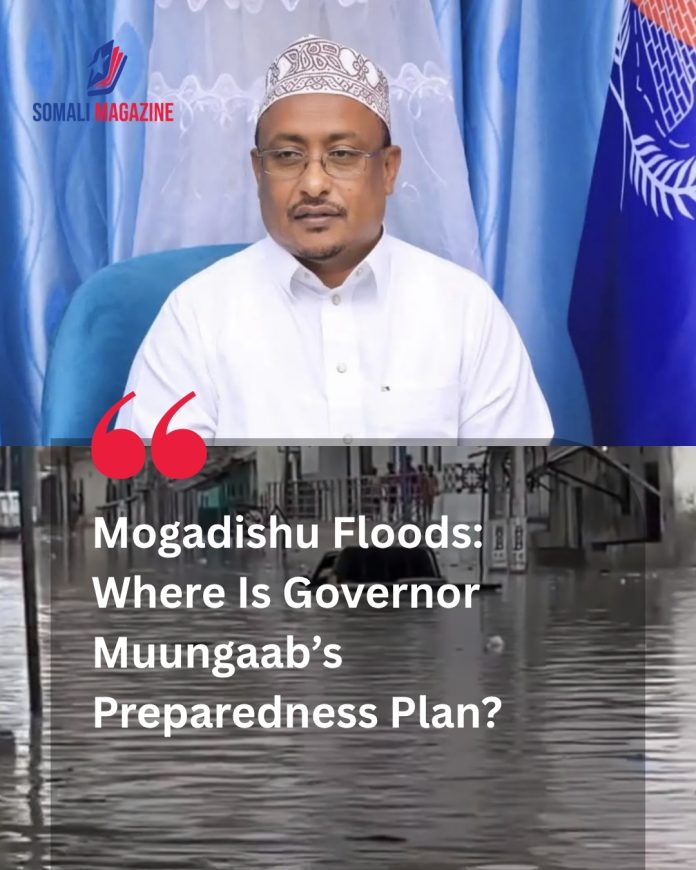
Two days of paralysis. A capital unable to move. A governor who must now answer the public.
Mogadishu has not simply received heavy rain.
For two consecutive days, the capital has struggled to function.
Workers have been unable to reach their offices. Businesses have lost working hours. Roads have become difficult to navigate. Vehicles are stranded, and residents are being forced to deal with waterlogged streets simply to move around their own city.
For the people of Mogadishu, this is not a theoretical climate discussion.
This is their daily life being disrupted in real time.
And the person responsible for the municipal administration of the capital is Hassan Mohamed Hussein “Muungaab,” Mayor of Mogadishu and Governor of Benadir.
Nobody is asking Governor Muungaab to stop the rain.
The question is much simpler:
What did his administration do to prepare Mogadishu for it?
THIS IS WHERE ACCOUNTABILITY BEGINS
Heavy rainfall can overwhelm any city.
But Mogadishu has a history of flooding, and the city already knows where its vulnerabilities are.
In May 2025, extreme rainfall produced devastating flash floods across the capital. SoDMA recorded rainfall of between 95 and 120 millimeters and reported widespread disruption to transportation and daily life. Six major roads were submerged, while homes and infrastructure were damaged.
At least seven people died in that disaster, according to Reuters and other reporting, while hundreds of families were affected.
That was not a warning from the future.
It already happened.
So what changed?
Were drainage systems substantially upgraded?
Were the worst flood zones systematically addressed?
Were emergency pumps acquired?
Were critical roads redesigned or protected?
Were drainage channels maintained before this year’s rains?
Where is the publicly available preparedness plan?
These are the questions Governor Muungaab should answer.
Not because a governor controls the weather.
Because a governor controls municipal priorities.
THE EXCUSE OF “IT WAS HEAVY RAIN” IS NOT ENOUGH
Of course the rainfall matters.
Of course extreme weather creates challenges.
But government exists precisely because communities face challenges that individuals cannot solve alone.
A resident cannot build a drainage system.
A shopkeeper cannot redesign a major road.
An office worker cannot install emergency pumps across the city.
These are responsibilities that require public institutions.
When the streets become impassable and thousands of people cannot reach work, the administration cannot simply point toward the sky.
The rain came from the sky. The infrastructure is the responsibility of government.
AND THE NEXT TEST IS ALREADY COMING
The timing makes this even more serious.
Authorities have warned about heightened flood risks associated with El Niño and the coming Deyr season.
FAO has warned that October–December 2026 could bring significant flooding, with the probability of above-normal seasonal rainfall reaching as high as 90 percent in parts of Somalia. It has also urged early preparation before the rains intensify.
The Benadir administration itself has issued warnings about the potential impact of Super El Niño.
So there is no shortage of warnings.
There is no shortage of history.
There is no shortage of evidence that Mogadishu is vulnerable.
What is missing is a visible demonstration that the city has learned from the past.
MUUNGAAB CANNOT WAIT FOR ANOTHER DISASTER
Governor Muungaab should come before the public and explain the city’s preparedness.
How much money has been allocated to flood prevention?
How many drainage systems have been rehabilitated?
How many have actually been cleaned and maintained?
How many emergency pumps are operational?
Which neighborhoods are considered high risk?
What emergency response mechanism exists for major roads?
What is the plan to keep hospitals, government institutions and major commercial areas accessible?
And if the coming Deyr rains are heavier than normal, what happens then?
The public deserves specific answers—not slogans.
MOGADISHU DESERVES A GOVERNMENT THAT PREPARES
A capital city should not discover its weaknesses every time the clouds open.
The 2025 floods exposed the vulnerabilities.
The current disruption is exposing them again.
The forecasts are now warning that the coming months could bring additional danger.
That leaves the administration with a choice: treat these events as temporary inconveniences, or finally confront the infrastructure and planning problems that make every major rainfall a crisis.
This is not about politics.
It is about roads.
Drainage.
Emergency response.
Public safety.
Economic activity.
And accountability.
Governor Muungaab cannot control the rain.
But he can be held accountable for what his administration does before, during and after it.
And after two days in which thousands of residents have struggled simply to get to work, the people of Mogadishu have every right to ask:
MUUNGAAB, WHERE IS YOUR PLAN?
The clouds are warning us. The streets are warning us. History is warning us.
The question now is whether Mogadishu’s leadership is listening.