
Facebook

Twitter (X)

Instagram

Somali Magazine - People's Magazine
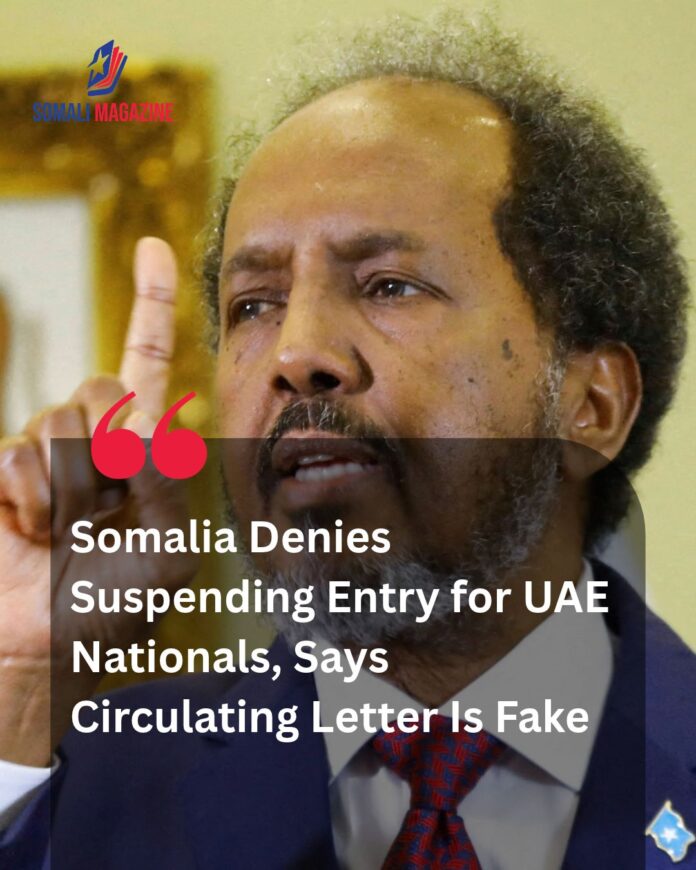
Amid heightened diplomatic tensions between Mogadishu and Abu Dhabi, Somalia denies suspending entry for UAE nationals, says circulating letter is fake after a forged document claiming to restrict travel went viral online. According to official clarifications reported on Saturday, November 21, 2026, the Director General of Somalia’s Immigration and Citizenship Agency, Hussein Qaasim Yusuf, stated that a widely shared notice purporting to bar Emirati passport holders from entering the country was entirely fabricated. The fraudulent letter, which bore a forged signature under the director general’s name, claimed that airlines operating flights into Somalia had been instructed not to board affected passengers without prior clearance. In remarks dismissing the document, Yusuf emphasized that no such directive had been issued by the immigration agency and noted that regulatory decisions governing commercial airline operations fall under the mandate of Somalia’s civil aviation authority.
The fake circular began spreading rapidly across social media platforms just days after diplomatic relations between Somalia and the United Arab Emirates deteriorated sharply. Earlier in the week, President of Somalia Hassan Sheikh Mohamud accused the UAE in a televised address of undermining Somalia’s national unity and sovereignty. On Wednesday, Somalia’s Ministry of Foreign Affairs reiterated its rejection of what it described as continued Emirati interference and stated that Mogadishu would take lawful measures to safeguard its sovereignty, though the ministry announced no restrictions on civilian travel. By Thursday, Somalia’s cabinet had ordered the UAE ambassador in Mogadishu to depart within 72 hours and recalled its own envoy from Abu Dhabi, prompting the Emirati foreign ministry to condemn Mogadishu’s approach as escalatory and hostile.
Federal officials noted that even during previous diplomatic ruptures earlier in 2026—when Somalia’s cabinet annulled bilateral port, security, and defense agreements with the UAE and restricted Emirati military and cargo aircraft from Somali airspace—civilian travel by Emirati citizens was never suspended. Immigration authorities warned travelers, airlines, and members of the public to rely strictly on verified government channels rather than unauthenticated documents circulating on social media during periods of heightened political friction. Meanwhile, the UAE government has also emphasized that its dispute with federal authorities in Mogadishu does not alter its appreciation for ordinary citizens, including the large Somali diaspora community residing in and traveling through the Emirates.
As Somalia denies suspending entry for UAE nationals, says circulating letter is fake, media observers point out that geopolitical crises in the Horn of Africa are increasingly accompanied by online misinformation capable of disrupting commercial aviation and public clarity. While formal diplomatic channels between Mogadishu and Abu Dhabi remain strained following Thursday’s ambassadorial expulsions, Somali authorities confirmed that standard immigration entry procedures for civilian travelers remain unchanged.