
Facebook

Twitter (X)

Instagram

Somali Magazine - People's Magazine
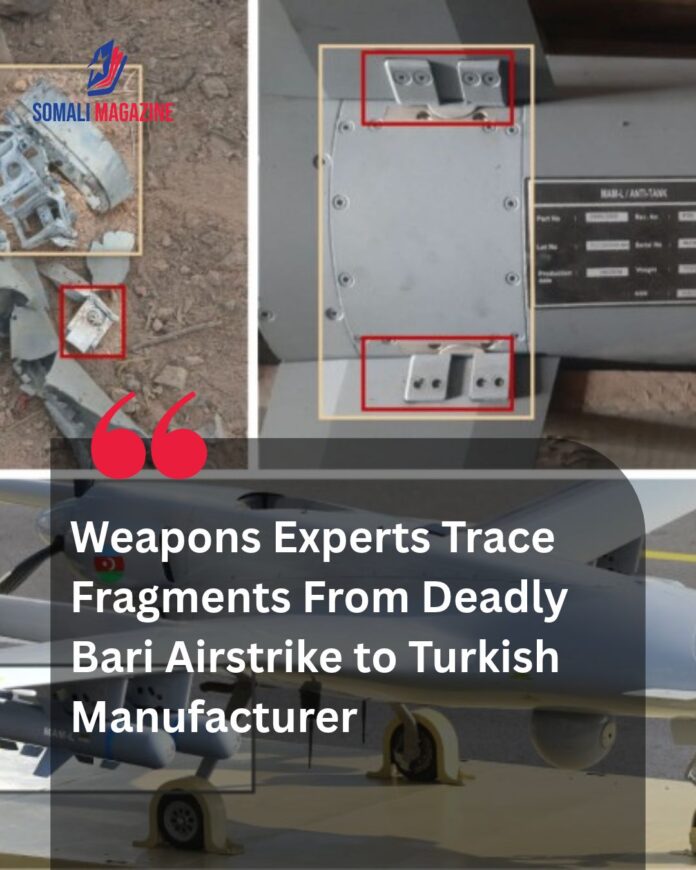
Forensic examination of munition fragments recovered from northeastern Somalia has traced the weapons used in a fatal strike earlier this year to Turkish defense manufacturing, as Turkish-made missiles identified in deadly Somalia airstrike, investigation finds in newly published reporting. According to an investigation published by The Guardian and cited in regional reports on Wednesday and Thursday, November 25–26, 2026, independent weapons researchers analyzed photographs of shattered missile casings retrieved in Baxaya, a locality in the Golis Mountains of Somalia’s Bari region. The May 21, 2026 strike killed a pregnant woman and her three children while leaving their father wounded.
Munitions specialists Trevor Ball and N.R. Jenzen-Jones of Armament Research Services examined the physical characteristics and technical markings on two missile remnants found at the scene. Based on their assessment, the experts concluded that the fragments originated from MAM-series precision-guided munitions produced by the Turkish state-owned defense company Roketsan. Jenzen-Jones noted that the recovered remnants were consistent with an attack launched by an unmanned aerial vehicle, most likely a Turkish-built Bayraktar TB2 drone. However, the investigators emphasized that identifying the origin and manufacturer of the munitions does not establish which military force operated the aircraft or authorized the May 21 operation. No government had publicly claimed responsibility for the Baxaya strike at the time the findings were released.
The findings add to broader scrutiny surrounding remote drone operations and civilian harm across Somalia’s protracted conflict. Bayraktar TB2 drones and Roketsan MAM-series munitions have been documented in Somalia since 2022 as part of expanded security and counterterrorism cooperation between Ankara and Mogadishu against militant groups operating in southern, central, and northeastern regions. Over the past two years, international rights monitors and local communities have repeatedly called for greater transparency, independent investigations, and clear command-and-control accountability when airstrikes result in civilian casualties. Security analysts note that while unmanned aerial systems provide long-range surveillance and strike capabilities in rugged terrain such as the Golis Mountains, verifying target intelligence and distinguishing combatants from civilians remain critical obligations under international humanitarian law.
As Turkish-made missiles identified in deadly Somalia airstrike, investigation finds, the Baxaya case highlights the evidentiary role that physical debris analysis plays in documenting otherwise unacknowledged aerial strikes. Neither federal authorities in Mogadishu, regional officials in Puntland, nor the Turkish government had issued an official comment addressing the forensic findings on the May 21 strike as of Thursday, leaving the chain of command behind the attack unconfirmed.