Facebook

Twitter (X)

Instagram

Somali Magazine - People's Magazine
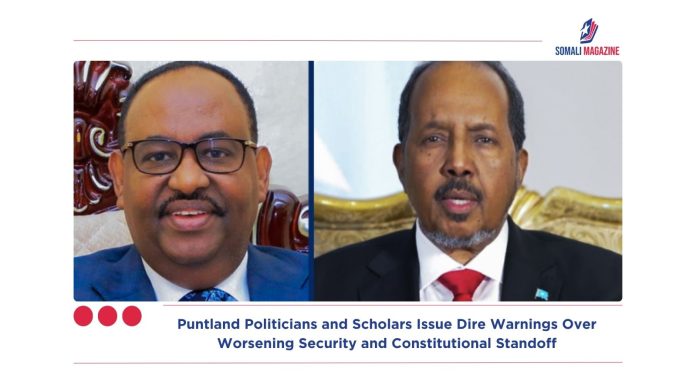
A prominent coalition of Puntland politicians and scholars has issued a stark warning regarding the rapidly deteriorating relationship between the regional administration in Garowe and the Federal Government of Somalia. In a series of joint declarations and academic panels held on Wednesday, civil society leaders, constitutional lawyers, and opposition figures expressed deep alarm over worsening political and security tensions that threaten to plunge the semi-autonomous northeastern region into a localized armed conflict. The intellectuals emphasized that the continuous collapse of institutional communication between Mogadishu and federal member states has reached a dangerous tipping point, directly compromising long-term regional stability, economic confidence, and vital local counterterrorism campaigns.
The latest anxieties are driven by aggressive regional military deployments and parallel command structures crystallizing along key strategic transport corridors. Over the weekend, Puntland authorities heavily reinforced security checkpoints outside major urban centers, including Bosaso, Galkayo, and the capital city of Garowe, explicitly ordering local units to restrict the movement of federal forces stationed within the territory. This tactical escalation followed Mogadishu’s unilateral appointment of a controversial military commander to oversee the Somali National Army’s 54th Division based in Garowe. Puntland-aligned figures view the appointment as a direct effort by the central government to undermine local security architectures, while federal authorities maintain that national military assignments fall strictly within the constitutional purview of the executive branch.
Beyond the immediate military standoff, the underlying friction centers on a deep constitutional crisis regarding the future direction of the national electoral framework. Intellectuals and legal scholars noted that the federal parliament’s unilateral approval of sweeping constitutional amendments—which extended presidential mandates and shifted power away from the traditional clan-based system—lacks cross-regional legitimacy. In response to what they characterize as authoritarian overreach, regional leaders alongside the newly formed Somalia Future Council have threatened to initiate parallel political processes to protect their autonomy. The panel of experts warned that without a swift return to a inclusive, consensus-based electoral process, the nation risks unprecedented administrative fragmentation.
The group concluded by urging the international community and traditional elders to step in as neutral mediators before the current political brinkmanship devolves into open urban warfare. Security analysts have warned that a prolonged domestic standoff creates dangerous security vacuums that extremist organizations like Al-Shabaab and Islamic State factions are actively waiting to exploit. As regional state heads continue to suspend ties with the central capital, Puntland’s academic and political elite stress that preserving the federal system and preventing a total security breakdown requires an immediate cessation of unilateral military maneuvering and a genuine commitment to comprehensive dialogue.