Facebook

Twitter (X)

Instagram

Somali Magazine - People's Magazine
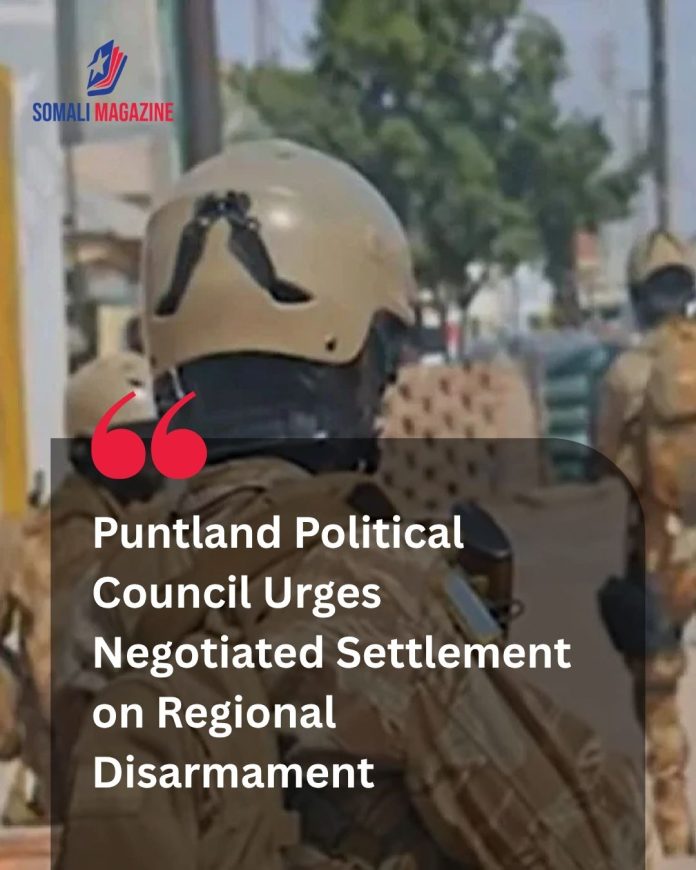
Amid heightened security friction across northeastern Somalia, the Puntland political council calls for dialogue and consensus on disarmament to prevent further military escalation in the region. In an official consultative statement released in Garowe, the council emphasized that any initiative aimed at collecting weapons or disarming armed units must rely on inclusive public consultation and broad social agreement rather than unilateral executive mandates. Political leaders and regional stakeholders urged the Puntland administration to directly engage traditional elders, religious scholars, intellectuals, and business leaders before carrying out additional security sweeps.
The call for political mediation comes after recent military confrontations in regional urban centers, including Galkayo and Bosaso, where local defense forces took control of bases occupied by units aligned with the Federal Government of Somalia. Regional authorities under President Said Abdullahi Deni subsequently issued ultimatums requiring federal-aligned personnel to surrender their heavy weaponry and integrate into Puntland security forces. In response, opposition politicians and civil society representatives warned that uncoordinated disarmament efforts risk triggering wider communal instability and deepening the political rift between federal and state institutions.
A primary focus of current reconciliation talks involves resolving the military standoff in the Kodmo area within the Bari region, where federal-aligned troops have reportedly resisted directives to surrender their arms to regional authorities. Clan elders from the Bari, Nugal, and Mudug regions have stepped in to facilitate negotiations between local military commanders and Puntland state officials, seeking to establish peaceful integration protocols before regional deadlines expire. Political analysts observe that negotiated settlements remain the most viable pathway to stabilize contested security infrastructure and maintain public confidence.
Federal authorities in Mogadishu have maintained a cautious stance as political mediation efforts unfold across the state. Meanwhile, civil society groups reiterate that security sector reforms require transparent frameworks to avoid creating power vacuums that insurgent groups could exploit. As traditional elders continue dialogue in Garowe, the council’s declaration highlights the delicate balance between state authority and community-led consensus during periods of political fragmentation.