
Facebook

Twitter (X)

Instagram

Somali Magazine - People's Magazine
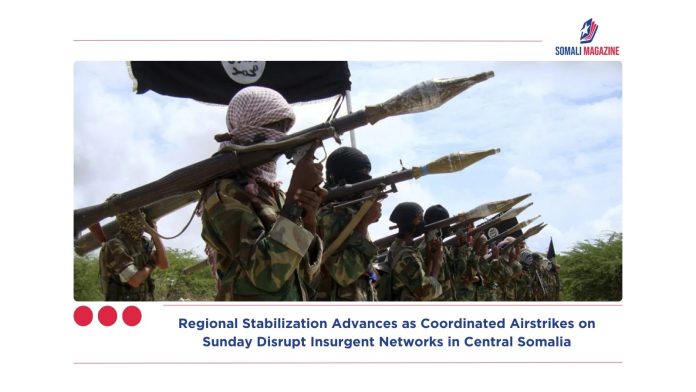
The execution of highly targeted coordinated airstrikes on Sunday has dealt a severe blow to extremist networks operating within the volatile pockets of central Somalia as federal forces accelerate their sweeping counter-insurgency offensive. According to an official press release issued by the Ministry of Defence in Mogadishu, the joint aerial operation was conducted by the Somali National Army in close alignment with designated international security partners. The precise kinetic engagements successfully neutralized twenty-six active al-Shabaab fighters who had gathered across strategic rural installations, including the remote areas of Addow Jilib, Gayfo, and Qordhere. Military representatives confirmed that the high-stakes deployment focused heavily on active mobilization centers where insurgent elements were actively organizing asymmetric maneuvers designed to disrupt civilian trade corridors and compromise local state security frameworks.
Beyond inflicting substantial personnel casualties, the tactical assets deployed during the mission successfully obliterated key logistical equipment utilized by the militant group to sustain its operations. Ground intelligence reports verified that the strikes entirely destroyed a heavily modified utility vehicle, commonly known locally as an “Abdi-bile,” alongside a specialized fuel tanker that authorities stated was critical for powering mobile insurgent units. Defense officials emphasized that neutralizing these specialized transport assets effectively paralyzes the group’s short-term mobility, denying them the capability to transport heavy weaponry or launch sudden cross-border incursions against nearby defensive bases. The ongoing campaign reflects an evolving national military strategy that prioritizes the systemic degradation of the adversary’s logistical networks before committing frontline infantry forces to physical clearing operations.
The volatile Middle Shabelle region remains a primary focal point for joint security maneuvers due to its dense network of rural sanctuaries and its proximity to major transit routes leading directly toward the national capital. Regional administrators have consistently maintained that liberating these agricultural hubs is foundational to securing long-term economic stability and re-establishing comprehensive federal governance. While independent verification of exact field statistics remains structurally challenging due to the remote nature of the terrain, the central government has strongly reiterated its institutional commitment to pursuing insurgent leaders and weakening their broader administrative infrastructure. This latest aerial victory serves as an essential safety mechanism for regional communities, shielding agricultural populations from illegal taxation networks and forced recruitment drives.
As the armed forces continue to consolidate their control over the central provinces, security analysts observe that sustaining this aggressive operational tempo is crucial as continental peacekeeping frameworks undergo a gradual transition. The capacity of the domestic defense apparatus to manage complex airborne and ground-level intelligence operations independently is viewed as a vital benchmark for sustainable state-building. With further joint counter-terrorism efforts anticipated in the coming weeks, the strategic precision displayed during the recent weekend deployments signals a resolute collective effort to neutralize extremist threats and foster long-term developmental progress across the evolving federal member states.