
Facebook

Twitter (X)

Instagram

Somali Magazine - People's Magazine
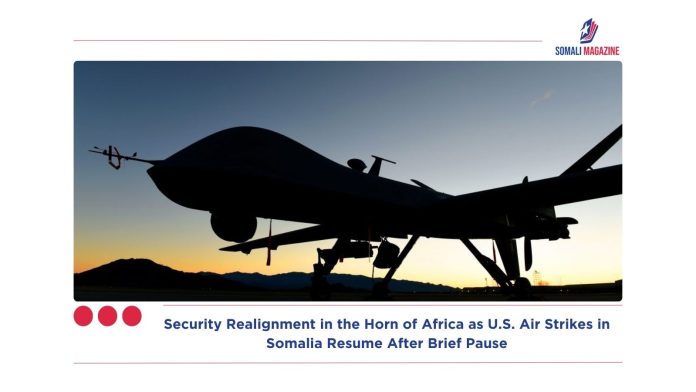
U.S. air strikes in Somalia have officially resumed following a brief operational pause, signaling a renewed momentum in the long-standing military partnership between Washington and Mogadishu. According to formal communiques released by United States Africa Command, a series of precisely coordinated kinetic engagements were executed during mid-June across the lower Juba region to disrupt active insurgent maneuvers. The recent operations included tactical aerial bombardments in the vicinity of Route 109 near Kismayo Airport, as well as separate targeted actions near the town of Welmaro. These synchronised deployments, conducted in close coordination with the Federal Government of Somalia and the Somali National Army, represent the most significant wave of aerial counterterrorism operations observed in the territory over the past quarter. Military planners emphasized that the primary objective behind these sudden engagements remains the systematic degradation of al-Shabaab militant networks and the preservation of regional security structures.
The resumption of these aerial campaigns follows an unpublicized tactical reassessment period during which external monitoring groups observed a temporary reduction in American kinetic activity across the Horn of Africa. Security experts suggest that this operational pause allowed joint intelligence teams to thoroughly verify high-value targets, update localized threat assessments, and reinforce strict civilian casualty mitigation protocols. The United States Africa Command maintained its standard protocol of withholding specific details regarding the exact aerial assets and special forces units involved to protect ongoing operational security in the field. However, early assessments published by defense officials indicate that the latest strikes successfully eliminated multiple active combatants without inflicting injuries or casualties on nearby civilian populations. This emphasis on precise targeting remains a critical component of the broader campaign, as international oversight bodies continue to closely monitor the humanitarian impact of foreign military interventions within the country’s borders.
The shifting operational landscape arrives at a crucial juncture as local authorities prepare to assume greater independent responsibility for national defense. With African Union transition forces gradually drawing down their territorial presence, the reliance on advanced foreign surveillance and air support has become increasingly vital for maintaining control over liberated zones. Local administrative leaders in the Juba regions welcomed the defensive air cover, noting that the strikes help prevent extremist factions from massing forces to launch large-scale asymmetric attacks against vulnerable municipal centers. Furthermore, the strategic focus extends to northern Somalia, where separate air operations earlier this year targeted Islamic State factions hidden deep within the rugged terrain of the Golis Mountains. By maintaining a dual-front pressure campaign, the combined forces hope to suppress the recruitment capabilities and financial supply lines of both major insurgent networks.
As the security environment remains fluid, diplomatic figures stress that sustainable stability will ultimately require a comprehensive approach combining military pressure with deep institutional reforms. The Federal Government of Somalia continues to prioritize the stabilization of newly recovered territories, deploying community police forces and initiating local governance frameworks to fill the vacuums left by retreating militants. Observers note that while U.S. air strikes in Somalia provide an indispensable shield for advancing ground troops, the long-term success of the counterterrorism operations depends heavily on building resilient national frameworks capable of enforcing the rule of law independently. For now, the reactivation of American aerial support delivers a clear message to regional adversaries, demonstrating that despite shifting global priorities, the commitment to securing the volatile Horn of Africa remains a core objective for international defense partners.