
Facebook

Twitter (X)

Instagram

Somali Magazine - People's Magazine
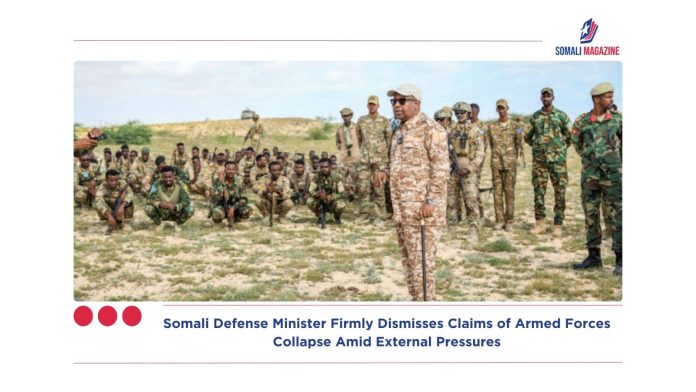
The Somali defense minister has formally dismissed assertions regarding the institutional breakdown of the national armed forces, speaking directly from frontline operational zones amid mounting international financial shifts. Defense Minister Ahmed Moallim Fiqi addressed these concerns during a prominent tour of the El-Dher district within the Galgaduud region, where he directly engaged with forward-deployed combat units. His public statements follow an explicit announcement by the United States indicating an impending cessation of logistical funding contributions routed through the United Nations Support Office in Somalia. According to regional defense analysts, this sudden geopolitical development has placed fresh scrutiny on the long-term sustainability of local security structures as multilateral frameworks undergo rapid transformation. Despite these complex external developments, government representatives have reiterated that national troops remain fully engaged in executing critical counter-terrorism operations without any disruption.
The evolving situation traces back to a diplomatic notification wherein Washington outlined a firm decision to terminate specific financial support mechanisms by the conclusion of the current calendar year. This intense U.S. funding pressure primarily impacts resource allocations traditionally utilized by the African Union peacekeeping mission, an entity that has long served as a critical operational partner for domestic forces. Senior international diplomats have indicated that without this essential framework, regional security initiatives could face pronounced operational friction, prompting the African Union to convene an extraordinary emergency session to assess its long-term strategic posture. U.S. officials cited persistent institutional divisions and delayed security sector reform as core factors influencing the policy redirection, arguing that international aid must yield more self-sustaining governance structures. This sharp critique has naturally intensified the ongoing political debate within the nation regarding security ownership, resource management, and the immediate future of frontline military engagements.
Faced with these multi-layered challenges, the Somali defense minister emphasized that domestic military personnel possess the resilience, capability, and morale necessary to defend national sovereignty independently. Military command leadership accompanying the high-level defense delegation reinforced this message, emphasizing that tactical structures remain entirely intact and actively prepared to scale up independent field campaigns against insurgent groups. While some internal opposition groups have expressed concern that sudden funding withdrawals might jeopardize recent territory gains, the federal administration continues to urge absolute public solidarity with the active armed forces. Independent security experts note that while the impending logistical transition presents an undeniably steep hurdle for the country, it simultaneously accelerates the imperative for sovereign institutional self-reliance. As the strategic timeline approaches its critical year-end juncture, the overarching focus remains squarely on the ability of the national command to successfully absorb these sudden geopolitical shocks while preserving military sector stability across liberated provinces.