
Facebook

Twitter (X)

Instagram

Somali Magazine - People's Magazine
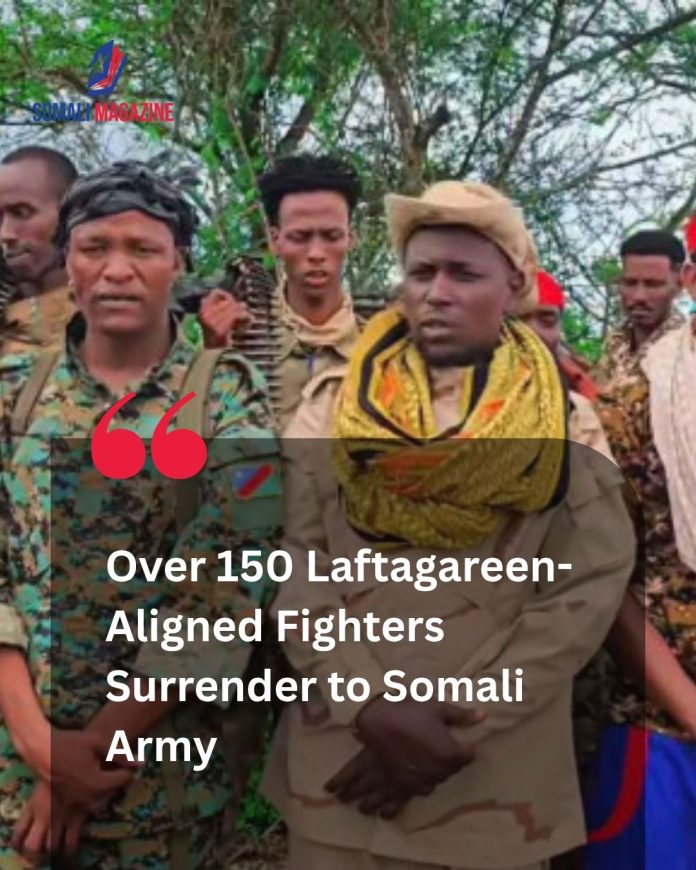
Official security channels in Bay region confirmed significant de-escalation progress after the Defense ministry says Laftagareen-aligned fighters surrender to federal army units deployed across central Southwest State. In a public statement, the Ministry of Defense revealed that approximately 150 combatants previously loyal to former regional president Abdiaziz Hassan Mohamed Laftagareen laid down their arms following successful local mediation efforts. The surrendering force was formally led by Ibrahim Kalaay, the former commissioner of Awdiinle district, who publicly renounced armed resistance alongside his men before integrating into national disarmament protocols. Military officers confirmed that the group surrendered dozens of small arms, heavy crew-served weaponry, and several technical combat vehicles at designated security assembly points situated outside the administrative capital of Baidoa.
The formal capitulation follows months of heightened political friction and intermittent armed skirmishes in the countryside surrounding Baidoa following major leadership transitions within the regional governance structure. Tensions mounted after federal forces established operational control over administrative infrastructure in late March 2026, prompting splinter militia groups aligned with the former administration to maintain defensive positions along key transport corridors. According to military representatives, local community elders and civil society leaders played a pivotal role in facilitating dialogue with Ibrahim Kalaay and his subcommanders, encouraging them to abandon politically motivated combat activities in favor of peaceful integration. Defense officials noted that the surrender significantly reduces operational threats along major transit routes connecting Awdiinle district with broader commercial hubs across the Bay region.
Security analysts view the disarmament as a crucial turning point for regional stabilization efforts as federal authorities work to consolidate administrative authority across Southwest State. The Ministry of Defense reiterated that comprehensive reconciliation programs remain open for remaining armed factions seeking to disarm, emphasizing that the federal government will not tolerate unauthorized weapons that compromise civilian safety. While federal commanders continue negotiation efforts to persuade remaining outlying combatants to disarm, joint security forces have intensified surveillance around every major Baidoa security checkpoint to prevent potential insurgent infiltration or sporadic clashes. Government officials emphasized that integrating former combatants into structured national programs provides a viable pathway toward permanent demobilization while reinforcing public trust in federal security institutions.
Local business leaders and agricultural communities in Awdiinle district welcomed the peaceful resolution, noting that reduced troop movements will facilitate safer commercial transport and agricultural trade across the region. As regional authorities evaluate the broader impact after the Defense ministry says Laftagareen-aligned fighters surrender to federal army divisions, state representatives expressed optimism that the successful surrender of these elements will serve as a functional blueprint for broader demobilization. Moving forward, federal defense institutions maintain that sustained diplomatic engagement alongside structured military integration remains essential to ensuring lasting governance, civil order, and economic resilience for all residents living within Southwest State.