
Facebook

Twitter (X)

Instagram

Somali Magazine - People's Magazine
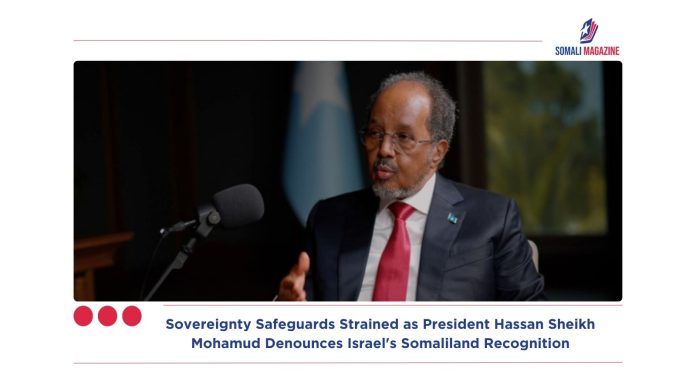
President Hassan Sheikh Mohamud has strongly condemned the State of Israel’s official decision to recognize the breakaway northern region of Somaliland, calling the unexpected foreign policy pivot “one of the darkest days in the history of Somalia”. Speaking in an extensive broadcast interview with Mogadishu-based Dawan TV, the federal leader accused authorities in Tel Aviv of actively exploiting a vulnerable, long-standing internal dispute between the central government and regional actors in Hargeisa. Mohamud asserted that the unilateral diplomatic recognition formalized in late December 2025 does not represent a genuine political breakthrough for the self-declared republic, but rather a strategic calculation aimed at embedding foreign security architecture directly into the Gulf of Aden.
The escalating diplomatic dispute highlights a profound East African geopolitical shift that has immediately drawn widespread condemnation from major multilateral organizations and neighboring states. The Federal Government of Somalia maintains a rigid, long-term policy that considers the northern territory an indivisible component of its sovereign territorial integrity, treating any unapproved foreign state-to-state pacts as a direct breach of its national independence. Mohamud revealed during his briefing that international actors had previously approached the federal capital seeking maritime and security cooperation due to mounting trade vulnerabilities near the Bab el-Mandeb chokepoint. According to the president, Mogadishu explicitly declined the overtures based on humanitarian principles, international law, and its unwavering solidarity with the Palestinian people, prompting external entities to bypass federal authority entirely.
Regional security specialists observe that the ongoing friction could pose significant complications for broader Horn of Africa maritime security and existing stabilization programs. While thousands of residents in Hargeisa reportedly celebrated the bilateral declaration, Mohamud warned that local administrators have fallen into a sophisticated geopolitical trap that could inadvertently drag the wider region into an unnecessary, externalized conflict. The federal administration emphasized that it remains fully committed to its peaceful, three-decade-old framework of internal dialogue and reconciliation over domestic force, though it will aggressively mobilize international legal channels to isolate the unsanctioned diplomatic agreement.
As the United Nations Security Council prepares to review the fluid security landscape following formal complaints lodged by Somali diplomats, major global powers have swiftly moved to reinforce the existing status quo. The United States, the European Union, and the African Union have reissued formal statements backing Mogadishu’s central authority and rejecting the validity of unilateral state partitions. Despite the high-profile exchange of accredited envoys between Israel and the de facto administration in Hargeisa earlier this spring, the federal government maintains that the lack of broader international consensus ensures the controversial maritime arrangement will fail to yield durable, globally recognized sovereign status.