
Facebook

Twitter (X)

Instagram

Somali Magazine - People's Magazine
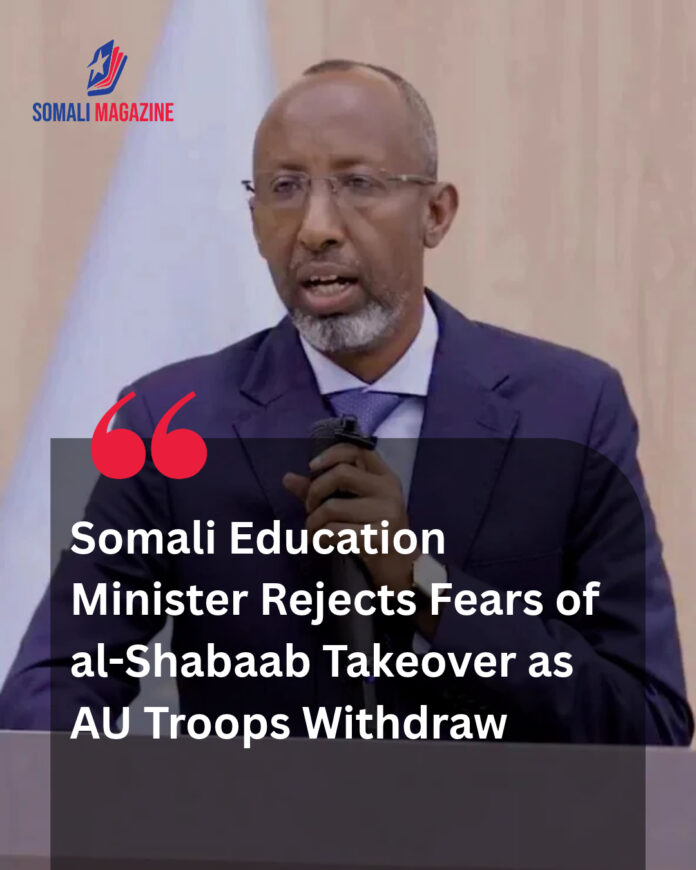
Amid growing public debate over regional security transitions in the Horn of Africa, the Somali education minister rejects fears of al-Shabab takeover as AU troops withdraw while calling on citizens to place greater trust in domestic institutions. Speaking during a public panel discussion held under the theme “What is preventing Somalia’s statehood from strengthening?”, Minister of Education Farah Sheikh Abdulkadir addressed mounting concerns surrounding the scaling back of foreign military deployments. According to reports from the event, the minister dismissed suggestions that the departure of international peacekeepers would lead to a militant resurgence or collapse of state authority, emphasizing instead that sustained public participation and confidence in national security forces remain vital to safeguarding stability.
The remarks come at a pivotal juncture as Somalia prepares to assume greater operational responsibility for areas previously secured by the African Union Support and Stabilization Mission in Somalia, known as AUSSOM. Recently, Uganda—historically one of the largest troop-contributing nations to successive African Union missions in the country—initiated the withdrawal of soldiers deployed under bilateral arrangements and outlined plans to gradually reduce its participation in AUSSOM. Military reports confirm that an initial contingent of Ugandan personnel has already departed Mogadishu as part of a phased drawdown, a development driven in part by persistent international funding shortfalls and logistical strains affecting the peacekeeping mission.
While some security officials and defense analysts have voiced concern over whether the Somali National Army possesses sufficient logistical capacity to immediately fill security gaps across strategic corridors in southern and central Somalia, federal officials maintain that domestic forces are steadily building self-reliance. During the panel discussion, Abdulkadir framed national security as inseparable from broader state-building efforts, institutional governance, and civic unity. He stressed that overcoming longstanding structural challenges requires citizens to actively support state institutions rather than relying indefinitely on external military protection.
As the Somali education minister rejects fears of al-Shabab takeover as AU troops withdraw, the federal government continues to navigate complex security and political pressures across the country. Although al-Shabab retains an active presence in parts of southern and central Somalia and continues to launch sporadic attacks, officials in Mogadishu insist that coordinated domestic operations and ongoing institutional reforms will prevent the group from reversing hard-won territorial gains. Moving forward, defense observers note that the pace of international troop reductions, coupled with the readiness of Somali security forces and sustained logistical backing, will remain critical factors in determining long-term stability during the transition.