
Facebook

Twitter (X)

Instagram

Somali Magazine - People's Magazine
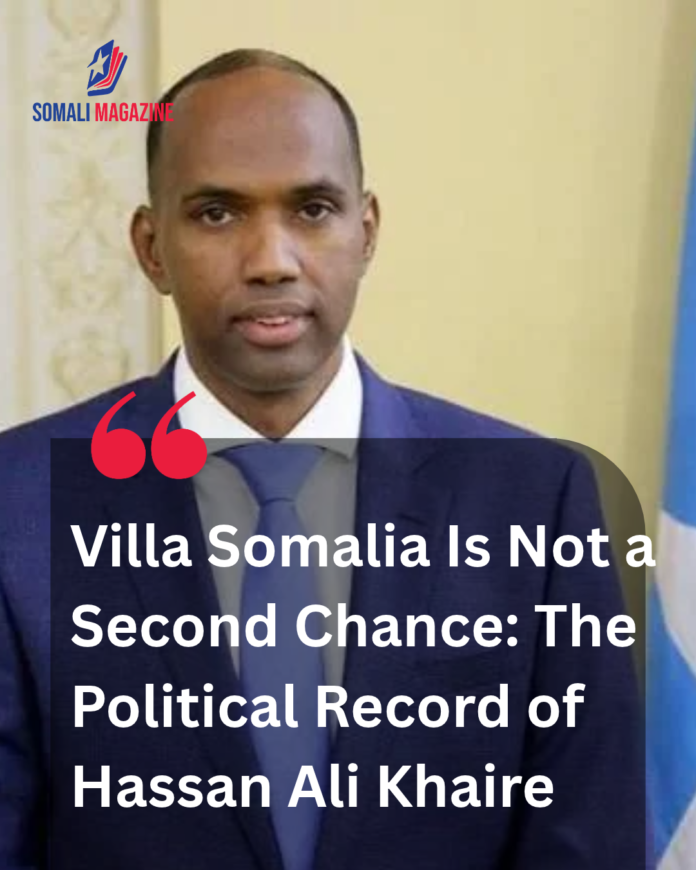
In July 2020, Somalia witnessed one of the fastest political collapses in its modern history. In a matter of seven minutes, 170 members of the House of the People voted to remove Prime Minister Hassan Ali Khaire from office in an overwhelming vote of no confidence. At the time, the speed of his downfall exposed a critical vulnerability: a leader who commands international applause often lacks the domestic trust required to hold a fragile coalition together.
Six years later, amid Somalia’s November 2026 constitutional crisis, Khaire is campaigning for the nation’s highest office. Presenting himself through his Hiigsi & Horumar platform as a modernizing technocrat and defender of constitutional order, he asks Somalis to hand him the keys to Villa Somalia.
Yet a sober examination of his governance record reveals a troubling truth. Electing Hassan Ali Khaire to the presidency would not stabilize Somalia; it would expose the country to severe institutional, federal, and economic danger.
A Proven Threat to Federalism and National Unity
Today, Khaire speaks passionately about defending the constitution and protecting regional autonomy. However, Somalis do not need to guess how he governs when he holds executive power—they lived through it during the Nabad iyo Nolol administration from 2017 to 2020.
Under his premiership, relations between the Federal Government of Somalia and the Federal Member States deteriorated into bitter, destabilizing confrontations. Rather than building consensus with regional leaders in Puntland and Jubaland, his government pursued heavy-handed centralization that fractured national unity and paralyzed political cooperation.
Somalia’s federal system survives on delicate trust and compromise. Returning an architect of federal confrontation to the presidency at a moment when the nation is already deeply divided risks pushing regional tensions past the breaking point.
Institutional Fragility When Leadership Is Tested
The Somali presidency requires a leader who can absorb political shocks, negotiate with rivals, and maintain parliamentary stability under immense pressure. Khaire’s exit from the premiership demonstrated the exact opposite.
His 2020 ouster was not merely a procedural vote; it was the culmination of alienated lawmakers, broken political understandings, and an inability to build lasting domestic alliances. While Khaire excels at addressing international forums and Western donors, foreign diplomatic backing cannot substitute for domestic legitimacy.
If a leader could not sustain the confidence of parliament as Prime Minister, entrusting him with the supreme executive authority of the presidency invites renewed paralysis and institutional collapse.
Weaponizing Economic Uncertainty
Even from the opposition benches, Khaire’s recent political tactics have raised alarms about how he treats Somalia’s fragile economic recovery. Following the Supreme Court’s November 2026 ruling on institutional mandates, Khaire publicly warned foreign companies and investors that state agreements signed after April 2026 would be declared void.
While holding caretaker governments to legal standards is vital, threatening unilateral contract cancellations broadcasts instability to the very international investors Somalia desperately needs to create jobs and rebuild infrastructure. Furthermore, critics and local observers have pointed to unresolved financial disputes from his past political campaigns with domestic Somali media outlets as a sign of how local businesses are treated when political priorities shift.
A president who treats state continuity and commercial commitments as political leverage risks driving away vital capital and isolating Somalia’s economy.
Misplaced Priorities in a Time of Crisis
Somalia is currently confronting overlapping emergencies. Millions of citizens face severe humanitarian hardship, and national security forces require unified political backing to defeat Al-Shabaab. Overcoming these threats demands a president who acts as a national healer—someone capable of uniting clans, empowering federal states, and honoring commitments to local institutions and businesses.
Hassan Ali Khaire’s political history shows a consistent pattern of prioritizing centralized control and international image-building over durable domestic consensus. Somalia cannot afford an experiment in repeating past mistakes. At this perilous crossroads, handing the presidency to a leader whose previous tenure ended in a seven-minute collapse is a gamble the Somali people cannot survive.
By Abdi Mohamed
Read this also: https://somalimagazine.so/seven-minutes-to-lose-power-now-he-wants-the-presidency-is-hassan-ali-khaire-fit-to-lead-somalia/