
Facebook

Twitter (X)

Instagram

Somali Magazine - People's Magazine
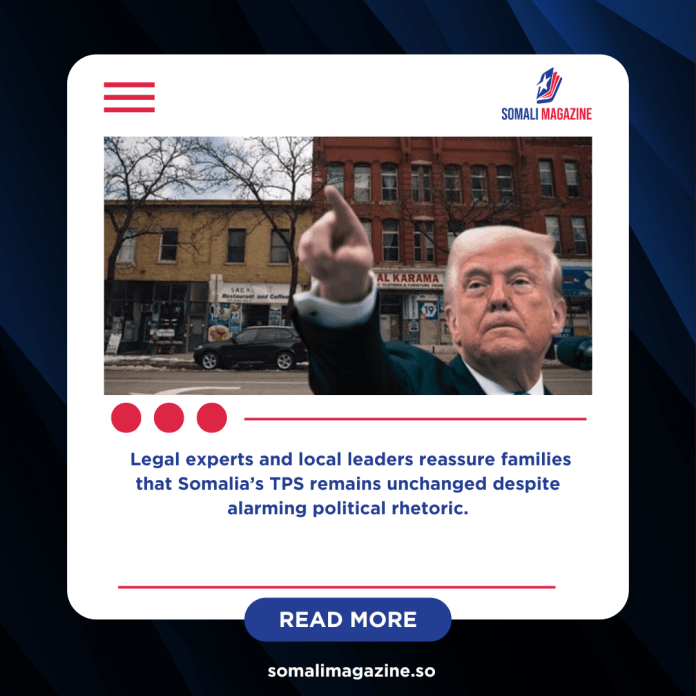
Somali American families in Minnesota are feeling frightened and angry after U.S. President Donald Trump posted on his Truth Social account that he was “terminating, effective immediately,” Temporary Protected Status (TPS) for Somalis in the state. His post also accused Minnesota of being a center of “fraudulent money laundering” and claimed, without proof, that “Somali gangs are terrorizing the people.” The comments caused confusion and fear among hundreds of Somali TPS holders who have lived legally in the U.S. for years. Immigration experts and officials quickly clarified that TPS cannot be ended through a social media post, and that no legal change has happened.
Under U.S. law, TPS can only be changed through a formal process led by the Department of Homeland Security (DHS). The agency must publish an official notice and give at least 60 days’ warning before ending a country’s TPS designation. Any change would affect all Somali TPS holders in the entire country, not just in Minnesota. According to federal data, about 700 Somali nationals currently have TPS, and advocates estimate that between 400 and 500 of them live in Minnesota. The state, however, is home to more than 75,000 Somali Americans, most of whom are U.S. citizens or permanent residents and would not be affected by TPS changes.
TPS is meant to protect people from countries experiencing war, natural disasters, or other dangerous conditions that make returning unsafe. Somalia first received TPS in 1991 during the civil war, and the designation has been renewed ever since under both Republican and Democratic presidents. The Biden administration extended and redesignated Somalia’s TPS as recently as July 2024, giving an 18-month extension until March 2026. DHS said Somalia still faces ongoing conflict, insecurity, flooding, food shortages, and limited humanitarian access. Somali students in the U.S. also received special relief measures allowing more flexible work and study arrangements.
Community leaders in Minnesota say Trump’s words have caused panic among families, especially those where parents have TPS and children are U.S. citizens. Jaylani Hussein, executive director of CAIR-Minnesota, said Trump’s comments feel like an attack on the Somali and Muslim community. Immigration lawyers added that the president’s post has no legal power, and that any real attempt to end Somalia’s TPS would likely face strong court challenges.
Minnesota officials also responded. Attorney General Keith Ellison said his office is watching the situation and made it clear that the president cannot end TPS “on a bigoted whim.” Governor Tim Walz accused Trump of targeting an entire community for political purposes. Representative Ilhan Omar reminded people that most Somali Americans are citizens and that the president’s words will not change that.
Across Minneapolis and St. Paul, Somali residents and allies spent the weekend gathering for potlucks, prayers, and information sessions to calm fears and share accurate legal guidance. At Karmel Mall, hundreds came together to show unity and support. Faith leaders, community organizers, and business owners said the Somali community is hardworking, deeply rooted in Minnesota, and determined not to be divided by political rhetoric. Some non-Somali Minnesotans also joined the gatherings to show solidarity.
Despite the fear, community organizers say the message is clear: Somali Minnesotans are part of the state and are here to stay. Religious leaders urged TPS holders to stay informed, keep their documents updated, and listen only to official announcements from DHS. Advocates say they are ready to take legal action if the administration attempts to formally end TPS for Somalia. For now, the program remains fully in place.