
Facebook

Twitter (X)

Instagram

Somali Magazine - People's Magazine
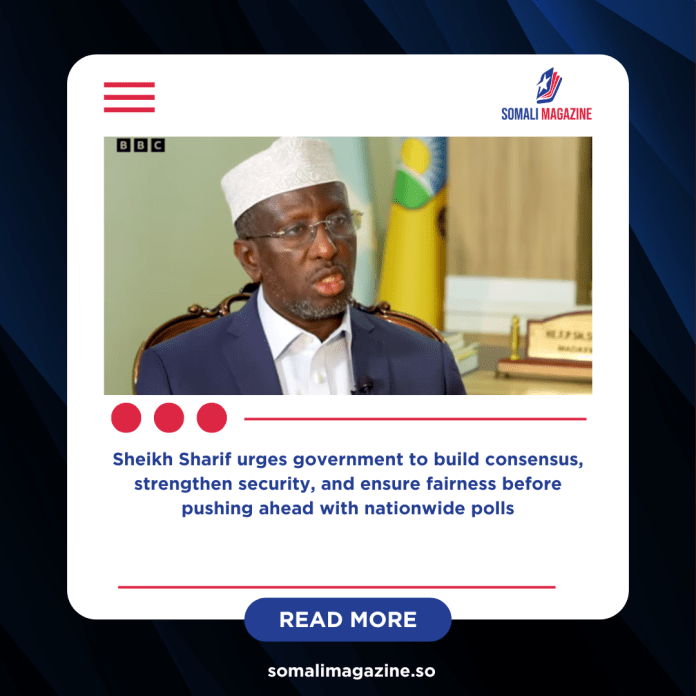
Former Somali President Sheikh Sharif Sheikh Ahmed has warned that Somalia is still not ready to hold a genuine one-person, one-vote election, saying the push for such a system does not match the realities the country is currently facing. In an interview with the BBC Somali Service, he said that although the idea of direct elections is popular, the conditions required to make it possible have not yet been put in place.
According to Sheikh Sharif, the government’s announcement that Somalia is preparing for universal elections sounds good on paper, but remains mostly political talk. He argued that meaningful progress towards this goal has not happened because there is no agreed roadmap, no strong political consensus, and no solid institutional foundation to support such an important national shift. He stressed that elections cannot succeed through statements alone—there must be proper laws, active political parties, and reliable security structures across the country.
Sheikh Sharif also expressed deep concern about Somalia’s overall security situation. He said the country is at a critical stage where many people fear for its future if leaders do not work together to create a united plan. He noted that insecurity has increased in several regions, and the lack of coordination between political actors could lead to even greater instability. He warned that without strong leadership and national unity, the state itself could face serious risks in the coming years.
A major part of Sheikh Sharif’s criticism focused on the newly appointed electoral commission. He said the commission does not reflect the diversity of the Somali political field and lacks the broad acceptance needed for a fair electoral process. In his view, a commission formed through consultation and agreement among different political groups would have been more trustworthy. Instead, he argued that appointing members from one side—particularly those close to Villa Somalia—weakens public confidence in the entire process.
He added that only one political group currently appears to have meaningful influence in the preparations for the upcoming elections. He believes this imbalance harms the principles of multiparty democracy and could create further tensions between the government and the opposition. Sheikh Sharif said that if one group dominates the process, other voices will feel excluded, which can lead to disputes that make national progress even more difficult.
To avoid a worsening political climate, the former president urged the government to work with all stakeholders to build an agreed-upon political framework. Such a framework, he said, is necessary to prevent unnecessary clashes and to ensure that Somalia’s transition towards democratic governance is peaceful and credible. He emphasized that the government must take the lead in bringing together different political actors, clan leaders, and community representatives to discuss and settle on a common vision for elections and long-term stability.
As Mogadishu prepares for local elections expected at the end of December 2025, Sheikh Sharif’s comments serve as a reminder that the path toward full democracy requires more than timelines and announcements. It demands real effort in strengthening institutions, improving security, and ensuring fairness in every step of the process. He stressed that if Somalia hopes to successfully move toward one-person, one-vote elections, leaders must address the current challenges honestly and work together to create an environment where all citizens can participate safely and confidently.