Facebook

Twitter (X)

Instagram

Somali Magazine - People's Magazine
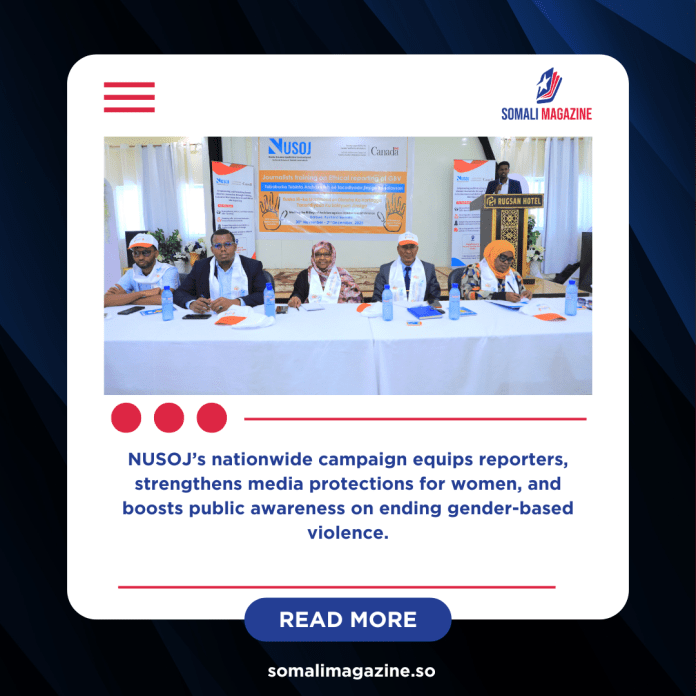
The National Union of Somali Journalists (NUSOJ) has successfully wrapped up its participation in the global 16 Days of Activism against Gender-Based Violence, marking an important step forward in the country’s efforts to promote gender justice and protect media workers. Supported by the Canada Fund for Local Initiatives (CFLI), NUSOJ carried out a series of activities from November 25 to December 10 aimed at empowering journalists across Somalia to report more responsibly on gender-based violence and make newsrooms safer and more inclusive for women.
The campaign officially began on November 25, the International Day for the Elimination of Violence Against Women, with the launch of the National Safeguarding Initiative for Women Journalists in Mogadishu. More than 150 female journalists, male colleagues, and media stakeholders attended the event. They received practical training on personal safety, digital security, collective advocacy, and ways to address sexual harassment and other abuses that often take place in newsrooms, during field reporting, and online. The initiative helped women journalists build confidence, strengthen their networks, and develop skills to better protect themselves and support others in the industry. Male journalists were also encouraged to play an active role in ending harmful workplace behaviours and building healthier media environments.
NUSOJ then expanded the campaign nationwide through workshops in Garowe in Puntland and Kismayo in Jubaland. These trainings focused on ethical and responsible reporting on gender-based violence, with an emphasis on trauma-informed storytelling, survivor-centred reporting, and verifying information accurately. Journalists explored how the media can help challenge discrimination, highlight systemic problems, and support survivors without causing additional harm. The workshops inspired new media discussions across Federal Member States, sparking conversations led by women and young people about resilience, accountability, and the urgent need to address gender-based violence in communities. Many of these discussions gained significant engagement on radio, television, and social media.
The campaign concluded on December 10, International Human Rights Day, with a Human Rights Colloquium held in Mogadishu. The event also marked the start of a new three-day training session for journalists in the capital. Participants reflected on the challenges of reporting on sexual violence and workplace harassment and discussed practical steps to improve gender justice across Somalia’s media sector. Journalists committed to championing safer, more respectful, and more ethical newsroom cultures, where both women and men can work freely and confidently.
NUSOJ leaders emphasized that journalism plays a crucial role in protecting communities by exposing abuse and holding authorities accountable. They noted that this responsibility can only be fulfilled when journalists have the skills and freedom they need, and when newsrooms are safe and supportive for everyone. The 16-day campaign demonstrated how strong and impactful the media can be when it uplifts survivors’ voices and challenges harmful behaviours that have long gone unaddressed.
The results of the campaign were significant. More than 150 journalists benefited from the various trainings and development sessions. Sixty-two media outlets improved their readiness for gender-sensitive reporting and committed to strengthening workplace protections for women. Public awareness also increased, with media content from the campaign reaching an estimated 2.5 million people through broadcast channels, along with more than one million engagements on social media. These outcomes highlight a growing movement for positive change within Somalia’s media landscape, driven by journalists committed to fairness, safety, and human rights.