
Facebook

Twitter (X)

Instagram

Somali Magazine - People's Magazine
Several registered political organizations in Somalia have rejected claims by the National Electoral Commission (NEC) that they are among the 20 groups cleared to take part in the upcoming Banadir local council elections, raising fresh concerns about the credibility of the process.
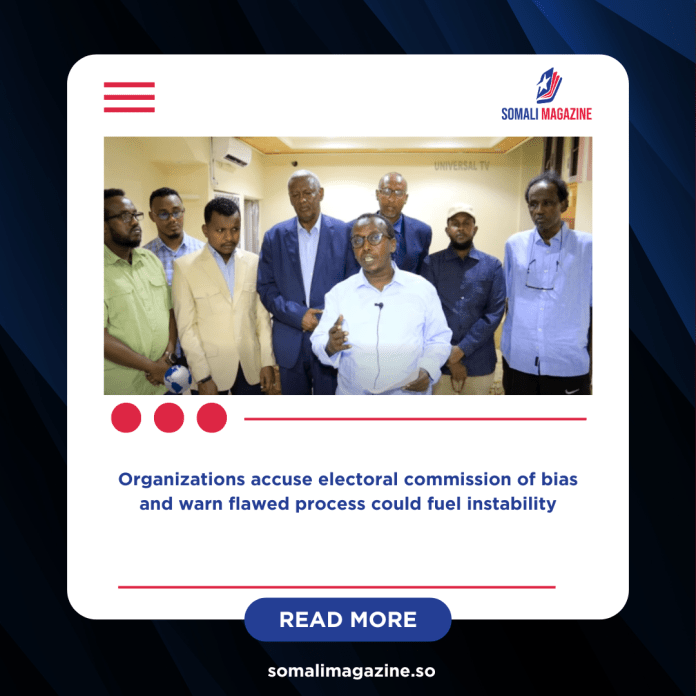
At a press conference held in Mogadishu on Sunday, representatives of the organizations said they were wrongly listed by the commission and accused it of violating electoral laws. They expressed serious doubts about the December 25 elections, warning that the process lacks transparency, fairness, and independence.
The groups said they had held five rounds of discussions with the NEC in an effort to resolve their concerns, but all talks ended without meaningful progress. According to the representatives, the commission failed to demonstrate independence and was unable to exercise its mandate impartially. They claimed that despite making numerous compromises and concessions in good faith, their efforts did not lead to any changes or guarantees.
“It has become clear to us that the commission is not operating independently,” the organizations said in a joint statement. They argued that political interference and the misuse of government resources have significantly undermined the integrity of the electoral process. In their view, the NEC has been unable or unwilling to resist pressure from authorities, which has weakened public trust in the elections.
The organizations stressed that an electoral commission must be free from political influence to ensure credible and peaceful elections. They warned that proceeding with a flawed process could increase tensions in Mogadishu and beyond, potentially pushing the country toward instability.
In light of these concerns, the groups called on Somali citizens from all walks of life to take action to protect peace and democracy. They appealed to religious leaders, civil society organizations, politicians, women, and young people to speak out and help prevent the elections from becoming a source of conflict. According to them, silence in the face of an unfair process could have serious consequences for the country’s fragile political environment.
The NEC had earlier announced that 20 political organizations had officially submitted their candidate lists for the Banadir local council elections. Initially, 61 political organizations registered to participate in the process, signaling strong interest in the elections. However, only a fraction of those groups ultimately submitted candidates.
On November 24, the commission extended the deadline for submitting candidate lists by two weeks, allowing organizations to present their nominees between November 25 and December 10. Despite the extension, most registered political organizations did not submit candidates, a development that critics say reflects widespread dissatisfaction with how the elections are being handled.
The protesting organizations argue that their decision not to participate should not be interpreted as a lack of interest in democratic processes. Instead, they say it is a principled stand against what they describe as a compromised and non-transparent system. They maintain that participating under such conditions would only legitimize an electoral process they believe is deeply flawed.
As the December 25 election date approaches, uncertainty continues to surround the Banadir local council polls. With most registered political organizations effectively withdrawing, questions remain about the inclusiveness and legitimacy of the vote. Observers warn that unless concerns about independence and fairness are addressed, the elections may struggle to gain public acceptance and could further strain Somalia’s political landscape.
The situation highlights ongoing challenges facing Somalia’s efforts to build strong, credible democratic institutions. For many political actors, the outcome of the Banadir elections will serve as a key test of whether electoral bodies can operate independently and earn the trust of the public in a highly sensitive political environment.