
Facebook

Twitter (X)

Instagram

Somali Magazine - People's Magazine
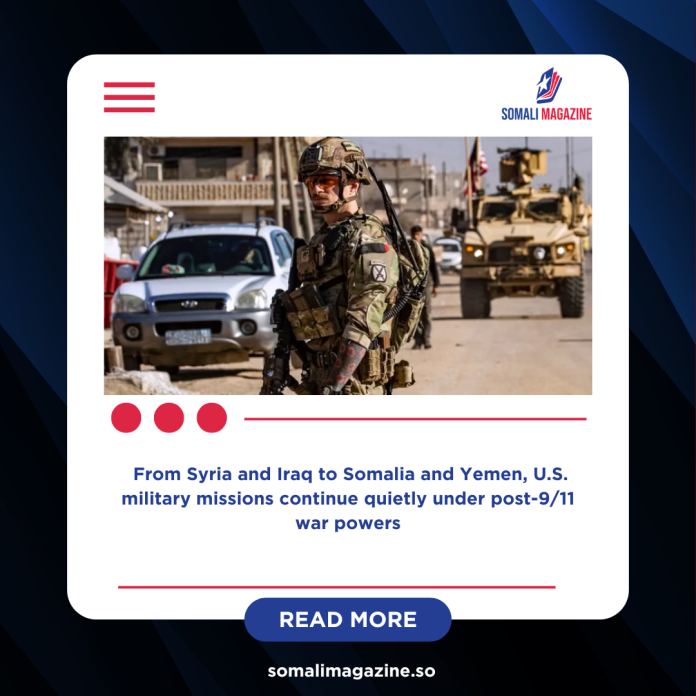
While U.S. leaders in Washington focus their public debates on future threats from powerful rivals like China, Iran, and Russia, American troops are still actively involved in conflicts many people believe ended long ago. Quiet but ongoing military operations continue in Syria, Iraq, Somalia, and Yemen, carried out under legal authorities passed after the September 11 attacks more than twenty years ago. These missions no longer dominate headlines or presidential speeches, but they have not stopped. Instead, they have faded from public view while remaining dangerous for the service members involved.
Today, about 40,000 U.S. troops are still stationed across the Middle East. This number is far smaller than during the height of the wars in Iraq and Afghanistan, but it shows that America’s military presence in the region never fully disappeared. In several countries, U.S. forces continue to conduct raids, launch airstrikes, intercept enemy attacks, and work alongside local partners, often in unstable and hostile environments.
In Syria, roughly 900 American troops remain deployed in the eastern part of the country. Their stated mission is to prevent the return of the Islamic State group after its territorial defeat. In practice, U.S. forces still face regular threats, including rocket and drone attacks from Iranian-backed militias, especially during periods of rising regional tension. American troops work closely with the Syrian Democratic Forces to track down remaining ISIS fighters, who continue to carry out ambushes, assassinations, and attempts to free prisoners. The danger became clear again late last year when two National Guardsmen and an American contractor were killed in an attack by a suspected ISIS fighter. Despite the risks, there is no formal declaration of war in Syria and no clear end date for the mission.
In Iraq, the U.S. military presence is shrinking but not yet finished. Under a recent agreement with the Iraqi government, Washington has begun reducing troop numbers and transferring more responsibility to Iraqi security forces. Around 900 U.S. troops remain, and that number is expected to drop by about 20 percent as the mission winds down. However, American forces still face threats from armed groups backed by Iran and remain authorized to defend themselves or strike ISIS targets if the group shows signs of returning. While the war no longer looks like the large-scale conflict of the 2000s, U.S. troops are still operating in a country where stability is not guaranteed.
Somalia represents one of America’s least visible but longest-running military efforts. About 500 U.S. troops are stationed there, working alongside Somali forces against al-Shabab, a group linked to al Qaeda. U.S. airstrikes are frequent, though details are often limited. The American military first became involved in Somalia in the early 1990s, withdrew after deadly fighting in Mogadishu, and then gradually returned through counterterrorism operations in the 2000s. After a brief pullback in 2020, U.S. troops were redeployed in 2022 and continue their mission today, largely out of the public spotlight.
In Yemen, the United States does not have permanent bases on the ground, but it is still actively involved in fighting. U.S. naval and air forces regularly intercept missiles and drones fired by Iran-backed Houthi forces targeting ships in the Red Sea and Gulf of Aden. These attacks have drawn American sailors and pilots into direct combat. Earlier in 2025, U.S. forces carried out weeks of air and naval strikes across Yemen, hitting hundreds of targets linked to the Houthis’ weapons systems in an effort to protect global shipping and prevent further escalation.
None of these conflicts have been formally ended by Congress. Most continue under the same post-9/11 authorizations that remain in place decades later. While U.S. leaders say the Middle East no longer dominates American foreign policy as it once did, the reality on the ground shows that these wars are not truly over. They continue quietly, without clear conclusions, and with American troops still in harm’s way.