
Facebook

Twitter (X)

Instagram

Somali Magazine - People's Magazine
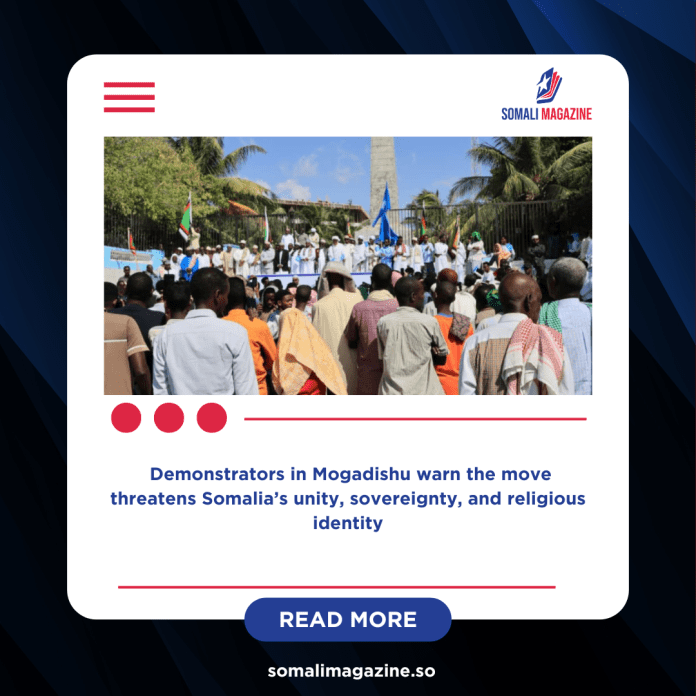
Somali religious scholars, joined by large crowds of civilians, gathered in Mogadishu on Wednesday to strongly protest Israel’s decision to recognize Somaliland as an independent state. The demonstration, held at Daljirka Dahson in the heart of the capital, was marked by chants, speeches, and banners rejecting what participants described as foreign interference that threatens Somalia’s unity, sovereignty, and religious identity.
The rally brought together a wide range of people, including senior Islamic clerics, traditional elders, intellectuals, youth, and ordinary residents from different parts of Mogadishu. Many protesters carried signs calling for national unity and warning against any attempts to divide the country through outside influence. Speakers repeatedly emphasized that Somaliland, a northwestern region that declared independence in 1991, remains an inseparable part of Somalia under international law.
Religious leaders at the gathering warned that recognizing Somaliland could have serious political, social, and religious consequences for Somalia and the wider Muslim community. They argued that the issue is not only about borders or politics, but also about national identity and the shared history and faith of the Somali people. According to the clerics, allowing foreign countries to interfere in Somalia’s internal affairs could deepen divisions and weaken efforts toward long-term stability.
Sheikh Bashir Ahmed Salad, chairman of the Somali Council of Ulama, delivered one of the most prominent speeches at the rally. He criticized any engagement with Israel on Somali internal matters, insisting that disputes within the country should only be addressed through dialogue among Somalis themselves. He said Somalia’s problems cannot be solved by turning to external actors whose interests may not align with those of the Somali people.
“The Muslim community discusses and resolves its own affairs,” Sheikh Salad told the crowd. “Going to Israel to solve our problems is not a good step. Israel will always put its own interests first, not the interests of Somalia.” He also spoke against the Abraham Accords, arguing that they normalize Israel’s actions toward Palestinians and undermine the rights of the Palestinian people, a cause that many Somalis strongly support.
Other speakers echoed similar views, calling on Somaliland’s leadership to reconsider decisions and relationships they believe could harm Somalia’s unity. They urged leaders in the north to return to Somali-led dialogue, reconciliation, and peaceful discussions that respect the country’s territorial integrity. The clerics stressed that unity and cooperation among Somalis are essential at a time when the nation is still recovering from decades of conflict and instability.
Protesters also directed their message to the international community, asking foreign governments and institutions to respect Somalia’s sovereignty. They warned that unilateral actions, such as recognizing Somaliland without broad international agreement, could inflame tensions in an already fragile region. Demonstrators said such moves risk undermining peace-building efforts and could create new political and security challenges.
Israel’s decision last month to recognize Somaliland made it the first country to do so, triggering strong reactions from Somalia’s federal government and widespread condemnation from regional and international organizations. Somalia’s authorities have described the move as a violation of international law and an attack on the country’s territorial integrity. In response, bodies such as the African Union, the Arab League, and the United Nations have reaffirmed their support for Somalia’s unity and rejected any recognition of Somaliland outside internationally accepted processes.
Wednesday’s rally highlighted the depth of public opposition within Somalia to Israel’s move. It showed how religious leaders, civil society groups, and ordinary citizens are aligning with political authorities to push back against external pressure. For many Somalis, the protest was not only about Somaliland, but also about defending national dignity, unity, and the right to resolve internal issues without foreign interference during a period of heightened diplomatic and security uncertainty.