
Facebook

Twitter (X)

Instagram

Somali Magazine - People's Magazine
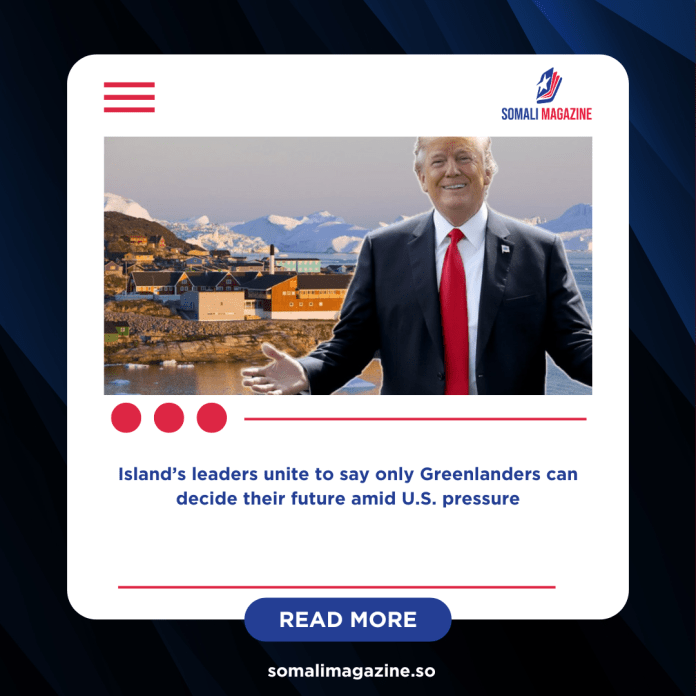
Greenland’s political leaders have strongly rejected renewed remarks by U.S. President Donald Trump suggesting that the United States could take control of the Arctic island, insisting that only the people of Greenland have the right to decide their future. The response came on Friday after Trump said Washington would “do something in Greenland whether they like it or not,” reviving a controversial idea he first raised several years ago.
In an unusual show of unity, leaders from all five political parties represented in Greenland’s parliament issued a joint statement condemning any form of foreign pressure or interference. They made it clear that Greenland does not wish to become part of either the United States or Denmark. Instead, they emphasized a shared national identity and the right to self-determination. The statement stressed that Greenland’s future is a matter for its own people and cannot be dictated by any external power.
Trump, speaking earlier at the White House, repeated his long-held argument that U.S. control of Greenland is important for American national security. He claimed that without U.S. involvement, rival powers such as Russia or China could increase their influence in the Arctic region. Trump said the United States would prefer to gain control through an agreement but suggested that stronger measures could not be ruled out, comments that alarmed leaders in Greenland and beyond.
Greenland is the world’s largest island, with a population of around 57,000 people. It is a self-governing territory within the Kingdom of Denmark, managing most of its domestic affairs while Denmark handles defense and foreign policy. Both the Danish government and Greenland’s authorities have repeatedly stated that the island is not for sale and that its status cannot be changed without the consent of its people.
The island’s strategic location in the Arctic has made it increasingly important as global interest in the region grows. Melting ice has opened new shipping routes and increased access to natural resources, drawing attention from major powers. Greenland is believed to hold significant deposits of rare earth elements and other critical minerals used in renewable energy technologies, as well as potential oil and gas reserves. While much of these resources remain difficult or expensive to extract, their long-term value has added to Greenland’s geopolitical importance.
Following Trump’s remarks, Greenland’s party leaders announced plans to bring forward a session of parliament to allow for a full political discussion and to protect the rights and interests of the population. Although the exact date has not yet been set, the move reflects the seriousness with which Greenland’s leaders view the situation. Parliament was last in session in November and was originally scheduled to meet again in early February.
The comments have also caused unease among European allies. Several members of the North Atlantic Treaty Organization (NATO) have warned that any attempt by the United States to seize Greenland by force would have serious consequences for the alliance. Danish Prime Minister Mette Frederiksen has gone as far as saying that an American takeover of Greenland would effectively mark the end of NATO as it is currently understood, highlighting the potential damage to transatlantic relations.
Greenland’s long-term future remains closely linked to the question of independence. Under a 2009 agreement with Denmark, Greenlanders have the legal right to declare independence through a democratic process. All five political parties support independence in principle, but they disagree on how quickly it should happen. The current governing coalition favors a gradual approach that focuses on building economic strength and institutions, while the opposition party Naleraq, which gained significant support in the 2025 election, has called for a faster break from Denmark.
Meanwhile, diplomatic efforts appear to be underway. U.S. Secretary of State Marco Rubio is expected to meet next week with Denmark’s foreign minister and representatives from Greenland. Trump first floated the idea of acquiring Greenland during his first term in 2019, a proposal that was quickly rejected at the time. The latest comments suggest that the issue remains a sensitive and unresolved point in relations between the United States, Greenland, and Denmark.