
Facebook

Twitter (X)

Instagram

Somali Magazine - People's Magazine
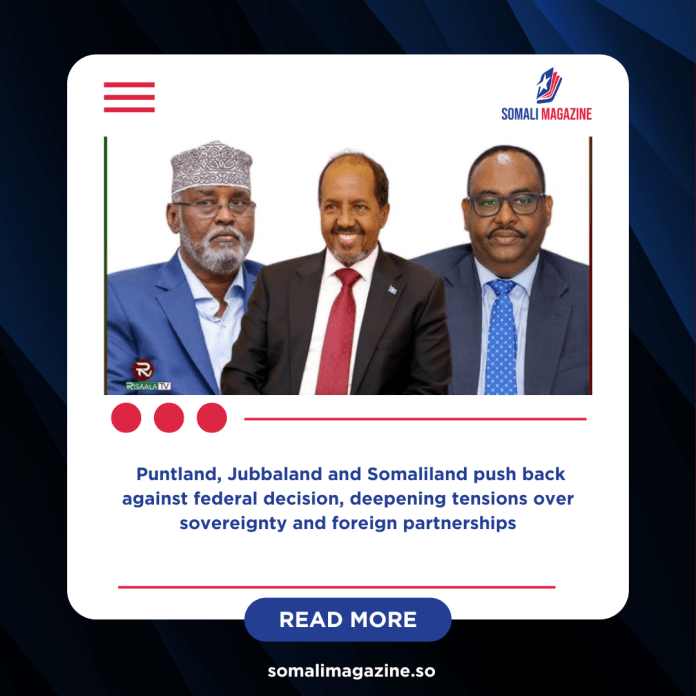
Somalia’s federal government and several regional administrations are locked in a growing dispute after Mogadishu moved to cancel security and defense agreements linked to key ports, a decision that has been firmly rejected by Puntland, Jubbaland and Somaliland. The disagreement has exposed deep divisions over authority, foreign partnerships and the balance of power within Somalia’s federal system, raising concerns about political stability and national cohesion.
On Monday, Somalia’s Cabinet voted to annul all security and defense agreements and related cooperation tied to the ports of Berbera, Bosaso and Kismayo. The decision was made during a Cabinet meeting in Mogadishu, with federal officials saying the agreements violated Somalia’s sovereignty, national unity and political independence. According to the government, some of these arrangements were signed or implemented without the approval of the federal authorities, which under Somalia’s provisional constitution are responsible for foreign relations and national security matters.
Regional administrations responded quickly and forcefully. Puntland authorities said the federal government does not have the legal right to interfere in security agreements connected to the development of Bosaso port or other security cooperation between Puntland and the United Arab Emirates. In a public statement, Puntland described its partnership with the UAE as lawful and essential for maintaining security and supporting economic growth in the region. Puntland officials argued that such cooperation directly benefits local stability and trade, and should not be undermined by decisions made in Mogadishu.
Jubbaland also rejected the Cabinet’s decision, saying it does not recognize the federal move. The Jubbaland presidency stated that the decision violates Somalia’s provisional constitution and undermines the powers granted to federal member states. According to Jubbaland officials, agreements related to the port of Kismayo fall squarely under the authority of the regional administration, not the federal government. They warned that unilateral actions by Mogadishu risk weakening trust and cooperation between the center and the regions.
Somaliland issued the strongest response. The Somaliland administration, which considers itself independent from Somalia despite lacking international recognition, said the federal government has no authority over Berbera port or any agreements linked to it. In its statement, Somaliland said Berbera is located within what it described as an independent territory and that all agreements with the UAE were approved through Somaliland’s own constitutional institutions. The administration said these deals are aimed at improving trade, infrastructure and regional stability, and accused Mogadishu of attempting to interfere in matters beyond its control.
The federal government’s decision came amid an investigation by Somalia’s Immigration and Citizenship Agency into the alleged unauthorized use of Somali airspace and territory. The investigation is linked to claims surrounding the movements of Aidarous al-Zubaidi, the leader of Yemen’s Southern Transitional Council, a group backed by the UAE. The Saudi-led coalition fighting in Yemen has accused al-Zubaidi of defying orders to travel to Riyadh for talks and instead mobilizing forces inside Yemen.
According to the coalition, al-Zubaidi later left the southern Yemeni city of Aden by sea before departing the region by air, allegedly with assistance from the UAE and through Somali territory. Coalition spokesperson Maj. Gen. Turki al-Maliki claimed al-Zubaidi boarded a flight accompanied by aides under the supervision of UAE officers. The Southern Transitional Council has denied these allegations, insisting its leader remains in Aden. Somali officials have not publicly confirmed whether al-Zubaidi passed through Somalia, but the Cabinet cited the broader investigation as part of the background to its decision.
The dispute reflects long-standing tensions between Somalia’s federal government and regional administrations over control of ports, security partnerships with foreign states and the division of powers under the federal system. Analysts warn that the standoff could further strain relations at a time when Somalia is already facing serious security threats, political challenges and increasing regional pressure. Without dialogue and compromise, they say, the conflict risks deepening internal divisions and complicating Somalia’s efforts to assert sovereignty while maintaining cooperation with its regions.