
Facebook

Twitter (X)

Instagram

Somali Magazine - People's Magazine
Iranian authorities have acknowledged for the first time that around 2,000 people, including security personnel, have been killed during nationwide protests that have rocked the country for the past two weeks. The figure was disclosed by an Iranian official speaking to Reuters, marking the clearest admission yet of the scale of the violence linked to the government’s crackdown on the unrest.
The official said that those responsible for the deaths were “terrorists,” whom the government accuses of killing both protesters and members of the security forces. No detailed breakdown was provided on how many of the dead were civilians versus security personnel, and the official requested anonymity. Human rights groups and opposition activists outside Iran have disputed the official estimate, claiming the real number of deaths could be significantly higher.
The protests began on December 28, initially triggered by worsening economic conditions, including the sharp fall in the value of Iran’s currency and rising living costs. What started as demonstrations over economic hardship quickly expanded into broader protests, with many participants openly calling for the removal of Iran’s clerical leadership. The unrest has become the most serious internal challenge to the authorities in at least three years, unfolding at a time when Iran is already facing heavy international pressure.
The situation has drawn strong reactions abroad. On Monday evening, U.S. President Donald Trump announced new measures targeting Iran’s economy, including a 25% import tariff on goods from any country that continues to do business with Iran. Trump also said that military action remained one of the options under consideration in response to Iran’s handling of the protests, using unusually blunt language to underline his stance.
Iran has not yet issued an official response to the tariff announcement, but China was quick to criticize the move. Despite long-standing U.S. sanctions, Iran continues to export much of its oil to China, as well as to countries such as Turkey, Iraq, the United Arab Emirates and India, making the potential impact of the new tariffs a major concern for Tehran.
European leaders have also weighed in. German Chancellor Friedrich Merz said he believed Iran’s government could be approaching its end, arguing that a system forced to rely on violence to survive was no longer sustainable. His comments were swiftly rejected by Iranian Foreign Minister Abbas Araqchi, who accused Germany of double standards and dismissed the remarks as lacking credibility.
Inside Iran, there are still no visible signs of a split within the country’s powerful security and political elite, a factor analysts say is crucial to the survival of the current system. Authorities appear to be pursuing a dual strategy: acknowledging that some public anger over economic conditions is legitimate, while at the same time enforcing a tough security response to suppress the protests.
Government spokesperson Fatemeh Mohajerani said the state viewed both protesters and security forces as part of the same national family and claimed efforts were being made to listen to public concerns. However, officials have repeatedly accused the United States, Israel and unnamed “terrorist” groups of exploiting the protests to destabilize the country.
Lawmakers within Iran have also voiced concern. Mohammadreza Sabaghian, a member of parliament from central Iran, warned that failing to address public dissatisfaction could lead to even more intense unrest in the future.
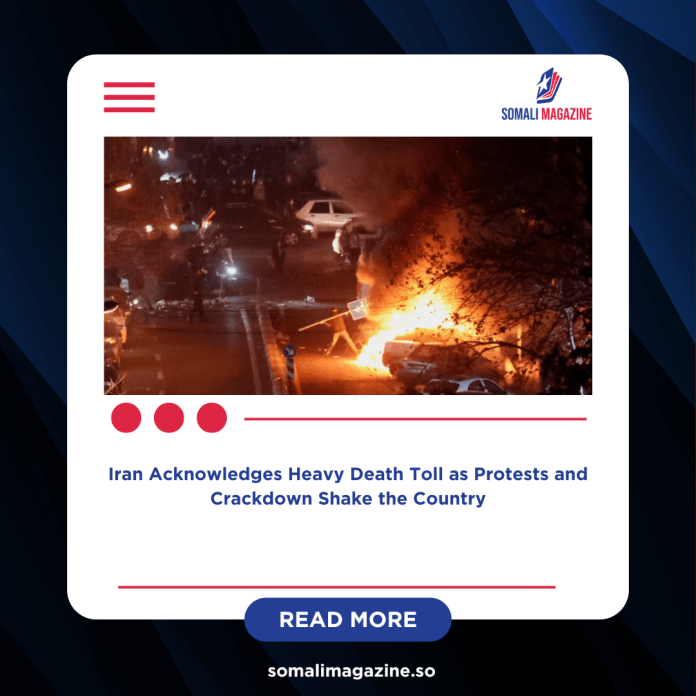
Information from inside the country has been limited due to communications restrictions, including internet shutdowns that have made it difficult to verify events on the ground. While phone services have reportedly been restored, internet access remains unreliable. Despite this, videos showing clashes between protesters and security forces, including gunfire and burning buildings, have circulated online and been verified by international media.
Human rights groups say thousands of people have been arrested, and families of victims have reportedly gathered at cemeteries to mourn and protest. At the same time, Iranian officials say they are keeping communication channels open with Washington, signaling a possible interest in dialogue even as tensions remain high.