
Facebook

Twitter (X)

Instagram

Somali Magazine - People's Magazine
On a cold Friday morning in Minneapolis, Mahad Omar watched in shock as armed federal agents chased down one of his neighbors, forced him to the ground, handcuffed him, and drove him away in a black SUV. Omar, a 28-year-old Uber driver who moved from Somalia to the United States as a child, said he never expected to see such scenes in the neighborhood he calls home. After the agents left, residents slowly stepped outside, whispering among themselves. Some women cried openly. For many, the incident felt like a line had been crossed.
Minneapolis has long been known as a welcoming city, especially for refugees, Omar said. Thousands of Somalis who fled civil war in the 1990s rebuilt their lives there through a federal refugee program. Today, the city is home to one of the largest Somali communities in the United States. Yet in recent weeks, many Somali Americans say they feel they are being treated as suspects simply because of who they are.
The heightened tension comes as Minneapolis becomes a focal point of President Donald Trump’s renewed immigration enforcement campaign. Federal actions have heavily targeted Somali Americans, following the spread of a viral video alleging widespread fraud at Somali-run daycare centers. While authorities say they are investigating criminal activity, Somali residents and leaders argue the response has gone far beyond addressing specific allegations and has instead turned into broad intimidation.
Community members say they have long dealt with discrimination for being Black, Muslim, or immigrants. But now, they say, the tone has become more aggressive and openly hostile. Religious leaders point to language used by top officials, including remarks describing a so-called “Somali problem,” as evidence that the community itself is being singled out.
Tensions escalated further after a federal agent shot and killed Renee Nicole Good, a woman whose SUV was partially blocking a lane in a Minneapolis neighborhood. The killing sparked protests across the country, but Somali residents say it did little to slow enforcement actions in their areas. Armed agents have continued to patrol apartment complexes and shopping centers, asking people for documents and detaining some on the spot.
Representative Ilhan Omar, the first Somali American elected to Congress, accused the administration of trying to frighten and silence the community. Speaking outside a federal building, she said even lawmakers were being blocked from fully inspecting detention facilities. Despite the pressure, she said, Somali Americans were refusing to be intimidated.
Somalis began arriving in the U.S. in large numbers more than 30 years ago. From a few thousand in 1990, the population has grown to about 260,000 people nationwide, with nearly half living in Minnesota. Most are U.S. citizens, many born in the country. Over time, the community has built businesses, improved economic conditions, and become politically active, winning seats in local and national government.
Still, suspicion has followed them for years. After the September 11 attacks, Somali money-transfer services were shut down, and later, cases involving a small number of young men joining extremist groups led to increased surveillance. Mosques received threats, and in 2017, one was bombed by a white supremacist.
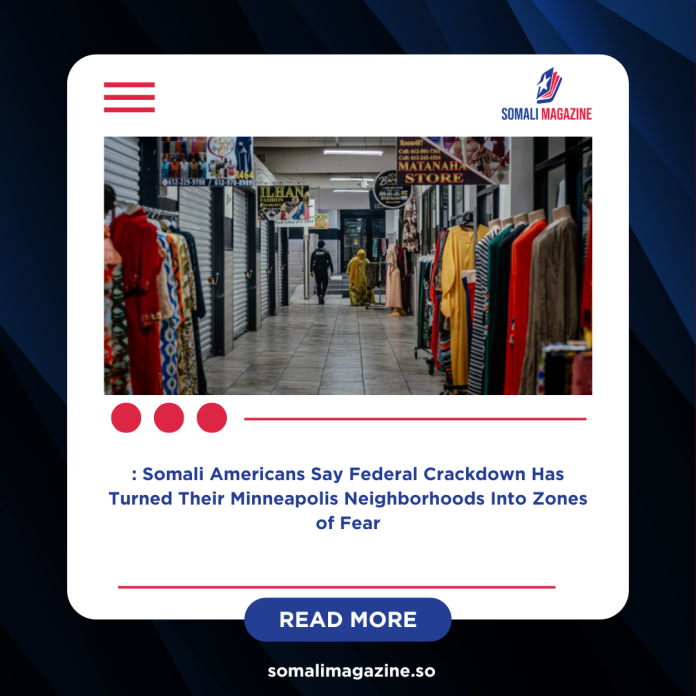
What feels different now, residents say, is the scale and visibility of enforcement. Black SUVs circle neighborhoods. Volunteers blow whistles to warn others when agents arrive. Children come home from school in tears after being called “garbage” by classmates. Some strangers walk into Somali-owned businesses demanding to see identification.
Federal officials deny claims of harassment, saying their focus is on arresting people involved in serious crimes, including fraud. Somali leaders agree that any real fraud should be investigated and punished. But they argue that the current approach paints an entire community as criminals and risks destroying vital services like childcare centers that many families rely on.
Despite fear and anger, many Somali Americans say they are finding strength in solidarity. Neighbors have shown up to protests, shared food from struggling local restaurants, and stood together outside mosques and homes. For people like Taher Muse, a business owner born in Somalia and raised in Minneapolis, the situation is painful but not hopeless. Even after agents questioned him and his workers, he said he still believes in the country he grew up in. “This country is better than they think it is,” he said.