
Facebook

Twitter (X)

Instagram

Somali Magazine - People's Magazine
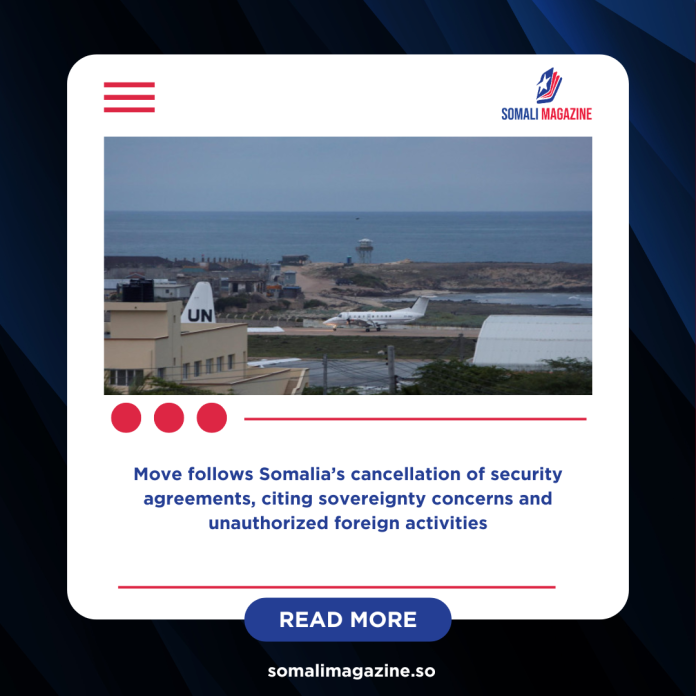
The United Arab Emirates has started removing its government equipment and supplies from Somalia, marking a new phase in the growing diplomatic and security rift between Mogadishu and Abu Dhabi. On Thursday, three cargo planes carrying UAE-owned materials departed from Aden Adde International Airport in Mogadishu, according to officials familiar with the operation. The flights are said to be the first step in a wider withdrawal process following Somalia’s decision to cancel key security and defense agreements involving the Emirates.
Government and aviation sources said two more cargo planes were expected to arrive in Mogadishu on Friday to complete the export of remaining equipment. The withdrawal follows a vote by Somalia’s federal Cabinet earlier this week to annul all security and defense agreements and cooperation arrangements linked to the UAE, particularly those connected to the ports of Berbera, Bosaso, and Kismayo. Somali authorities said the decision was taken after determining that the agreements violated the country’s sovereignty, national unity, and political independence.
Officials involved in overseeing the equipment removal said the process was not without tension. There were reported disagreements between Somali and Emirati officials over procedures, including the submission of documentation and authorization for the flights. Sources said UAE officials initially resisted directives issued by the Somali government but later complied by providing flight manifests and other required details. Only after these conditions were met were the planes cleared to depart.
The breakdown in relations comes amid a series of developments that have strained trust between the two sides. A key trigger was an investigation by Somalia’s Immigration and Citizenship Agency into the alleged unauthorized use of Somali airspace and territory. The probe focused on the reported movements of Aidarous al-Zubaidi, the head of Yemen’s Southern Transitional Council, a group backed by the UAE.
The Saudi-led coalition fighting in Yemen accused al-Zubaidi of defying instructions to travel to Riyadh for talks. Instead, the coalition claimed he mobilized forces toward the Al-Dhale region in southwestern Yemen. Coalition spokesperson Major General Turki al-Maliki later alleged that al-Zubaidi fled the southern Yemeni city of Aden by sea before leaving the region by air, with Abu Dhabi facilitating his transit through Somali territory. According to al-Maliki, al-Zubaidi boarded a flight accompanied by aides under the supervision of UAE officers. The Southern Transitional Council has rejected these claims, insisting that its leader remains in Aden.
The dispute has also unfolded against a wider and increasingly complex diplomatic backdrop. Last month, Israel announced it had formally recognized Somaliland as an independent state, becoming the first country to do so. Somalia strongly condemned the move, reaffirming that Somaliland remains part of its internationally recognized territory. Reports citing Israeli officials suggested that Abu Dhabi played a role in facilitating the recognition, a claim that further deepened tensions between Mogadishu and the UAE.
The Emirates has for years maintained strong economic and security ties with Somaliland. One of the most significant projects is a $442 million investment by Dubai-based logistics firm DP World to develop and operate the Port of Berbera. Somalia’s federal government has consistently objected to such agreements, arguing that they were signed without its consent and undermine its authority over national territory.
The visible withdrawal of UAE equipment from Mogadishu highlights how sharply relations between the two governments have deteriorated. It also signals a possible adjustment in the Emirates’ presence in federal Somalia, even as its influence continues to be felt in some regional administrations. For Somalia, the move is being framed as a clear assertion of sovereignty and constitutional authority.
Somali officials say the government is not turning its back on international partnerships. Instead, they stress that cooperation must be based on mutual respect and full recognition of Somalia’s unity and independence. As one of Mogadishu’s most influential foreign partners scales back its on-the-ground presence, that position is now being tested, with broader implications for regional politics and security cooperation in the Horn of Africa.