
Facebook

Twitter (X)

Instagram

Somali Magazine - People's Magazine
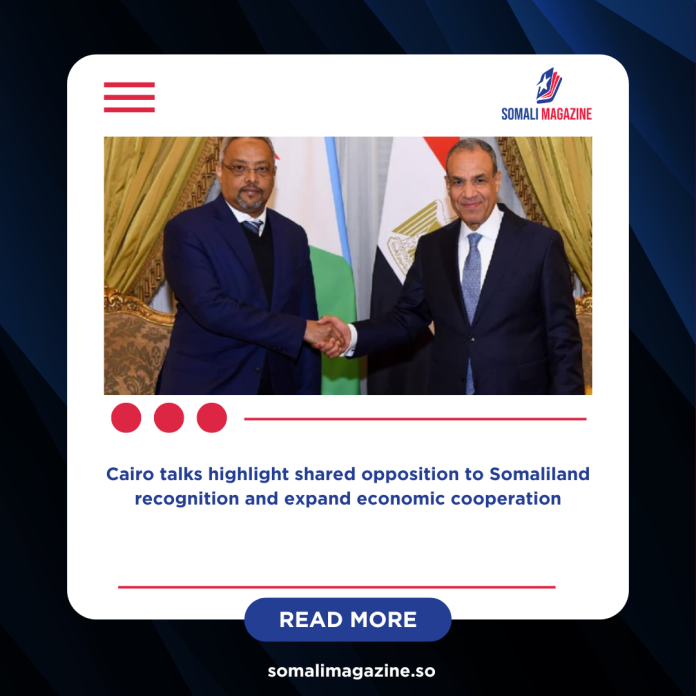
Egypt and Djibouti have reaffirmed their strong support for Somalia’s unity, sovereignty, and territorial integrity during high-level talks held in Cairo, signaling a shared stance on one of the Horn of Africa’s most sensitive political issues. The discussions brought together Egyptian Foreign Minister Badr Abdelatty and Djiboutian Foreign Minister Abdulqader Hussein Omar on Wednesday, on the sidelines of the fifth consultative meeting focused on enhancing coordination over peace efforts in Sudan.
During the meeting, both ministers reviewed key political and security developments across the Horn of Africa and emphasized the importance of preserving regional stability at a time of growing geopolitical tensions. Central to their discussions was Somalia, where Egypt and Djibouti reiterated their firm rejection of any actions that could undermine the country’s unity or threaten its internationally recognized borders.
According to a statement released by Egypt’s Ministry of Foreign Affairs, the two sides strongly condemned Israel’s recognition of the so-called “Somaliland,” describing the move as a violation of Somalia’s sovereignty and territorial integrity. They stressed that Somalia’s unity is non-negotiable and warned against unilateral steps that could deepen divisions or fuel instability in the region.
The ministers also voiced clear support for Somalia’s legitimate federal institutions, underlining the importance of respecting the country’s constitutional framework. They rejected any attempts to establish parallel political entities, noting that such efforts pose a direct threat to national unity and long-term stability. Both sides further dismissed claims linking the Somaliland issue to any plans involving the displacement of Palestinian people, describing such narratives as misleading and unfounded.
Beyond Somalia, the talks addressed broader regional crises, including the ongoing conflict in Yemen. Abdelatty reaffirmed Egypt’s unwavering support for Yemen’s unity and territorial integrity, calling for an inclusive political process led by Yemenis themselves. He emphasized that a comprehensive political dialogue remains the only viable path toward restoring peace, security, and stability in the country, and urged all parties to exercise restraint and avoid further escalation.
The meeting also highlighted the deepening relationship between Egypt and Djibouti, with both ministers expressing satisfaction over the growing momentum in bilateral ties. Abdelatty welcomed the shared commitment to expanding cooperation across a range of economic sectors, particularly trade, energy, infrastructure, and logistics. He stressed that closer economic integration would benefit both countries and contribute to regional development.
A key focus was the implementation of joint projects aimed at strengthening connectivity and boosting trade flows. Abdelatty noted that Egypt is keen to enhance its commercial presence in Djibouti, especially following the recent opening of a Banque Misr branch in the country. The move was described as a significant step toward facilitating investment, supporting businesses, and deepening financial cooperation between the two nations.
Both sides also expressed their readiness to convene the next meeting of the Egypt-Djibouti Business Council in the near future. The council is expected to play a central role in increasing trade volumes, encouraging private sector partnerships, and translating political goodwill into tangible economic outcomes in line with the strategic partnership between Cairo and Djibouti.
As the meeting concluded, the two ministers agreed to maintain close coordination and regular consultations on regional and international issues. They reaffirmed their shared commitment to supporting peace, security, and stability across Africa, with particular attention to the Horn of Africa and the Red Sea region, which they described as vital to regional and global security.
The talks underscored Egypt and Djibouti’s aligned positions on key geopolitical challenges and reflected a broader effort to strengthen cooperation among regional partners at a time of heightened uncertainty. Their united stance on Somalia, combined with plans for deeper economic collaboration, signals a continued push for stability, dialogue, and development in one of Africa’s most strategically important regions.